Archive | Politics RSS feed for this section

When Poor Crisis Communication Defeats Smart Branding–Trump and NC in Cleveland

20 Jul


Trump Blog Still.001

     In a presidential campaign that has been anything but predictable, strategic and organized, Donald Trump has finally put together a surprisingly strong branding strategy for the Republican National Convention.  And then watched it blow up.

     The Trump campaign and the RNC have gone to great lengths to brand each day of the convention with an overarching platform central to the Trump campaign.

     In marketing and branding parlance, the Trump camp and the RNC are very shrewdly appealing to personal core values: keep me safe, save my job, save my country, united we stand.  The clear goal is to reinforce these core values to build to the Trump brand promise of strong leadership to strengthen America.

      Here’s how the themes it will play out during the four days:

Monday: Make America Safe Again

  • Core value: Keep me safe

 Tuesday: Make America Work Again

  • Core vale: Save my job

 Wednesday: Make America First Again

  • Core value: Save my country

Thursday: Make America One Again

  • Core value: United we stand

             Trump himself had already been ramping up his social media rhetoric in preparation for the first convention day’s core value of ‘keep me safe.’   He especially used the Baton Rouge police shootings as a Facebook call to action.

                  On Twitter the day before the convention he also tried to weave the threat from ISIS into the narrative.

      But Trump’s marketing team has also been proactive and smart in making sure his social media messaging has tied directly into the core value agenda.  Each day on Facebook the team has posted branded content reflecting the day’s agenda and inviting followers to engage.  Monday’s theme of ‘keep me safe’ brought several posts throughout the day of videos and images for viewers to share.


     On day two, the core value of ‘save my job’ was addressed directly by Trump himself on Facebook.   It’s a smart tactic to keep Trump’s own words in the public dialog of his followers as they await him to address the convention on Thursday night.


     But even the best branding can’t overcome the push of a campaign’s own mistakes and the pull of the news media and social media in off-message directions.  Case in point is the speech of Melania Trump on the opening night of the convention.  The allegations of blatant plagiarism from Michelle Obama’s 2008 speech at the Democratic National Convention are damaging at best.   The side-by-side split screen compiled by CNN and other news outlets is a communications management nightmare for any organization.


   Even worse, was the campaign’s denial and refusal to address the issue.  If there’s any lesson for communicators in the 21st century it is that you have to work at the speed of news.   The complete 20-hour vacuum of activity on the GOP convention floor and the virtual silence from the Trump campaign is deadly in the world of 24 hour news.   What the campaign organization doesn’t help fill, the news media and social media will fill for them.   And that’s exactly what led to the heated confrontation between CNN anchor Chris Cuomo  and Trump Campaign Manager Paul Manafort where Cuomo called him a liar.


    It took the Trump campaign two days to finally acknowledge and respond to the crisis.   In a posting on Trump’s website, in-house staff writer Meredith McIver admitted she wrote the speech based on conversations he had with Melania Trump who read her portions of Mrs. Obama’s speech as examples of what she liked and wanted to say.  McIver admitted she did not check Mrs. Obama’s speeches. (Figure 1)
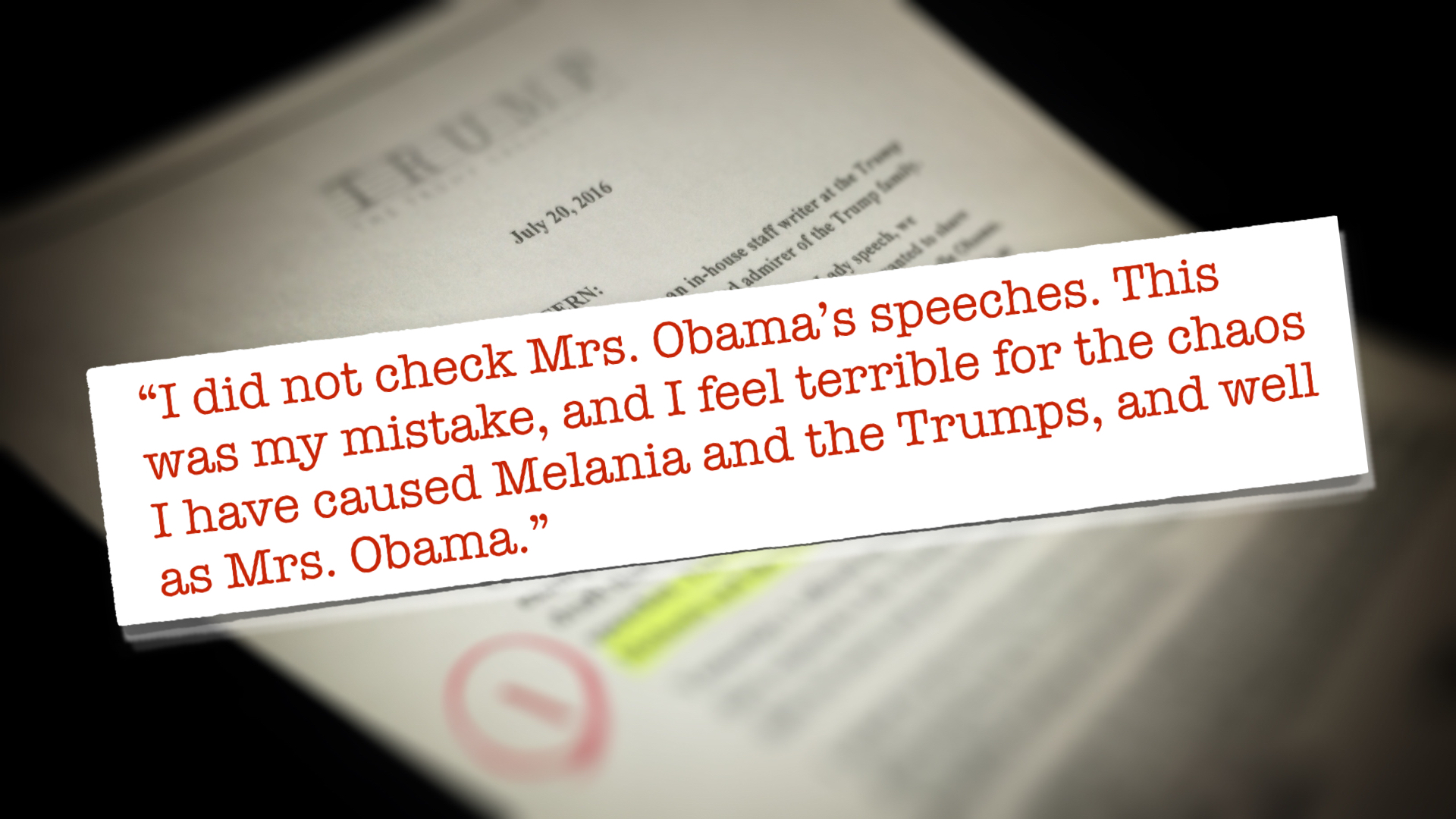
Figure 1 - Letter from Trump in-house writer Meredith McIver

Figure 1 – Letter from Trump in-house writer Meredith McIver

     The incident shows that the best branding and communication efforts also must constantly plan for the contingencies of crisis communication.   In this case, Malania’s speech slipped through the cracks of an otherwise seemingly disciplined RNC communications team and it raises serious questions about the competence of the Trump campaign.

     Effective crisis communications calls for an immediate response, often times an immediate commitment of an organization to cause no more harm, and dare I say it—apologize.   Ms. McIver did.  We know that publicly such a word is rare in Mr. Trump’s vocabulary.  Ignoring the issue while waiting for the next news cycle is not a crisis communications strategy.   Responding sooner would have allowed the campaign to get back on track with the smart branding of his convention.  But it may also leave lingering questions with voters about how he may make decisions as president in more consequential crisis matters.

#     #     #
Marco Rubio’s Words That Don’t Work

14 Mar

Trump Rubio Header Pix                        

     The gloves have come off. Except this isn’t a fistfight, it’s more like a middle school food fight. Welcome to the 2016 GOP presidential race.

     It’s an election cycle where virtually every known rule about political campaigns has been run through the shredder—several times. But the sudden shift by Senator Marco Rubio to complete with Donald Trump in his own sandbox defies established strategic positioning and communication logic.

    The shift in Senator Rubio’s tactics that began with the debates on February 25th, saw him sharply attack Donald Trump by trading personal insults before a CNN audience of millions. The attacks have continued on the campaign trail with the Rubio campaign even posting videos on its YouTube feed.  

     What’s puzzling is why Senator Rubio would go there. Yes, he is trailing in both the polls and delegate count to both Donald Trump and Senator Ted Cruz. And yes, he has to do something to spark his campaign and differentiate himself. But competing with Trump in the rhetoric of personal assaults only lowers himself to Trump’s level in an arena where he can’t win. It simply defies strategic thinking.

     Harvard Business School Professor Michael Porter argues that effective strategy is not competing in the same race, but running a different race.

     “Competitive strategy is about being different,” says Porter. “It means deliberately choosing a different set of activities to deliver a unique mix of value.” 

Trump Rubio Perceptual Map

Figure 1

      What applies to business strategy, also applies to strategic communication. For the moment, Sen. Rubio has a strategic communication problem that is in part creating his electoral problem. The perceptual map below shows how the remaining four republican candidates are positioned on axis of personal attacks verses conservative values and voter empathy. (Figure 1) By occupying with Trump a similar position on the perceptual branding map, Rubio cannot differentiate himself.   He somehow has to figure out how to re-position himself in the sweet spot in the mind of the voters—that is, outside of the blue curve on the map. 

Effective strategy is more than positioning.  Porter argues that it is also equal parts operational efficiencies and competencies.  For example, Barack Obama won the presidency in 2008 not just because of where he positioned himself in the mind of the voter, but also because his campaign had a core competency in social media engagement.  In 2012, the Obama campaign won again in part with its strategic superiority in using big data to mine the voter rolls.

     Time is clearly running out for Sen. Rubio and it may be already too late to for strategic changes to have any immediate impact.  If anyone is running a different race, it’s clearly Trump. Where the race is going, we don’t yet know.  Buckle up.

What Google Tells us About Who’s Ahead in Iowa

1 Feb

IMG_4055

         The latest polls from Iowa promise a potentially tight race for the first-in-the-nation caucuses.   The last poll from the Des Moines Register shows Donald Trump with a strong lead over Ted Cruz and Hillary Clinton in a statistical dead heat with Bernie Sanders.

         Polling in general has come under increased scrutiny itself.  Whether for political races or consumer research, tried and true methodologies have been blown up by the abandonment of land-line telephones.   Many have researchers have switched to online surveys, but even those methods face questions for their reliability.

         One emerging tool is internet search.  The CDC now uses search as a “canary in the coal mine” to alert them of pockets of emerging illnesses such as the flu.   Google Trends has shown surprising reliability in showing the strength of candidates too.  

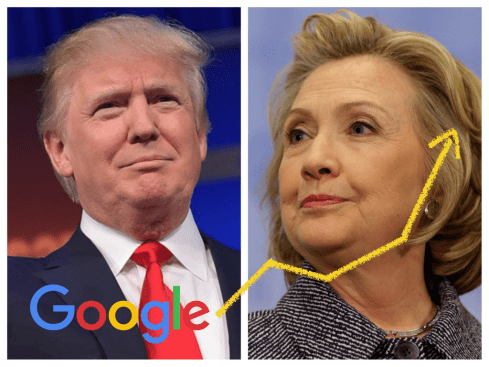
          The latest Google Trends data out of Iowa clearly show that Trump and Hillary have the momentum.  (Figure 1)

Google Trends Iowa 1-31-16

Figure 1


         Search is not 100% reliable.  While Google Trends showed former Pennsylvania Senator Rick Santorum with a strong upward trend going into Iowa in 2012 it didn’t necessarily indicate he would win—he did.

         But just as it showed Donald Trump picking up strong gains after the first republican debate in 2015 it does indicate social buzz and momentum and thereby provides a unique tool in measuring consumer, and in this case, political interests.


                                                                        #     #     #

Presidential Campaign Ads – What Bernie, Hillary, Cruz and Trump are Really Trying to Say to US

25 Jan

Ads 2

         Don’t touch that dial.  Despite the more sophisticated uses of social media, big data, and earned media, the political TV ad is far from dead.

         All of the major presidential candidates have so far deployed a limited air campaign in hopes of attracting money and votes.  But as a means of communication, are they effective or even persuasive to their intended audiences?

         There are clear strategies behind the first ads from Bernie Sanders, Hillary Clinton, Ted Cruz and Donald Trump.   At least two of these ads are very similar to product introduction campaigns we would see in the consumer-packaged goods category.   In many respects, the candidates are consumer-packaged products.  But each one takes a different strategy in attracting support through their campaign commercials heading into the voting in Iowa, New Hampshire, and South Carolina.

         Perhaps the most surprising ad so far comes from one of the most surprising candidates—Bernie Sanders.  In a field where every candidate is in some way shouting at the voters, Sanders found a powerful way connect without saying a word. 

Bernie Ad 2

Screen frame from Bernie Sanders’ “America” campaign ad

         Sanders’ use of the Simon & Garfunkel song “America” underneath the imagery of everyday Americans and people packing into Sanders’ campaign rallies give the illusion of a country longing to re-discover itself.   This is an aspirational ad that plays to our emotions and hopes through the use of a beloved folk song from the late 1960’s.  

         For Millennials, the ad appeals to their need of belonging and their search to build a future in their own image.   For their baby boomer parents, the Simon and Garfunkel song is a powerful priming cue—a time machine that takes them back to their own idealistic youth when they too wanted to “look for America.”  

         Keep in mind, when “America” was recorded in 1968, the country was at a pivotal political and social crossroad.  That year witnessed the assassinations of Martin Luther King Jr., Bobby Kennedy, the Tet Offensive in Vietnam, and the upheaval at the Democratic National Convention in Chicago.   The song that so much appealed to a new generation of Americans at that time has now been re-branded by Sanders as anthem for another new generation.  

          All good advertising should create an emotional bond between the product and the viewer—this one makes a powerful attempt.

         Where Sanders effectively uses nostalgia as an ad strategy, Trump just as effectively uses fear.

         By playing up to voters’ fear of terrorism Trump is effectively using Prospect Theory to mine for votes.   The behavioral economic theory holds that people are more fearful of potential loss than they are assured of a potential gain.   By tying terrorism to immigration, Trump uses those fears to make an argument that he is the candidate who will keep them safe.


         Hillary Clinton doesn’t outright use fear as her strategy, but she certainly is trying to appeal to voters’ anxieties about their economic and social struggles.

         In her latest ad, Clinton is not necessarily competing against Sanders, but instead republicans to whom she believes are not looking out for all Americans.

          Her message argument is that she’s fighting for all people who think they don’t have a chance.


          Finally, Ted Cruz trumpets his competence and authenticity.

         In many respects he’s re-introducing himself to voters in his latest TV ad as they prepare to head to the polls.   This ad is a clear appeal to rural voters reminding them of his Christian faith, commitment to freedom, and his political accomplishments.  While the ad doesn’t mention any specific opponent, it clearly attempts to differentiate himself from Donald Trump and Marco Rubio as the accomplished conservative in the race.


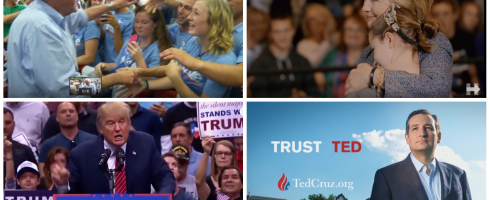
         When you break down all of the ads, there is a distinct strategy to each of them. (Figure 1)  They all have individual targeted audiences and a fairly clear message argument. 

Campaign Ad Graphic

Figure 1

         Arguably, Sanders may have the most powerfully aspirational ad of them all.  Trump effectively uses fear to motivate us to pay attention to his message.  Clinton plays to our desire to get ahead, and Cruz appeals to his competence help restore America.

         These are just four ads from four of the top candidates.   The race is young.  Stand by… and don’t touch that dial.

                  #          #         #

GOP Presidential Buzz — Who’s Got it, Who Doesn’t

10 Aug

GOP Debates 1  8-15

      It was reality TV at its best.  There was shouting, insults, bombastic rhetoric, and… Rosie O’Donnell.   Welcome to the first 2016 GOP presidential debates.  As one political scientist noted, it was Jerry Springer without Jerry.  No, this is not your father’s Republican Party anymore.  But television viewers ate it up.   They didn’t just watch, they tweeted, liked, searched, posted, and searched some more.

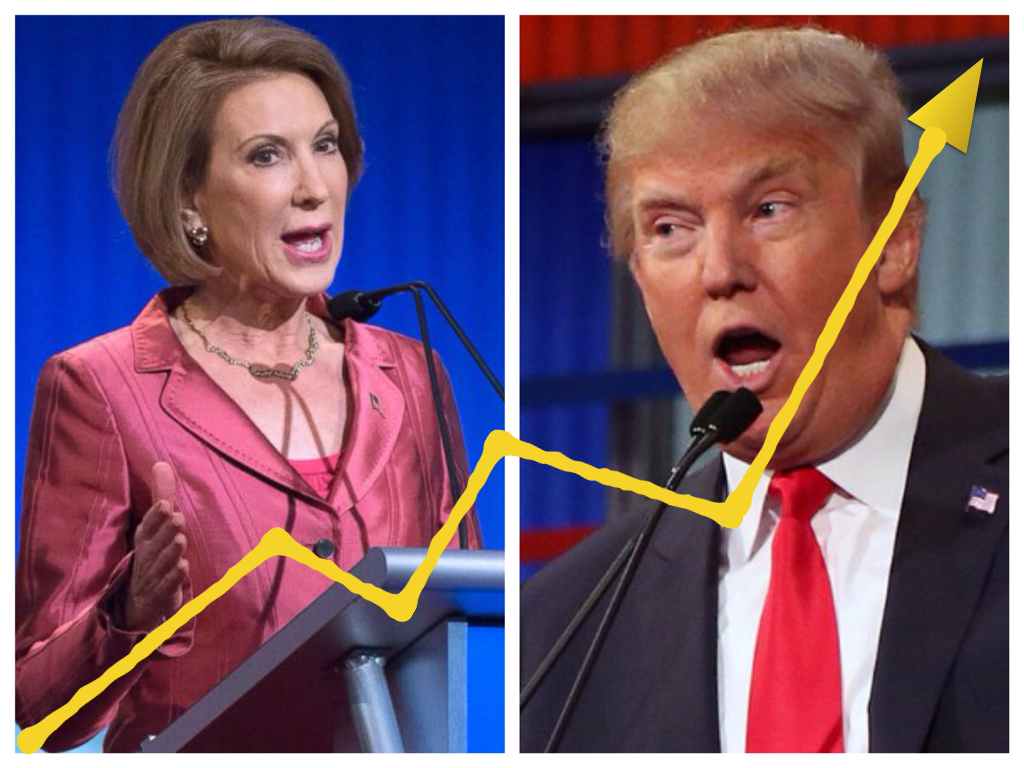
     This modern day media consumption phenomena creates real-time winners and losers.  Marketers call it “buzz.”  Google calls it “search.”  Whatever you call it, Donald Trump and Carly Fiorina owned it during the debates and it will likely deliver a short term boost to their campaigns. 

Figure 1

Figure 1

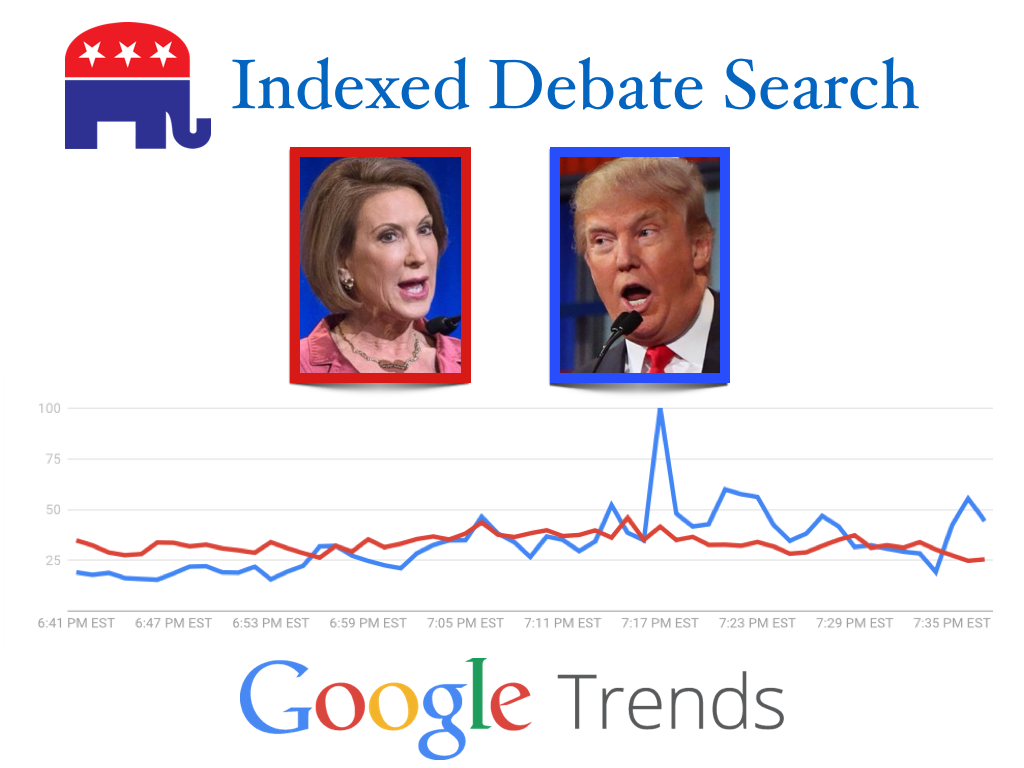
     The data from Google Trends shows that during the prime time debates, Donald Trump dominated web searches of people looking for more information on him and his presidential campaign. (Figure 1)  It doesn’t hurt that Trump has transformed himself into what political scientist David Schultz would call a politainer.  None of his nine competitors on the stage came close to the internet interaction he drove throughout the evening debates. 

     During the early undercard event called the “happy hour” debates, former Hewlett Packard executive Carly Fiorina also dominated internet buzz. (Figure 2)  Arguably, she commanded the attention in a more credible way.  Fiorina’s presence and responses were articulate, commanding, and authoritative.  She wasn’t just a candidate, she was a one-person c-suite—who just happens to be a woman.  She clearly connected with the audience in ways her early evening cohort did not.   GOP Debates 3  8-15

     What both Trump and Fiorina accomplished is part of the modern day political calculus.  In reality, it’s not much different from consumer product campaigns.  Buzz is one of the seven essential marketing drivers that brands from Proctor & Gamble to Beyonce use to grow their business.  

     Four years ago, I conducted a similar analysis of how buzz predicted the top finishers in the Iowa Caucuses where Rick Santorum won by a handful of votes.  The key is to stay consistent in the messaging and deliver enough strategic product news (campaign stances/messaging) to lead the followers on a journey toward activation—that is, contributing money and voting.   Santorum wasn’t able to sustain that early momentum and later dropped out of the race.  The jury is still out on whether Trump can also sustain the momentum, especially given his public statements about women and his not-so-wise fight with Fox’s Megyn Kelly.

     Social media is also part of the new calculus and contributes significantly to buzz and search.  On Twitter alone, interactions with the GOP debate topped major sporting events.

     It’s also no coincidence that Facebook co-sponsored the GOP debates with Fox News.  Facebook reports that 7.5 million people had more than 20 million interactions on the broadcast—that includes posts, likes and shares.   This is the new modern-day political engagement.   The candidates answered questions from Facebook during the debates through the channel’s own engagement campaign that drew 5 million views and 40,000 responses.   On the day of the event, Trump’s staff used the new “live” on Facebook feature to stream his arrival in Cleveland.   As of this writing it has earned more than two million views and 10,000 shares.


     Welcome to the 2016 presidential campaign.  As the first GOP debates showed, it will be a different kind of series of events with online engagement becoming increasing important drivers for securing funds and votes.

Cross-Channel Integration – How The White House Made D-Day More Than a Speech

13 Jun

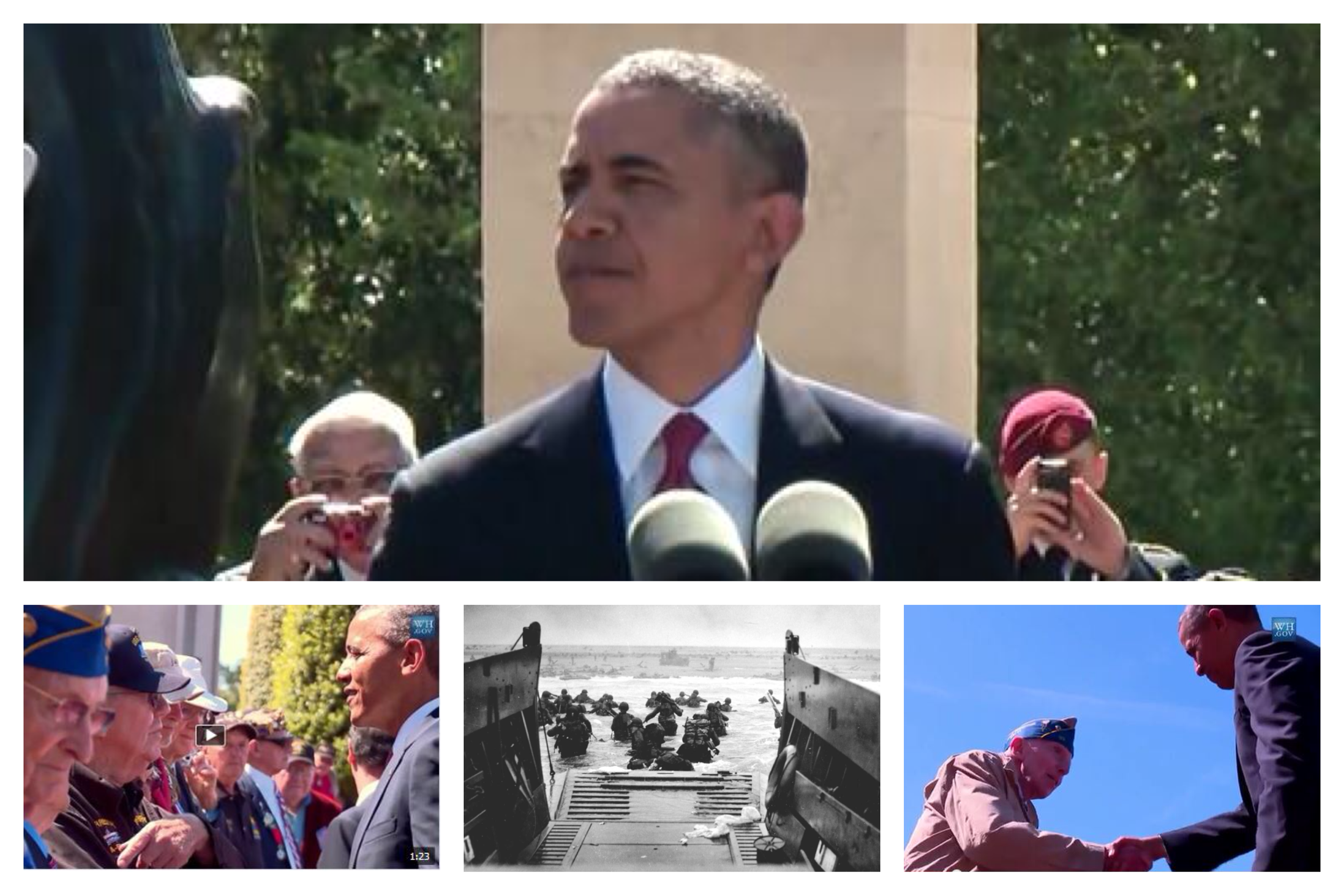
Obama D-Day Collage

       It’s a case of old school vs. new school communication.  Plato vs. Zuckerberg.  That is, speech vs. social media.  But in reality the two can and should complement each other and the White House communications team has just given another example of how to use and integrate these new channels to amplify an important message.  In this case D-Day.

      In many respects, President Barack Obama’s speech in Normandy was itself a teaching machine.  Filled with powerful rhetorical imagery and metaphoric values, he used the world’s oldest form of communication to commemorate and honor the past and reassure the future.

      The president’s opening line was itself masterful in its metaphoric power:

                   If prayer were made of sound, the skies over England that night would have deafened the world.”

 His second sentence was equally illustrative in its imagery:

“Captains paced their decks. Pilots tapped their gauges. Commanders poured over maps, fully aware that for all the months of meticulous planning, everything could go wrong: the winds, the tides, the element of surprise — and above all, the audacious bet that what waited on the other side of the Channel would compel men not to shrink away, but to charge ahead.”

      Gathered among an audience of D-Day veterans and foreign leaders the president had three clear goals in this address.  First, to remember and acknowledge sacrifices paid on the beaches of Normandy and to keep the story alive.  He did it in the form of a rhetorical challenge:

                   Whenever the world makes you cynical — stop and think of these men.”

     Second, the president needed to reassure America’s European allies that it’s un-waivered in its commitment to a free continent.  Finally, he had to acknowledge the continuing sacrifice U.S. service members are still giving in a post 9-11 world:

“And as today’s wars come to an end, this generation of servicemen and women will step out of uniform. They, too, will build families and lives of their own. They, too, will become leaders in their communities, in politics, in commerce and industry — the leaders we need for the beachheads of our time. God willing, they, too, will grow old in the land they helped keep free. And someday, future generations, whether seventy or seven hundred years hence, will gather at places like this to honor them — and to say that these were generations of men and women who proved once again that the United States of America is and will remain the greatest force for freedom the world has ever known.”


D-Day Blog WH Facebook

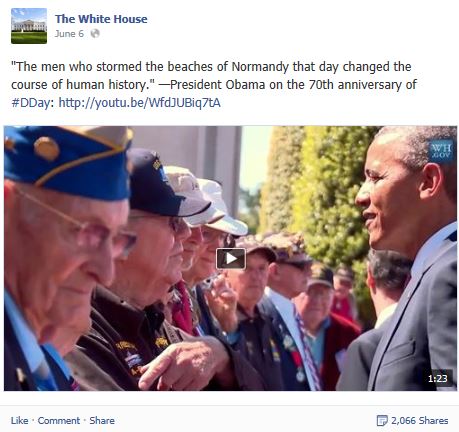
Figure 1 – White House Facebook post of the D-Day event linking to a YouTube video.

        For a president severely struggling at home and in congress, it may have been one of his better moments.  But the challenge for the White House was not letting the message disappear into the sands of Normandy.  Major media coverage significantly helped.   But as an established brand, the White House also controls its own messaging, and in this case it tactically coordinated and integrated the D-Day message across multiple media channels to ensure it was targeted to a series of narrow audiences for the widest possibly reach. (Figure 1)

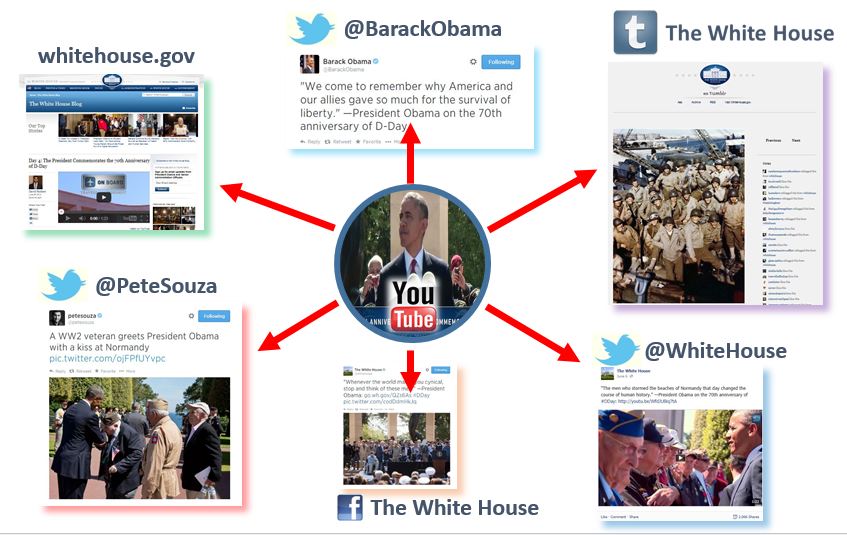
         First and foremost, was the YouTube video of the speech.  But the White House communications team also targeted separate messages, pictures, and excerpts of the speech to individual social media channels. (Figure 2)  The multi-channel integration creates a hub and spoke network to target individual audiences where they live in social media.  

Figure 2 - The White House cross-channel integration profile.

Figure 2 – The White House cross-channel integration profile.

    In an age of modern communication it’s a smart strategic use of social media to amplify a message and engage participation.  If there was any fault in this particular strategy, it’s in the fact that the communications team should have tactically posted more images and messages throughout the day with a more coordinated effort in each post to link and drive audiences to the blog and the YouTube speech.   In that respect, it’s one miscue an otherwise disciplined communications team.

      It doesn’t have to be a presidential speech.  The lessons for brands, corporate communication teams and non-profits alike are profound.  Compelling content doesn’t have to live and die in a single space.   Integration across multiple channels is key—and often free.  The White House team gives a useful strategic road map for communicators to follow.

Embracing Vine — How One Veteran Political Journalist Tweets a New Narrative

26 May

Rachel Blog Cover Pix

   One of the great challenges for brands and journalists alike is engaging consumers in an era where information is a snack and not a meal.  One of Minnesota’s premiere political reporters is now measuring that engagement by seconds in addition to column inches.     

    The Minneapolis StarTribune’s Rachel E. Stassen-Berger is more than a newspaper reporter.  She’s a multi-platform, multi-channel journalist who writes, blogs, tweets, and even produces video stories for startribune.com.  With more than 36-thousand tweets she is a prolific user of Twitter and one of the state’s most followed political journalists.  And it’s through Twitter that she’s experimenting with seven-second Vine videos to engage her followers in new ways.      

     “We’ve been using Vine for a while in various ways and I’ve sort have played with it a little bit in journalism,” said Stassen-Berger.       

     Like most news organizations, the StarTribune has encouraged its reporters to embrace social media and use various channels such as Facebook, Twitter and Vine to reach their readers where they live in social media.  New research from John H. Parmelee in the Journal of Media Practice shows how most American political reporters have settled in on Twitter.   For Stassen-Berger, the perfect opportunity to expand her use of Twitter with embedded Vine videos came during Governor Mark Dayton’s State of the State address where she approached Democratic lawmakers inside the House chambers and asked them what they wanted to hear from the Governor.        

    Here are three of her vines:


      After the governor’s address, Stassen-Berger captured the Republican response from two candidates seeking the party endorsement to run against Dayton.  


     For Stassen-Berger’s followers, the tweets and vines when followed in real time help tell a brief narrative about the story.  Furthermore, the Vine video with sound extends credibility to the tweet and makes the news event itself more accessible, more real.

     “I think the moment that it crystalized with me as a good use of it was actually on caucus night,” said Stassen-Berger.

     “I was in the office and was running a live blog and all sorts of reporters were out in the field and feeding to me so I could feed the live blog.  And one of the things I said to them was, ‘Try to use Vine and particularly if you can go up to someone and think of a specific question and say you’ve got seven seconds to answer.’” 

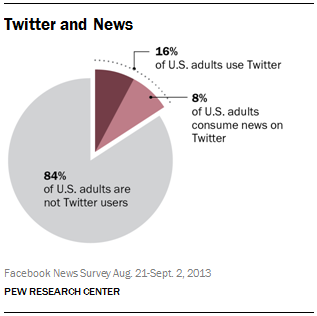
Figure -1 Pew Research Twitter News Consumers

Figure -1 Pew Research Twitter News Consumers

      Through trial and error, Stassen-Berger says the secret is to come up with a focused question that the subject can answer very quickly.  It also takes persistence and a little patience.  “It takes a couple of takes.  Because it’s only seven seconds and it’s a challenge,” she said.

      As news consumption habits change, the use of Vine to give little snippets of context to a news event through Twitter is a smart strategy.  New insights by Pew Research Center show the overall Twitter user base is still relatively small, but those who are on the channel are relatively strong news consumers.  Pew found that half of Twitter’s users are seeking news. (Figure 1)

     That important insight collides against further Pew research that shows the number of consumers watching online news videos is steadily growing—now more than half all online video viewing. (Figure 2)  Increasingly, more of that video is consumed on mobile platforms.  Digital analytics agency comScore just released new research showing mobile video viewing has risen 37% in the past year among German consumers, a strong indicator of a trend that is typically later matched by U.S. audiences. 

Figure 2 - Pew Online Video News Demographics

Figure 2 – Pew Online Video News Demographics

      Pew also finds that the viewers who are watching online news videos dramatically trend young.  Nearly half of all 18-29 year olds watch online news videos. This is a critical audience to news organizations as they try to engage young consumers who watch less television news and read fewer newspapers than previous generations.

    Furthermore, the use of Vine in news coverage doesn’t just tend to lend more credibility to the story but also the storyteller.  After all, much like the newspaper she writes for, Stassen-Berger is a powerful brand herself.  By using Vine to give her followers more accessibility to the stories she’s covering, she also builds upon an important theoretical model that I’ve established called the Blotz Typology.  It’s a four-part model that provides a road map toward building and sustaining credible online relationships that in turn could lead to more engagement and more followers.

      Stassen-Berger just sees it as another way to tell a story.

       “People do react and it allows them another way to see the news,” she said.

“I Lost My Best Friend Too.” A Speech Lesson From an Unlikely Source—Gov. Mark Dayton

25 May


    Minnesota Governor Mark Dayton put down the script this week.  The words that escaped the bondage of talking points prove the power of discourse that comes not from a page, but from one’s soul.

      On the political stage, even the corporate stage where every word spoken is weighed and measured, parsed and dissected, the governor displayed a moment of rhetorical brilliance—a teaching moment for leaders of all stripes. 

Peter Hobart Elementary School 4th graders Mohammed Fofana and Haysem Sani.  Both boys were killed in a land slide at Lilydale Regional Park in St. Paul, MN on May 23rd, 2013.

Peter Hobart Elementary School 4th graders Mohammed Fofana and Haysem Sani. Both boys were killed in a land slide at Lilydale Regional Park in St. Paul, MN on May 22nd, 2013.

      This was no ordinary audience.  No ordinary setting.   The gilded comforts of the governor’s capitol conference room were gone.   The clicking keyboards of reporters and the silent streaming of Tweets for a headline snacking world living in the moment were all as devoid as the hundreds of eyes staring back at him.

      Those eyes belonged to the classmates of two young boys who just lost their lives.  Mohammed Fofana and Haysem Sani were fourth graders at Peter Hobart Elementary School in St. Louis Park.  Their simple field trip to Lilydale Regional Park in search of fossils ended with a rock slide.  The tragedy didn’t just suffocate two fourth grade boys, if left their entire school gasping for answers. 

       The governor didn’t have any. 

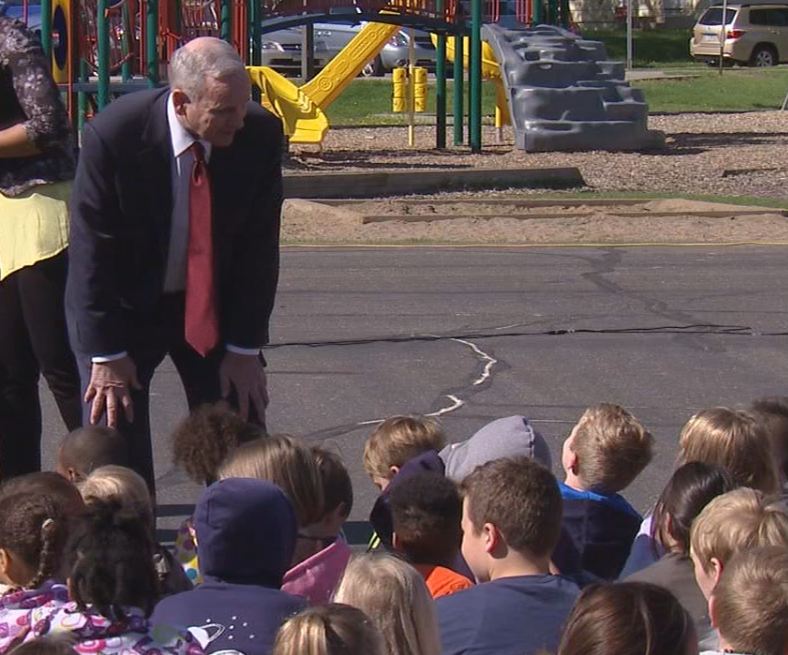
Gov. Mark Dayton talking to students at Peter Hobart Elementary School in St. Louis Park, MN on May 24th, 2013

Gov. Mark Dayton talking to students at Peter Hobart Elementary School in St. Louis Park, MN on May 24th, 2013

       Therein lies part of the simplistic strength of a message that was so powerful.  Before an entire school sitting cross-legged on the playground, the governor, like the school teacher he once was, bent down to talk to some of the kids at eye level.  Then getting up to the podium he did something nearly every executive of his stature never does—he stepped away.   Looking directly at the children he said these words:

       “At a terrible time like this, there’s nothing I can say.  There are no words that can make you feel better.  I know that because I lost my very best friend in an accident not unlike the one that took Mohammed and Haysem away from you.  He was hiking in a canyon in California and a rock slide came tumbling down.  It was raining a couple of days before and he was killed.

        I remember the horror I felt, I remember the shock, the disbelief.  And I remember greeting his wife and his daughter who is my God daughter, who was eleven years old.  And I said why, you know, why?  Why did this happen?  Why did not just a bad thing happen to a good person, but why did a terrible thing happen to a terrific person?  And in your school a terrible thing happened to a few young boys and two more who were injured.  And we pray for their recovery.”          – Mark Dayton

     For exactly three minutes and ten seconds Mark Dayton wasn’t a chief executive, he was a chief grandfather.   His own story of personal loss transcended the moment for those children and their parents.  Like a warm blanket, he covered their frailties by exposing his own.    He didn’t have an answer.  But he had a connection.  He had a narrative.

     What makes this moment especially remarkable is that Dayton, like many executives, is a leader who often struggles to find the right words.  Lofty oratory is not among his chief gifts.  But his brief moment with those Peter Hobart students this week was a masterful example of the power of speech when one searches for a connection and a story to tell. 

     The teaching moment for communicators and leaders alike is the essential need to always consider one’s audience.   In this case they didn’t need words on a page; they needed words from the heart.   Dayton put down the script and let his soul fly free.   

      Speech class is dismissed.

Obama on Gun Control — A Message Management Case Study

30 Mar
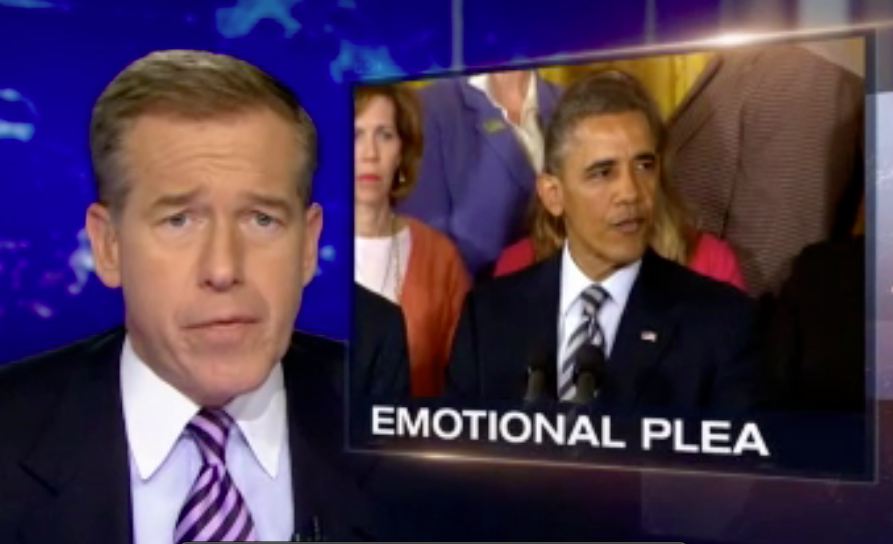
President Obama's gun safety push presented as the lede story on the NBC Nightly News on March 28, 2013

President Obama’s gun safety push presented as the lede story on the NBC Nightly News on March 28, 2013

              President Obama’s latest push on gun safety was hardly a shot in the dark.   His call for universal background checks on March 28th was a highly coordinated, multi-event, multi-channel message that offers a strategic communication model on a dynamic public policy issue.

                 With the raw emotions subsiding over the tragic Sandy Hook school shootings and the success of gun rights advocates at thwarting new legislative bans on military-style semiautomatic rifles, the Obama administration clearly needed to re-engage public opinion and build groundswell.    With little political support for banning military-style assault rifles, his new objective is keeping alive the proposal of universal background checks for all gun purchases.  The new strategy involves putting public pressure on congress.  The new tactics involved a national day of action with a highly coordinated series of events and social media engagements that would swamp news coverage and buzz in a 24-hour cycle. 

Figure 1 - Barak Obama Tweet on March 28, 2013

Figure 1 – Barak Obama Tweet on March 28, 2013

                 At the core of the new strategy was a White House press event featuring the victims and survivors of gun violence.  

               “Tears are not enough,” said the President. 

               He urged activists and citizens alike to “turn that heartbreak into something real” by urging their congressmen to pass meaningful gun control legislation.  By using the bully pulpit of the presidency, Obama was able to command the necessary national news coverage and earn the A-1 lede slot on the network evening news. 

Accent Signage shooting survivor John Souter speaking at a Minneapolis news conference.

Accent Signage shooting survivor John Souter speaking at a Minneapolis news conference.

                But just as important to the strategy was sending the same message to communities across the country, especially in blue states such as Minnesota and communities where gun violence is a salient issue.  In that effort the White House coordinated with gun safety organizations to hold more than 100 media events across the country that day featuring local gun violence victims pleading for action.                         

               In Minneapolis, the event featured John Souter, a survivor of the tragic workplace shooting at Accent Signage on September 27th.  Six of his co-workers died.  Souter was shot twice.   It was his first time speaking about the unspeakable.                 

                “How has it changed me?” contemplated Souter.   “I’m not the same person that’s for sure.  I don’t laugh like I used to.  These things are with you every day.”

                He commanded the attention of every news camera, every reporter’s notebook in town.  The local news conferences served as a force multiplier to the president by ensuring that local gun violence victims would be seen and positioned next to the president’s remarks in the evening news coverage.


Barak Obama Facebook post on March 28th, 2013

Figure 2 –  Barak Obama Facebook post on March 28, 2013

                It was also no accident that in the middle of Souter’s emotional testimony, the Barack Obama Twitter page posted a simple message:  “Fact:  Since 1968, 1.3 million Americans have died from gun violence.” (Figure 1)                                

               The more than a half a dozen tweets were joined by Obama’s Facebook posting of an infographic showing support for universal background checks seemingly as popular at apple pie. (Figure 2)  The posting received 64,000 likes and more than 10,000 shares. 

               Likewise, the video of the president’s White House speech immediately uploaded to YouTube recieved nearly 13,000 views. (See video below)              

                By the metrics of social media engagements, earned media, and buzz, the strategy was superbly executed.    It shows that strategic engagement is no accident and it offers a modern model in multi-channel communication.   But real success in this case is whether the strategy activates votes in congress.  For the moment that is a much harder task.  The whip counts are still out.