In a presidential campaign season cluttered with the white noise of attack ads and misinformation, along comes a simple and yet metaphorically powerful appeal.
It comes by way of twenty-something writer, actor, director Lena Dunham. The star of the HBO series “Girls” has made a name and brand for herself by revealing many of her own coming of age moments.
Dunham’s latest self-effacing reveal is her about her “first time.” No, not that first time.
It’s the first time she voted for a president—Barack Obama.
The sexually tinged metaphor is powerful, if not controversial. But from a pure communications point of view, it also one of the more strategically targeted and crafted messages of the fall election.
Let’s break it down.
Strategy: Attract Young Women Voters
Competitive Frame: Apathy
Message Argument: Make your first vote count
Target Market: Young college-aged women “achievers” who’ve never voted
Desired Response: Vote for Barack Obama
Idea: Sexual Innuendo
Execution: Woman-to-woman couch conversation
Part of what makes this appeal noteworthy is its simplicity. There’s no flashing graphics, no dramatic voice-over, no gotcha video clips, no scary music. To her peer group, Dunham’s girlfriend-to-girlfriend manner commands attention—let’s talk. Her exposed millennial sleeve tattoo commands credibility—I’m one of you.
Together, they give her standing to talk about why they need to “do it” with the right guy: “A guy who cares whether you get health insurance, and specifically whether you get birth control.”
The metaphors are powerful, the message consequential. Which is why it has gathered so much criticism. The independent women’s forum has called it sexist, and writer Ben Shapiro calls it tasteless.
The social media forces that have changed and influenced television viewing habits, are now changing political engagement too. Political communication that was once dominated by television commercials and yard signs has gone digital—and personal.
New research from Pew Internet reveals a significant number of Americans using social media—66%–are using social networking sites (SNS) to both follow politics and candidates and share their own political views.
Here are some of the top lines:
38% of those who use SNS & Twitter use social media to “Like” or promote material related to politics or social issues.
34% of social media users have used tools to post their own thoughts or comments on political or social issues.
33% have reposted political or social issues content that originally posted by someone else.
31% have encouraged others to take action on a political or social issue.
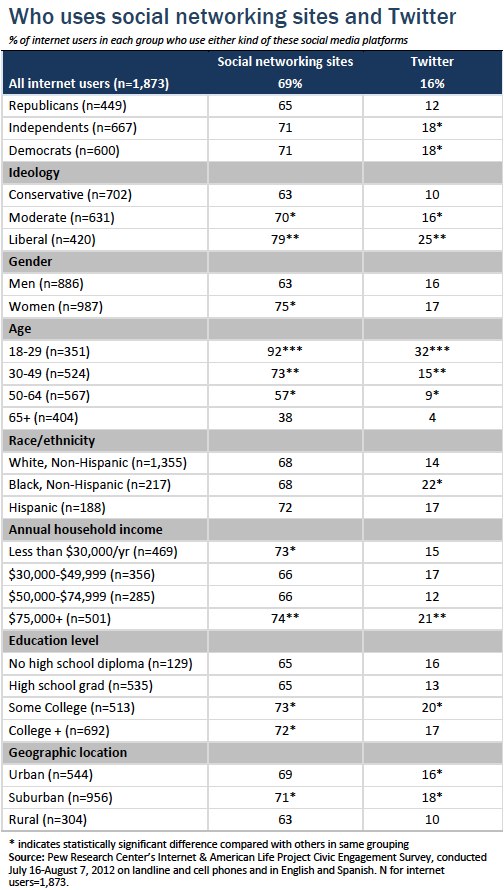
The Pew research also indicates that the power users skew heavily young and somewhat liberal. (Figure 1) That finding would support the explosive social media usage among viewers of the 2012 Democratic National Convention.
Figure 1 – Pew Internet
For television programmers, especially TV newsrooms, this latest set of data points is a gift for building strategies to engage younger viewers in way that is native and natural to them. As television entertainment producers have built social media engagement into live viewing of comedies, drama, and reality episodes, TV news operations have the same opportunity especially when it comes to live political events such as debates, forums, and rallies.
Some of the tactical engagement methods should include:
Create branded discussion forums by hashtagging events for people to follow. Example: #Fox9debates.
Use the hashtagged comments to drive on-air discussion and talk back with guests and experts.
Establish website chat rooms during major events that are moderated by newsroom talent.
On-air talent should direct viewers to specific content on the web or Facebook and encourage them to share it.
The reality of today’s connected world is that viewers are constantly screen-splitting, meaning they’re watching TV and interacting with a mobile device at the same time. By encouraging viewers to engage with your brand on another channel only builds the brand and helps them achieve the information and entertainment gratifications that they are seeking. Television programmers who don’t do this risk losing their viewers to someone else who will.
Here’s a few more important facts on the Pew Internet study. (Figure 2) The Pew research team lead by Lee Raine interviewed 2253 adults between July 16 and August 2, 2012. They found that 60% of American adults use either SNS or Twitter. Of the American adults who are online, 69% use SNS such as Facebook, LinkedIn and Google+, and 16% use Twitter.
Two men approached the presidential stage in Denver, but only one commanded it and walked off with a memorable message for the American voter to consider.
One of these men had a focused, clear message with passion and purpose. The other appeared rhetorically disheveled. If Aristotle were measuring the persuasive outcomes based upon authority, emotion and logic (ethos, pathos, logos) then Mitt Romney would have gone to the head of the class.
One of the key takeaways from the first presidential debate is not necessarily how poorly President Obama may have performed, but why Mitt Romney was more effective and memorable in framing one of his key messages: government is too big.
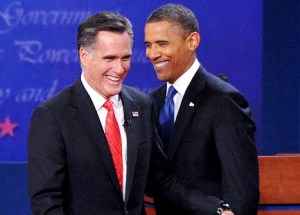
Presient Barack Obama and GOP nominee Mitt Romney at the presidential debates, October 3, 2012.
He did it with two metaphors. The most powerful stands seven feet fall and eats bird seed. The second, recast Washington as voodoo government. When moderator Jim Lehrer tried to elicit a response from Romney on the size of government, here was his response:
“I’m sorry Jim, I’m gonna stop the subsidy to PBS. I love Big Bird. I actually like you, too. But I’m not gonna keep on spending money on things to borrow money from China to pay for it.”
His second most powerful message took a long-time democratic boogeyman—trickle-down economics—and turned in on its head.
“And what we’re seeing right now is, in my view is a trickle-down government approach which has government thinking it can do a better job than free people pursuing their dreams. And it’s not working.”
Psychological researchers have long established that people process and remember what they already know. Ralph E. Reynolds of Iowa State University writing in the Journal of Educational Psychology strongly established how metaphorical writing vastly improved recall and understanding. Likewise, Thomas J. Reynolds has published extensive works in the Journal of Advertising Research on how metaphorical references build stronger advertising messages. The theory extends to political communication as well. Eugene Miller of the University of Georgia notes that political rhetoric has always relied heavily on metaphors whether it’s assigning players to the president’s “team,” to creating programs such as the “New Deal,” “New Frontier,” or “War on Poverty.” One of the most effective uses in a campaign came from Walter Mondale in 1984 when he blatantly stole a line from a Wendy’s hamburger commercial to describe rival Gary Hart’s domestic policies: “Where’s the beef?” The metaphor was devastatingly effective. Within weeks Hart’s campaign ended and Mondale won the democratic nomination.
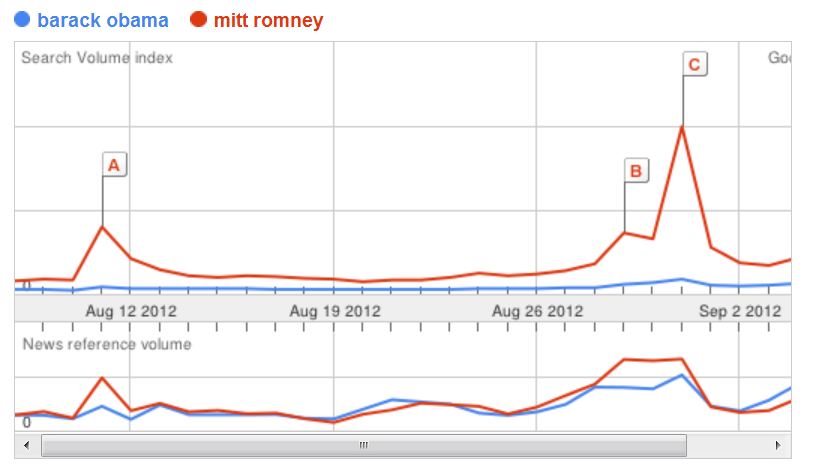
In this new era of explosive mediated social dialog, the Big Bird metaphor has become an instant internet meme. Within minutes of Romney’s reference, satirical Big Bird pages surfaced on Twitter and t-shirt designers went to their screen printers. Internet searches for both Romney and Big Bird skyrocketed. (Figure 1) By week’s end, the Big Bird reference even became material for Saturday Night Live’s Weekend Update.
Figure 1: Google Trends web search volumes. RED-Mitt Romney, BLUE-Big Bird
Mitt Romney’s chief goal in the coming weeks is to change the attitudes of the extremely narrow percentage of voters who have yet to make up their minds. In the first debate, he’s given them two symbolic images to consider. Wouldn’t it be ironic if come election day the chief lesson of the fall campaign didn’t come from 1600 Pennsylvania Ave, but instead from an address on Sesame Street.
Every good marketer knows there’s a small set of essential drivers to selling a product or idea—even a candidate. In the traditional marketing funnel there has already been plenty of awareness and product information on Barack Obama and Mitt Romney to help voters make their decision. But one of the most important intangible drivers is what marketers call buzz. After two weeks of heavy political showmanship, there’s some metrics which show one party and one candidate is winning the talkability battle.
In a world that is increasingly social and using digital social platforms for media and news consumption, a number of interesting patterns are occurring in the 2012 election. First, traditional TV viewership of the conventions is down from 2008. Second, those who are viewing the conventions are screen-splitting their attention. That is, they’re viewing a traditional TV or streamed feed of the convention speeches and simultaneously using another screen window or mobile device to interact with and share the content they’re viewing. It’s what 1960’s media prophet Marshal McLuhan would have called “cool” media consumption requiring the user to elaborate, process, and react. It’s a new world, a new dynamic, and a new form of marketing buzz.
Figure 2
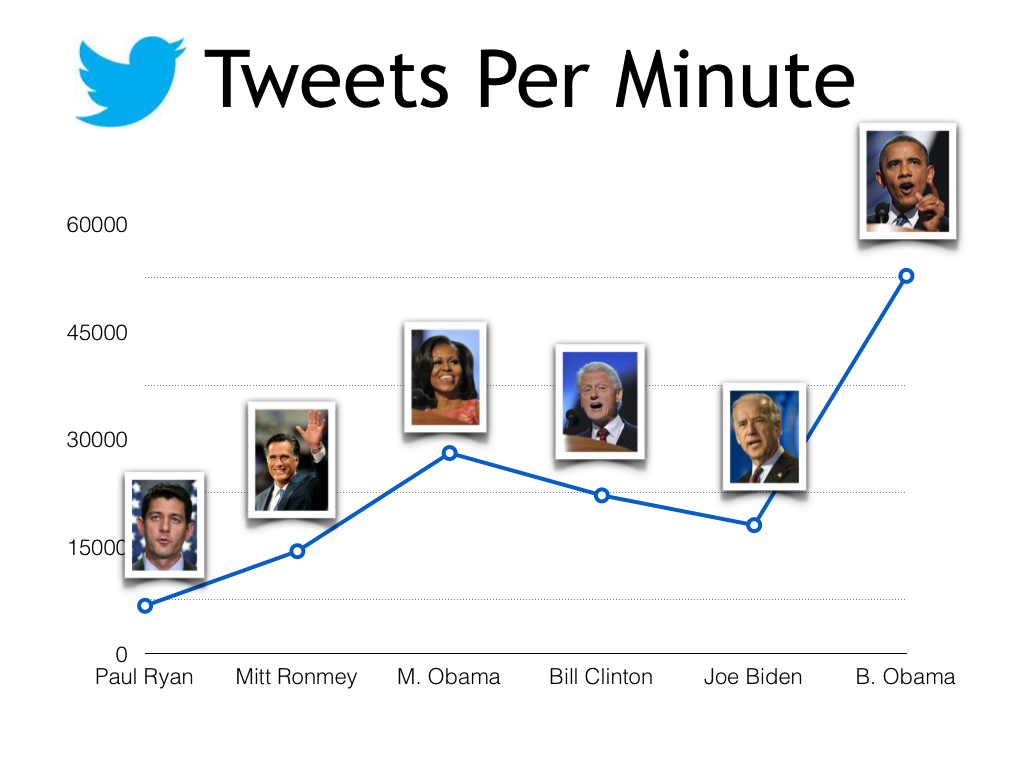
In this new pattern, it appears that the Democratic Party and Barack Obama have made significant gains. Using Twitter posts as a metric for buzz, the Democrats—especially Michelle and Barack Obama—have set new heights. In fact, Twitter reports that the 52,756 tweets per minute at the end of Obama’s acceptance speech on September 6th, set a new record. The number of tweets on the first lady’s speech two nights before doubled those of Mitt Romney’s acceptance speech. (Figure 1)
Twitter has its own political index measuring the sentiment of tweets on the candidates. In this metric, Obama has a 5:1 positive buzz advantage to Romney. (Figure 2)
Figure 3 – Alexa web site traffic
Another measure of buzz is the amount of traffic each candidate is attracting to his website. Here again according to the web analytics firm Alexa, Obama is steering far more traffic to his campaign site than Romney is to his. (Figure 3) The only metric that shows Romney with an advantage, is web searches tracked by Google trends. During the past 30 days Romney has drawn more people to their computers searching for information on him. (Figure 4) It’s a measure that makes perfect sense since Romney is still not as well known as the president who has spent one term in office.
Figure 4 – Google Trends for baracakobama.com & mittromney.com
While Obama is making impressive gains in social buzz, there are also critical limitations to using this as a predictor for the election. First and foremost are demographics. The use of social media is inherently dominated by Generation X and Millennials. As noted in a separate post, the number of viewers to the GOP convention heavily skewed toward Baby Boomers 55 and older. Political research tells us these are the people who actually vote. Second, buzz is only one of many drivers a campaign needs to put its candidate in office. From a marketing point of view, it also needs to elicit awareness, emotional bond, loyalty, and especially activation—getting their supporters to the polls.
After all, if social media buzz was the only driver that really counts, Ron Paul would be the GOP nominee.
Mitt Romney at the 2012 Repbublican National Convention
The clicking heard across America last week was the collective sound of TV sets turning off the Republican National Convention. But it doesn’t mean voters are necessarily tuning out, they’re just changing platforms.
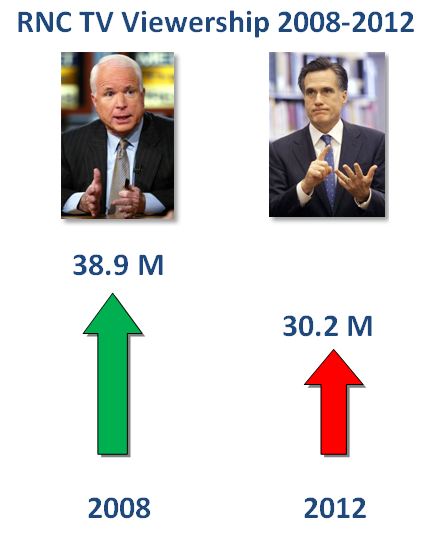
The overnight television ratings from Nielsen show Mitt Romney had 8 million fewer viewers for his acceptance speech than Senator John McCain gathered in 2008. Additionally, young voters largely didn’t watch.
Source: Nielsen
Nielsen’s data shows only 3.2 million viewers age 18-35 tuned in Romney’s speech compared with 17.5 million viewers age 55 and over—a gap of 5-to-1. President Obama may likely see a similar erosion as the DNC gathers this week in Charlotte.
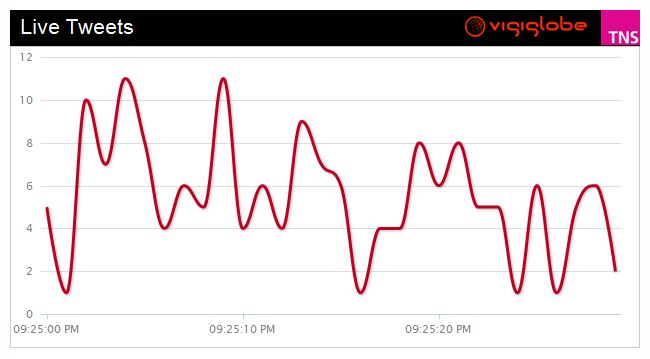
But there’s also strong evidence to show people aren’t tuning out, they’re just consuming politics in different ways. The conventions are no longer just TV viewing events, they’re social events with hundreds of shareable moments. And those moments are coming to news consumers where they now live—on their tablets, computers and smart phones. It is now such an important engagement dynamic that CBS News is now tracking Twitter convention messages in a real time graphic on its politics page.
cbsnews.com politics page
At the end of Romeny’s speech on August 30th, Twitter reports that more than 4-million Tweets were sent about the RNC. The total nearly doubled the number from the rest of the week. Together with Facebook, YouTube, and live streaming video they shatter the old one-way communication model of candidates shouting through a single TV camera to the masses. In this new dynamic, people are able to talk back and have conversations with each other—even with those not watching the event on television.
In this new conversation, Twitter reports people were especially talking about the conclusion of Romney’s speech by sending out 14,289 Tweets per minute. Clint Eastwood’s rambling unscripted attack of the president gathered the third highest score of 7,044 Tweets per minute.
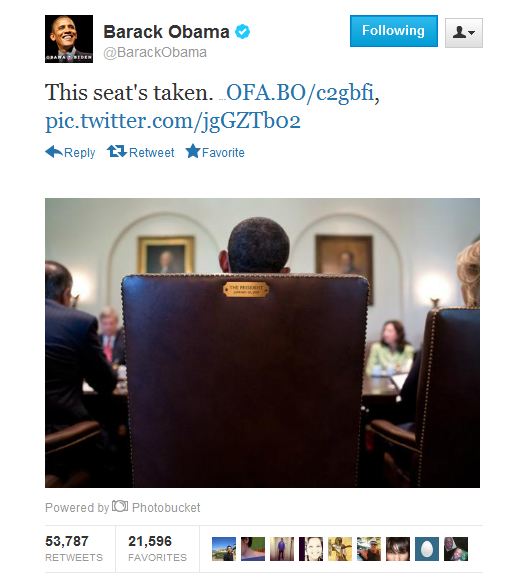
While Eastwood’s somewhat awkward empty chair metaphor became an instant internet meme, it was through social media—and not television—that President Obama had the last laugh. His Tweet responding “This seat’s taken” was the most re-tweeted message of the entire night.
If the #foundingfathers could only see us now.
(Update – 9-5-12:Twitter reports Michelle Obama’s DNC speech gathered nearly doublethe tweets per minute of Mitt Romney’s acceptance speech. One line in her speech, “we’ve got so much more to do,” gathered 22,004 tweets per minute.)
It’s far from a scientific sample of the electorate, but Google has so far been a fairly reliable predictor of election results so far in the 2012 presidential cycle.
Google tracks what people search for online. In a way, it’s a measure of groundswell and interest. Marketers call it buzz. When one mines the Google Trends data just for Minnesota in the past 30 days the search results show Ron Paul far and away has the most buzz. (Figure 1)
Figure 1 - Minnesota Google Search Trends
In the past six months I’ve observed how Google Trends served as a barometer for Michele Bachmann’s surprise win in the Iowa Straw Poll and Rick Santorum’s tight finish in the Iowa Caucuses.
The latest scientific poll out by Public Policy Polling shows Rick Santorum with a substantial lead over Mitt Romney, 30-24%. Newt Gingrich is next with 22% and 20% for Ron Paul. In other words, PPP shows nearly the opposite results as Google.
To be sure, Ron Paul has attracted a loyal following of younger supporters who have swamped every Minnesota campaign appearance in the past several days. Paul has also trended very well in Google in previous presidential contests. In fact, Google Trends showed him with the most buzz prior to the Iowa Caucuses. However, he has not been able to convert that buzz into votes. We’ll see if he’s able to accomplish that Tuesday night in Minnesota.
Old school Washington just got a lesson new school democracy.
The outcry over the proposed Stop Online Piracy Act and the January 18th internet blackouts lead by Wikipedia was the information age equivalent of the shoot-out at the OK Corral. This time Wyatt Earp was armed with a computer and millions of social media followers all firing cyber bullets at will. The McLaury Brothers in congress never stood a chance. SOPA and its companion Senate bill PIPA have been sent to a Boot Hill grave site. Don’t expect daisies to pop up anytime soon.
Social democracy won. But perhaps just as important is what lost—intellectual property.
The arguments on both sides were focused and compelling. Among the most articulate voices against SOPA is a brilliant Twin Cities internet and social media entrepreneur, Tyler Olson of SMCpros.
“SOPA fundamentally changes the internet,” Olson argues.
What frightens Olson and thousands of savvy internet consultants and entrepreneurs like him is that SOPA would have allowed the U.S. Justice Department to shut down internet sites that unbeknown to them contained or linked to copyrighted and protected material, be it movies, music, books, software, or other creative content.
“When the government, companies, individuals can request that anything be taken down it becomes an issue of freedom of speech, it becomes an issue of the Great Firewall of China which will now be potentially in the U.S.,” said Olson. “And those are the things that go against the democracy of America.”
Olson’s views have sympathetic support from at least one prominent media law expert. University of Minnesota Law Professor Jane Kirtley says SOPA goes after a critically important issue in an unfocused way.
“It’s using a sledge-hammer where a stiletto would be more appropriate,” said Kirtley.
But lost in the outcry over censorship and First Amendment rights, were the rights of people to also protect the things they create. Steve Cole is a jazz musician and recording artist who’s most recent album Moonlight has topped the Billboard jazz charts. Cole is also chair of the music business department at the McNally Smith College of Music in St. Paul, Minnesota.
“Of the music that is distributed through various channels only five percent we’re able to monetize. So, if that doesn’t give you an idea of what a herculean problem internet piracy is I don’t know what would,” said Cole.
I’ve included extended video Fox 9 interviews of both Kirtley and Cole making their arguments.
The main target of the SOPA legislation was overseas websites that steal and distribute copyrighted material that have been untouchable to U.S. regulators.
“We’re trying to fix a system that is broken. We’re trying to protect ourselves against violators of our intellectual property and their distribution too, and we don’t have a mechanism for enforcing that for overseas violators and this legislation does give us that ability,” said Cole.
The SOPA legislation was largely backed by institutional content providers including the man who ultimately helps me may my mortgage. (Disclosure statement: no one in my organization has been told to support a particular point of view on SOPA) NewsCorp Chairman Rupert Murdoch has been an outspoken supporter of SOPA for the same reasons as Cole. As the owner of 20th Century Fox, Fox News Channel and the Wall Street Journal, Murdoch believes SOPA is needed to combat a growing culture where people believe everything on the internet is free—or should be.
But there’s also another take on the debate and it come from James Allworth and Maxwell Wessel in the Harvard Business Review. Their analysis is that the media giants are pushing SOPA to protect business models that are no longer nimble and innovative.
“SOPA is a legislative attempt by big companies with vested interests to protect their downside,” Allworth and Maxwell write.
Had SOPA passed congress, they argue it would likely cripple emerging digital businesses. “Start-ups will be less competitive in the United States and we’ll have effectively disabled one of the few remaining growth engines of the economy,” said Allworth and Maxwell.
Every voice raises a significant issue. In the end, creative content should and must be protected. Our younger generation of internet users has to understand that not everything is free for their taking, copying, and sharing unless the creators of that content say they can.
Which brings us back to the OK Corral. Wyatt Earp won the day, but there will someday likely be another shootout. Let’s hope congress, as Professor Kirtley suggests, comes to the corral with a scalpel instead of a sledge-hammer.
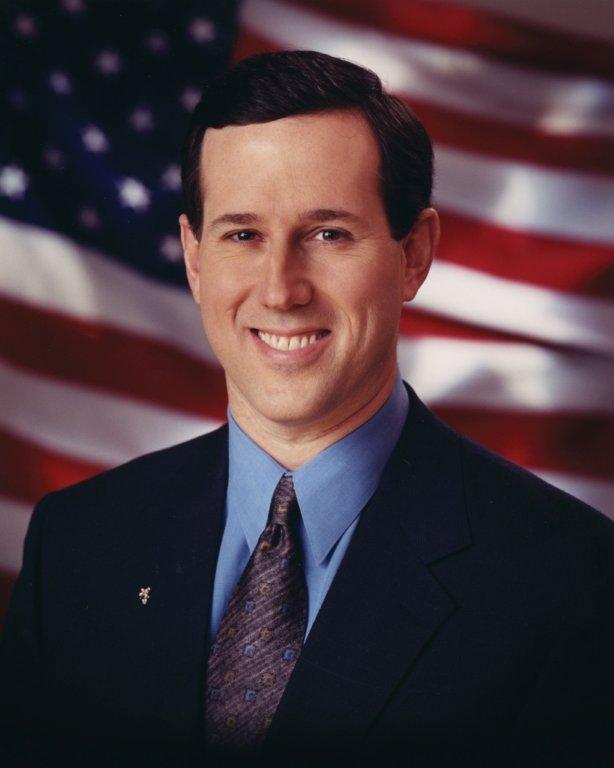
The fall harvest in Iowa is long over, but GOP presidential candidate Rick Santorum managed to winnow a few extra bushels—of votes. The caucus night celebrations and day-after headlines that trumpted Mitt Romney as the victor have been nullified by a certification count that awards Santorum the winner by a mere 34 votes. The history books will record Mitt Romney as the loser of the Iowa Caucuses and cast Ron Paul as the candidate who finally gained legitimacy. But, Santorum’s last minute surge will likely be studied by campaigns and political scientists for years to come.
GOP Presidential Candidate Rick Santorum
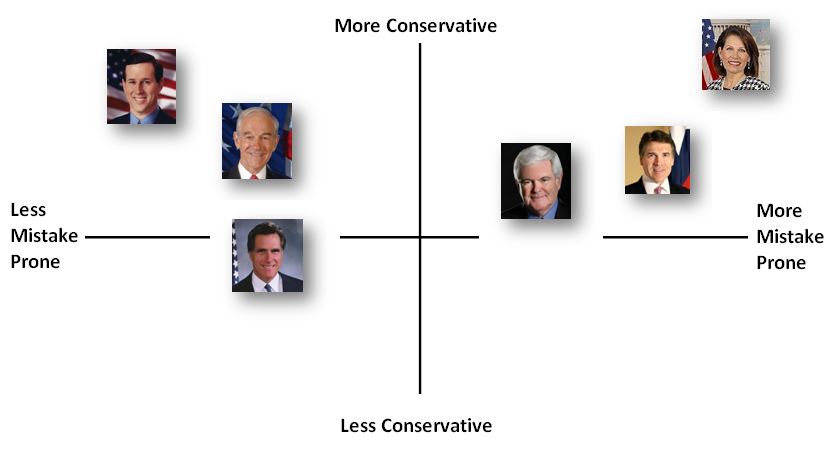
From a marketing communications point of view, Santorum’s first place finish is a lesson in the importance positioning strategy, tactics and luck. Santorum and his campaign successfully positioned himself as the social conservative who was consistently on message and disciplined enough to avoid mistakes. In the words of my grandfather, a lifelong dairy farmer, Santorum avoided stepping in too many “sugar daddies.” If you look at a perceptual strategy map of the major GOP candidates, Santorum carved out and maintained a unique position. (Figure 1) He occupied the space on the map necessary for a candidate to succeed among Iowa’s GOP activists: consistently conservative and gaffe free.
Figure 1 - GOP Perceptual Map of Iowa Caucus Candidates
It’s no accident that Romney, Santorum and Paul all finished in a near dead heat and everyone else as “also ran’s.” That’s where a little bit of luck played a significant factor. Michele Bachmann may have staked her claim as the most conservative candidate and an effective debater, but her perceived missteps on vaccines and other issues gravely affected her position on the perceptual map in the minds of voters. Texas Governor Rick Perry, and former House Speaker Newt Gingrich didn’t fare any better.
Santorum’s finish is also remarkable given the fact that he had little to no brand awareness in Iowa. His surge in the weeks leading up to the caucuses came as a result of what marketers call an effective execution of product news and product experience. In other words, his campaign staff and volunteers were able to effectively reach party activists with a message of how he was different and relevant. Furthermore, his personal appearances gave potential voters a chance to experience the candidate and size up his message against their own values.
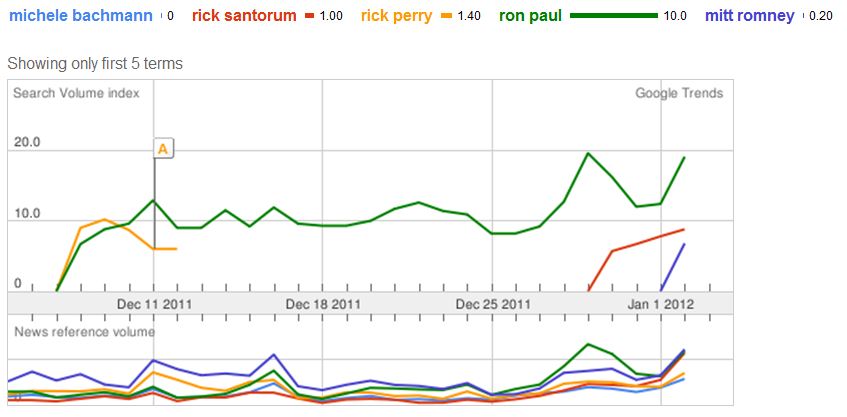
Figure 2 - Google Trends Data Leading up to Iowa Caucases
In my most recent post, I noted how Ron Paul was far and away leading the pack in buzz. This too is another essential marketing driver. The metrics in Iowa as measured by Google Trends showed Santorum gaining more web searches in the days leading up to the caucuses. (Figure 2) It’s an important metric because it shows that people are yearning to discover more about the candidate. In the end, Santorum was perhaps able to convert or activate more of that buzz into votes than was Paul.
The challenge now for Santorum and his campaign is trying to compete in two new markets. New Hampshire, South Carolina and Florida are a long ways from the corn fields of Iowa. Their voters have a different conservative value proposition will have their own perceptual map of where the candidates align. In New Hampshire, every indication is that Mitt Romney has strong brand awareness and emotional bonds with GOP activists. Those are powerful drivers for any challenger to overcome. But Santorum clearly now has a degree of buzz. What his campaign does with it and how it responds to the new scrutiny that will come could very well determine how long it takes for republicans to settle on a presidential nominee.
As we approach the Iowa Caucuses the GOP presidential candidates are making their closing arguments, but in many respects the party faithful are already voting—with their computers. The results present a fascinating web search tracking poll that could very well become a significant predictor of Tuesday’s winners and losers.
Back in August, the folks at Google digested the internet search trends of Iowans leading up to the GOP Straw Poll. Native daughter Michele Bachmann dominated the search results and became the somewhat surprise winner of the straw poll. (Figure 1)
Figure 1 - August Google GOP Candidate Searches in Iowa
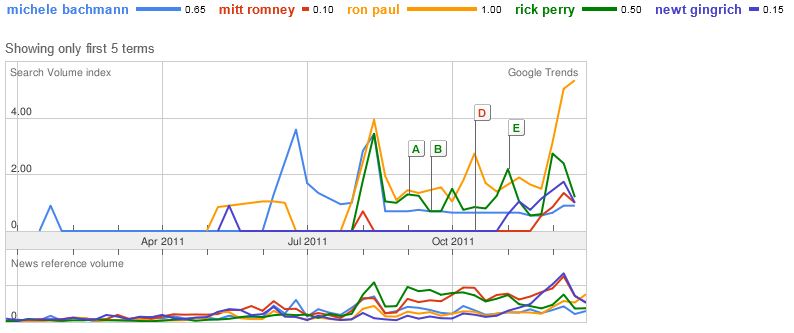
But the latest Google data from Iowa paints a different story. Texas Congressman Ron Paul far and away leads the trend results with Bachmann significantly trailing. (Figure 2)
Figure 2 - Current Google GOP Candidate Searches in Iowa
Paul is the only candidate who is trending up, everyone else is in a steep decline. In fact during the last 30 days in Iowa, Bachmann barely registers on Google Trends. Similar search data in August showed former Minnesota Governor Tim Pawlenty barely trending and in the end he failed miserably in the straw poll and promptly withdrew from the presidential race.
In my August 15th post, I noted how Bachmann was like a product brand and successfully used two key marketing drivers to her advantage, buzz and activation. She was able to garner much needed attention by positioning herself as the outspoken native Iowan who saluted to the Tea Party flag. Most critically, she was able to activate that buzz into votes at the straw poll. Bachmann was the Tobasco Sauce in a field of corn heading for the canning factory.
Five months later the trend results indicate Iowans feel burned and are searching for someone with less spice. Enter Ron Paul. He’s positioned himself as the Heinz 57 of the field—bold and authentic. He also has a consistent narrative.
GOP Presidential Candidate Ron Paul
Hamline University analyst David Schultz has repeatedly made a compelling case that narratives win elections. Paul’s Libertarian narrative of less government and more individual freedom may represent views that are outside of the mainstream, but nevertheless have been authentically consistent. Meanwhile, Bachmann’s narrative and brand have both been eroded by unfocused campaign appearances and staff defections. Iowans through their search results seem to indicate they no longer have an appetite for hot sauce, but they certainly aren’t big on ketchup either. (Gingrich, Romney, Perry, and Santorum)
Clearly, Paul has the buzz. What remains to be proven is if his brand is strong enough to activate that buzz into votes at Tuesday’s caucuses.
The Iowa Straw Poll is in the record books. Minnesota Representative Michele Bachmann pulled off a victory that three months ago seemed unimaginable. How she beat the likes of established pols such as Ron Paul, Tim Pawlenty, and Newt Gingrich & Company speaks as much to modern product marketing as it does to effective electioneering.
Make no mistake, Michele Bachmann is a product with her own unique brand. Bachmann differentiated herself among the GOP presidential candidates as the social conservative with “tude” and conviction. Bachmann called it “authenticity.” Whatever you call it, Iowa republicans bought it. Tim Pawlenty spent two years and millions of dollars in Iowa and in the end all his candidacy sold was canned corn. Bachmann sold Tobasco Sauce.
Google GOP Candidate Searches
Good brands and good marketers know there are several drivers to bring consumers to your product. In the end, Bachmann won the straw poll on Buzz and Activation. The number crunchers at Google have just released the data on which presidential candidates Iowans searched the web for leading up to the straw poll. Bachmann lead the pack. It wasn’t even close . That’s Buzz. But Bachmann was equally as effective in activating that buzz into votes. Pawlenty may have had a superior tactical ground organization, but lacked the strategy to create any kind of buzz for his candidacy and certainly could not activate enough supporters to vote.
Tragically for Pawlenty, he’s finally achieved some differentiation from the rest of the presidential candidates. He’s out.
Communication insights and analysis from a multiple Emmy and Edward R. Murrow Award winning journalist and former communications advisor. Master's degree in strategic communication from the University of Minnesota.













 Stand by...