Archive | Social Media Trends RSS feed for this section

When Holy Smokes Meet Holy Tweets

17 Mar


White smoke rising from the Sistine Chapel on March 13, 2013 signifying cardinals have elected a new pope.

White smoke rising from the Sistine Chapel on March 13, 2013 signifying cardinals have elected a new pope.

        In a world that communicates at the speed of light, the most important message in the universe wafted at the speed of smoke. 

         So much for the age of sophistication.

        But in that most ancient of means of communication, the smoke signals drifting from the roof of the Sistine Chapel collided with the ones and zeros that were beamed, typed, and shared around the world.   The strategic message immediately posted on the pontiff’s Twitter account @pontifex simply read, “HABEMUS PAPAM FRANCISCUM.”   The translation:  “We have a Pope Francis.” 

Figure 1

Figure 1

       In an instant, two memes went viral—the smoke and the Tweet.  

      Score one for the Vatican and its integrated cross-platform communications campaign.

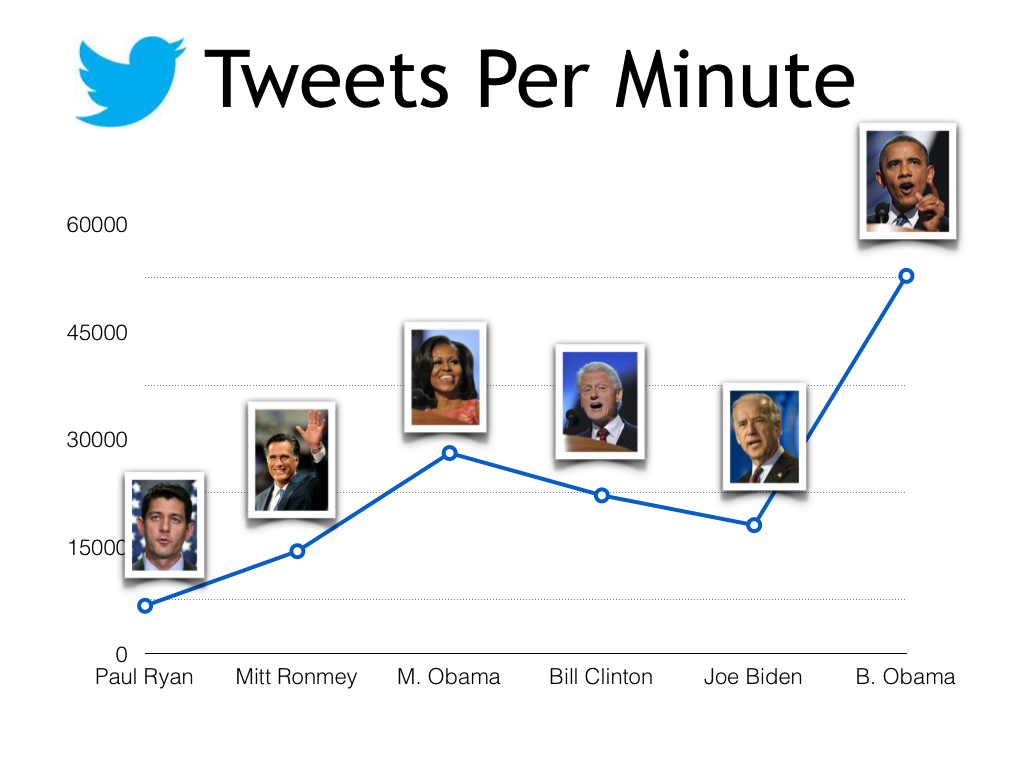
      We now know what followed wasn’t just religious history, but also a significant milestone in social media.  Twitter analytics tracked the number of tweets about the new pope running at a frenetic pace of 130,000 a minute.  It now ranks as one of the mot shared moments in the world, second only to this year’s Super Bowl at 150,000, and nearly doubles that of the Oscars at 70,000. (Figure 1)

Figure 2

Figure 2

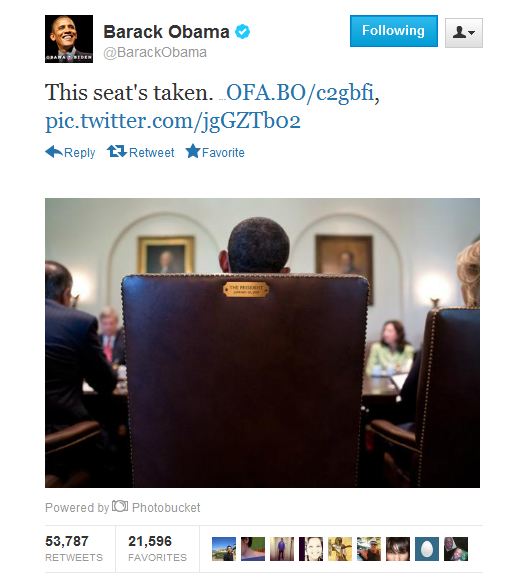
       As people watched and waited for Pope Francis to appear on the balcony overlooking St. Peter’s Square, they also retweeted  the message from @pontifex to the tune of more than 54,000 times.  That’s an impressive rate of sharing, although it stands in the shadows of President Obama’s election night tweet that was shared  by more than a half a million people. (Figure 2)

       Together they show how an institution steeped in tradition, deftly and strategically used two very divergent platforms to communicate to the world one of its most important messages of the new millennium.   

The Mobile Apps Revolution—How Brands and TV News Can Extend Engagement

11 Mar
TV news video app for iPad

TV news video app for iPad

     The spark that Guglielmo Marconi flung across the Atlantic in 1901 heralded a new world order.  From that moment forward, information transmission was forever divided between landlines and airwaves.  The past verses the future.  More than a century later the disruptive forces of technological innovation are still real—if Marconi could only see us now.

     The palm-sized computers we now hold in our hands have sparked an applications revolution that is every bit the information game-changer that Marconi ushered in with his wireless telegraph.  Just as radio led to television, computers led to the internet.  Now, mobile devices are leading to them both through applications—or apps. 

Figure 1 - ComScore U.S. Digital Future in Focus

Figure 1 – ComScore U.S. Digital Future in Focus

     The growth and usage of smartphone apps is prolific and real.  ComScore’s latest analysis of internet usages shows 37% of online minutes now come from mobile devices. (Figure 1)  Furthermore, four out of every five mobile minutes are spent on an app.

     Recent mobile research by Nielsen shows the average smartphone user now has 41 apps on their device. (Figure 2)  The dominant app by usage is Facebook followed by Google Maps. 

Figure 2 - Nielsen Smartphone Usage

Figure 2 – Nielsen Smartphone Usage

     Brands that that don’t embrace this new information revolution, including information providers such as news organizations, severely risk becoming marginalized in changing marketplace. 

     Sunil Gupta of the Harvard Business School has just laid out an impressive operational model for brands to build their own apps to extend their brand value on mobile platforms.   He does it by focusing on five categories:

    1. Add Convenience
    2. Offer Unique Value
    3. Provide Social Value
    4. Offer Incentives
    5. Entertain

     In Gupta’s model, he’s put the consumer first.  Far too many mobile news apps I’ve seen put the information consumer somewhere else.   Tap the icon and what comes up are stories that are 24 hours old, limited video, and information cluttered with pop-up ads.  Here’s what Gupta’s model might look like if we apply it in a customer-centric fashion.

1.       Add Convenience.  Here’s where most news apps fail with outdated information.  News junkies come to you for quick and current information, therefore stories and headlines need to be constantly updated.  Post short clips of video from the stories that are appearing, even if they are from a smartphone of a reporter in the field.  ComScore’s research indicates 60% of online searches for weather forecasts are all done on mobile devices, therefore those forecasts should also be constantly current.

 2.       Add Value.  Speaking of weather, one way to add value to a weather or news app is to create an alert system for approaching severe weather.  Another value-added strategy could partner with a local transportation agency to allow the app user to track commute times along a predetermined travel route.  Also, headlines broken down by zip code.

 3.       Provide Social Value.  Here’s where the app developers could build a feature to display the latest Tweets and Facebook postings from the organization.

4.       Offer Incentives.  The app could feature built-in coupons that tie in with a promotion or sponsor.  On-screen coupons to use at live events such as food discounts at ball games would be used as a strategy to build both app users and extend on-air sales.

 5.       Entertain.  This is where the app could offer clips of behind the scenes moments from entertainment programming such as American Idol or upcoming episodes of primetime news lead-ins.

     It’s a lot to think about in an era of shrinking staff resources and budgets.  But just as Marconi once upon a time proved to be a disruptive force in information technologies, mobile devices are proving they are just as disruptive.  The signals TV stations transmit from their towers are no longer the video and information dominant structures they once were.  As digital platforms grow and evolve, information content organizations need to develop multi-platform strategies or risk becoming yesterday’s news.

Going Mobile–Is TV News Missing the m-TV Revolution? [Infograph]

2 Feb

 MTV Flag               Like the flag in the old MTV promo, the way we use, watch, and access video and news is changing.  Welcome to the new m-TV—mobile television. 

                 Several new quantitative research studies suggest there is a revolution occurring before our eyes, one that consumers across two continents are literally holding in the palm of their hands.   Mobile technology and our ability to access information and share it from virtually any location may become either a disruptive force for broadcasters, or an incredible opportunity to extend content and brand value.      

Figure 1 - Pew Research Center

Figure 1 – Pew Research Center

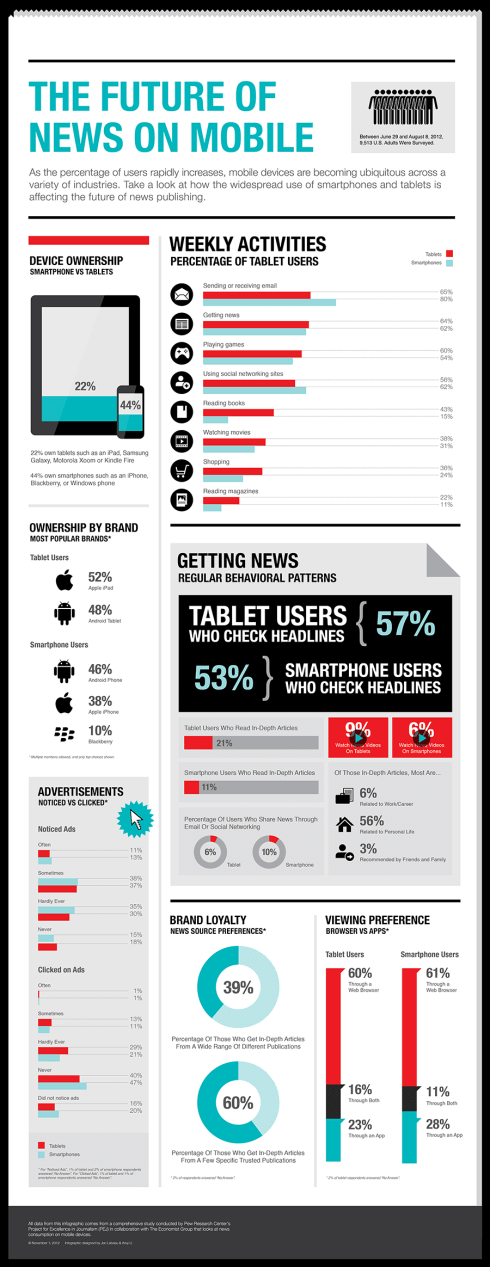
                Mobile devices are exploding in the U.S. marketplace.  Recent data from the Pew Research Center shows half of all U.S. adults now have a mobile connection to the internet through either a tablet or smartphone.  The results are based upon a scientific survey of 9,513 U.S. adults.  Accessing news is an important aspect what these users are consuming.  Fully 64-percent of tablet users and 62-perent of smartphone users say they use their devices to weekly to read and view news. (Figure 1)  In fact, Pew discovered that among tablet owners, news tied with email and games for the most popular activity.  On smartphones, news was second only to email.   

                For people who get news multiple times a day on their mobile devices, Pew also discovered they are more likely to turn to more sources, read more in-depth articles, and watch videos.

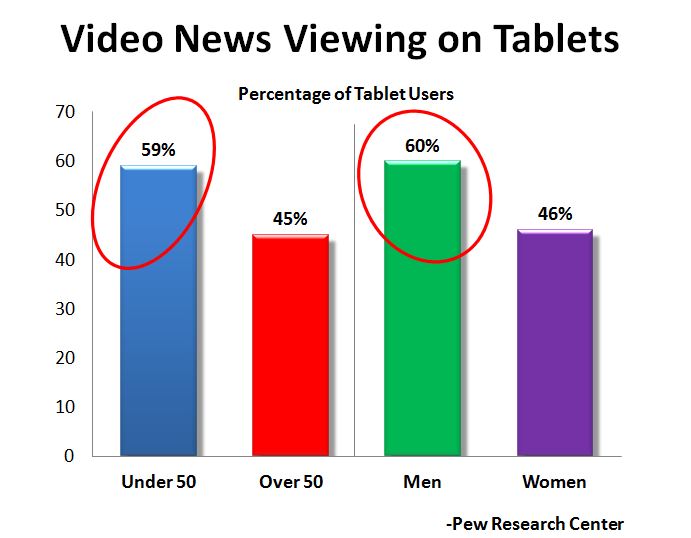
                This mobile video news consuming cohort represents virtually the same demographics most coveted by advertisers and television news organizations.  They tend to be young and slightly dominated by men—a many times illusive audience. (Figure 2) 
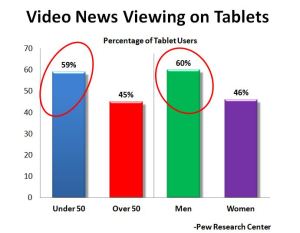
Figure 2

Figure 2

                This is by far not an American phenomenon.  In fact, the U.S. may be laggards compared to Europe.  Oscar Westlund’s research in the European communications journal Palabra Calve shows how mobile adoption and news consumption is far ahead of the U.S.  Sweden now has the greatest mobile penetration in the world with 101 mobile devices for every 100 people.  Westlund’s research of nearly 3,600 people reveals the early-adopters of these platforms tend to be men between the age of 15-49, and like their American cohort they are also power consumers of mobile news.  Fully 52-percent of these early-adopters use their devices for news.

                The trend is similar in Spain where the next generation of power consumers has already migrated to video news consumption.  Patricia Gonzalez Aldea’s research recently appearing in the International Journal of Iberian Studies revealed that young people haven’t stopped watching TV, they’ve only changed platforms in which they watch.

                Among the youngest group of 14-17 year olds Aldea discovered an important trend.  “They clearly prefer audio-visual media to keep them up to date with news and current affairs,” Aldea concluded.

                The findings in Spain show that the younger generation is demanding that TV content, even news, should be adapted to new platforms. 

TV news video app for iPad

TV news video app for iPad

                This all leads back to whether news organizations are leading the trend or following behind at their own peril.  Every credible newspaper and television news organization long ago established a presence on the web.  Many have also jumped into the world of mobile news apps.  Far fewer have stretched into the offerings of mobile video, and those which have tend to treat it as a necessary evil and not as a growth opportunity.                 

               The mobile trends and changing consumption habits demand that news organizations respond.  Television operations have an inherent advantage in m-TV given their video gathering and packaging expertise and infrastructure.  But they have to treat m-TV as a product launch, complete with a strategic business plan.

                Here’s a start:

  • Identify OPPORTUNITIES based on research:
    • Size of the organization’s digital consumption universe; Size of mobile market; Penetration and strength of 4G digital infrastructure among mobile providers; Number of current video downloads; Potential viewer reach; SWOT of m-TV expansion.
  • Goals:
    • Extend brand value through more mobile video content and views; Create a broader advertising base for increased revenue possibilities.
  • Objectives: Measurable benchmarks
    •  50% more mobile video content in 3 months; 55% more mobile app installations in 3 months; 65% more downloads in 6 months; 80% increase in six months of audience awareness of more mobile content.
  • Strategies:
    • Promote video content on web and apps; Create exclusive mobile content.
  • Tactics:
    • On-air promotion of mobile apps and web video; Drive video postings through Facebook & Twitter; Produce additional content and repurpose existing content for mobile platforms; Reporters post cell phone videos to social media to drive buzz for newscasts; More timely postings of video content.
  • Measurement:
    • Assess whether objectives were met.
  • Contingencies:
    • What if no buy-in from employees?  What if mobile engagement doesn’t increase?  What if brand awareness doesn’t grow?  What if ad click-through rates or ad views don’t increase?

                Traditional over-the-air television and news are not going away anytime soon, but their traditional market is clearly eroding.   Both Pew and the quantitative research conducted in Europe of mobile device usage makes it clear that audiences are rapidly changing the ways and platforms in which they access traditional content.  How content providers, especially news organizations respond may very well determine who survives and who profits.

                As Oscar Westlund concludes, “Mobiles are the future.  It’s not a question of whether it will be so, but when.”
Pew Research Center Infograph

Pew Research Center Infograph

How Social Media is Driving Political Engagement — What TV News Can Learn

22 Oct


Illustration courtesy of Social Media Daily

           The social media forces that have changed and influenced television viewing habits, are now changing political engagement too.  Political communication that was once dominated by television commercials and yard signs has gone digital—and personal. 

            New research from Pew Internet reveals a significant number of Americans using social media—66%–are using social networking sites (SNS) to both follow politics and candidates and share their own political views.  

            Here are some of the top lines:

  • 38% of those who use SNS & Twitter use social media to “Like” or promote material related to politics or social issues.
  • 34% of social media users have used tools to post their own thoughts or comments on political or social issues.
  • 33% have reposted political or social issues content that originally posted by someone else.
  • 31% have encouraged others to take action on a political or social issue.

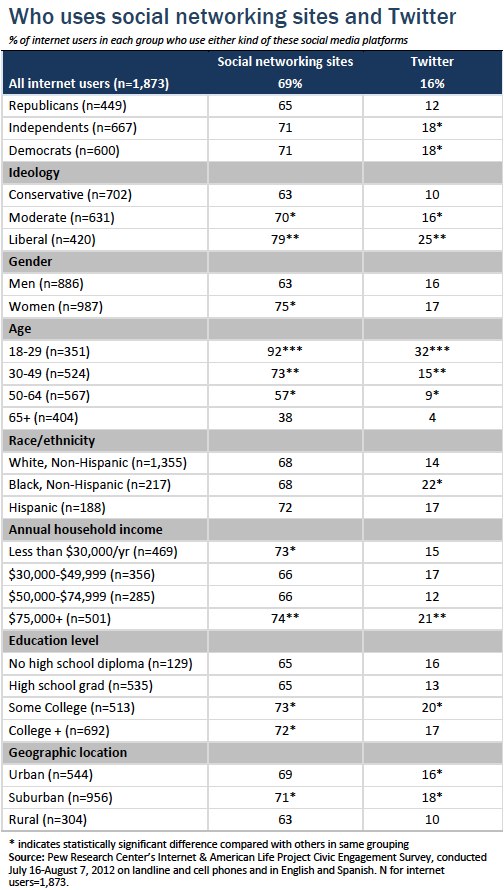
             The Pew research also indicates that the power users skew heavily young and somewhat liberal. (Figure 1)  That finding would support the explosive social media usage among viewers of the 2012 Democratic National Convention. 

Figure 1 – Pew Internet

             For television programmers, especially TV newsrooms, this latest set of data points is a gift for building strategies to engage younger viewers in way that is native and natural to them.  As television entertainment producers have built social media engagement into live viewing of comedies, drama, and reality episodes, TV news operations have the same opportunity especially when it comes to live political events such as debates, forums, and rallies.

             Some of the tactical engagement methods should include:

  • Create branded discussion forums by hashtagging events for people to follow.  Example: #Fox9debates.
  • Use the hashtagged comments to drive on-air discussion and talk back with guests and experts.
  • Establish website chat rooms during major events that are moderated by newsroom talent. 
  • On-air talent should direct viewers to specific content on the web or Facebook and encourage them to share it.

             The reality of today’s connected world is that viewers are constantly screen-splitting, meaning they’re watching TV and interacting with a mobile device at the same time.  By encouraging viewers to engage with your brand on another channel only builds the brand and helps them achieve the information and entertainment gratifications that they are seeking.  Television programmers who don’t do this risk losing their viewers to someone else who will.

             Here’s a few more important facts on the Pew Internet study. (Figure 2)  The Pew research team lead by Lee Raine interviewed 2253 adults between July 16 and August 2, 2012.   They found that 60% of American adults use either SNS or Twitter.  Of the American adults who are online, 69% use SNS such as Facebook, LinkedIn and Google+, and 16% use Twitter. 

Figure 2 – Pew Internet Survey Democraphics


Coca-Cola & Facebook. How Coke Writes the Book on Sharing—Again.

5 Sep

Facebook post by Coca-Cola

Coca-Cola didn’t become the world’s most recognized brand by keeping the cap on the bottle.

The not-so-secret success to Coke has always been its laser beam focus creating happiness that tastes better when it’s shared.

It should therefore come as no surprise that Coca-Cola has popped the cap on another major branding success—50 Million Facebook “Likes.”   In the process, Coca-Cola offers a blueprint in how to engage brand evangelists in social media space.

Facebook post by Coca-Cola

In every respect, Facebook is the perfect match for Coca-Cola.   Coke is a brand whose core identity is about sharing and it has masterfully positioned the brand on a social platform built for sharing.  But the key to Coke’s success on Facebook is how it engages its followers—always with a question or an invitation for people to share their own ideas.

To celebrate its 50 millionth “Like” Coca-Cola has created a special Facebook app inviting followers to share their thoughts on how to improve the world.   Coke promises to select one idea early next year and contribute to the cause.

The lesson for other brands on Facebook is that the platform is not a place for corporate news or industrial relations.  It’s a space where organizations can showcase their core values and let followers engage in what it means to them.

Now… where’s my bottle cap opener? 

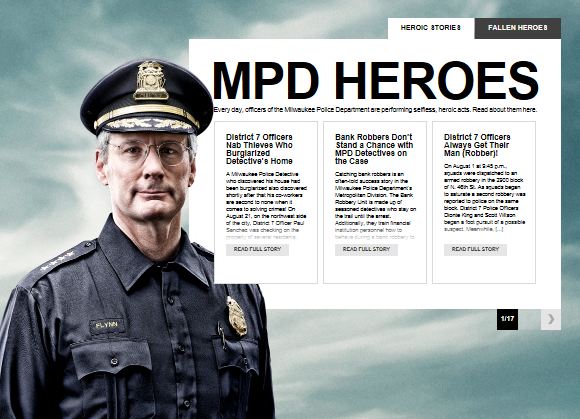
Badge of Honor—The Police Website That Will ARREST YOUR MIND.

26 Aug

The Milwaukee Police Department’s new website milwaukeepolicenews.com

That rumble just heard in the Midwest was Milwaukee’s former Police Chief Harold Brier turning in his grave.

The tough-as-nails chief ruled Cream City’s industrial streets for 20 years with shoe leather and shear force.  But now one of his successors has added a decidedly different weapon to his belt, one that is more strategic, social, and dare I say it—entertaining.

The result just may send that rumble through cyberspace as well.

Milwaukee’s Most Wanted on milwaukeepolicenews.com

The new website just rolled out by Milwaukee Police redefines government communication.  The sleek design, easy navigation and bold 3D visual imagry effectively brands the department as crime fighters and invites the public to get involved through smart interactive content.

Scroll down the screen and the site takes the user seamlessly through calendar-based crime reports, statistics, Milwaukee’s Most Wanted, and sharable profiles of everyday heroes.

The heroes page on milwaukeepolicenews.com

According to AdAge, the website was the brain child of current Chief Edward Flynn who enlisted ad agency Cramer-Krasselt to help them create a website that people would want to visit.  The goal is to enlist citizens to “Be a Force” in their own neighborhoods by empowering them with easily accessible information about what’s happening along their own block.

The old chief in an older time would never have conceived of such a strategic communication weapon as this.  It begs every organization—government or not—to assess how many old chiefs it has stuck in the past.

Hail to the new chief.

Social Media ROI — Turning “Likes” Into Cash For Somalia

10 Aug

“Though it’s only half a month away, the media’s gone.                           An entertaining scandal broke today, but I can’t move on.”                           – Helicopters, by Barenaked Ladies

Somali refugees recieving a sack of rice distributed by the American Refugee Committee in Mogadishu. (Courtesy ARC)

Like a flash in the night, they opened eyes.  The television lenses that zoomed in on Somalia a year ago focused the world’s attention on a devastating famine that killed 30,000 children in the span of just three months.  And then, with the click of a Klieg light they were gone.  Just another story, another crisis that turns on and off in a world preoccupied with the latest live trend on Twitter.

The reality for hundreds of thousands of refugees in Somalia is that survival is not a pop culture status update.  At the end of each day, the only status that matters is if they’re still alive.  But it led the Minneapolis-based American Refugee Committee to pose dire question—could it harness the power of social media to actually feed people?  Their answer has them converting “Likes” into food.

In the late summer of 2011, ARC in collaboration with the California design firm IDEO launched the I Am a Star for Somalia campaign.  The goal was to use social media to encourage people around the world to do small things to help ARC fight the famine.  By encouraging people to become part of the “Star” community, they were essentially asking them to take an inward view of the crisis rather than just watch it on TV.  This summer, ARC has advanced the campaign with the effort serving as a blue print for non-profits seeking to earn a return on investment in their social media ventures.

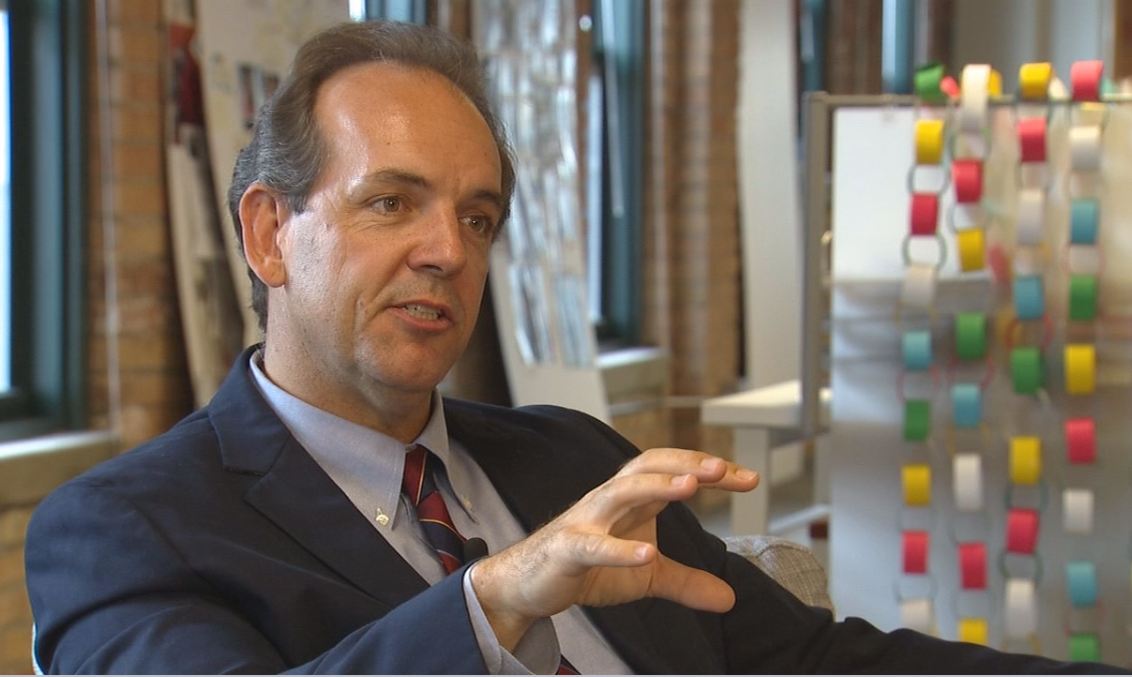
Paper chain hanging in the ARC headquarters in Minneapolis.

ARC secured a $50,000 pledge from Hormuud Telecommunications, Mogadishu’s largest phone provider, to support food distribution in ARC’s refugee camps.  But rather than simply accept a check, ARC designed a campaign to engage followers and build a broader community and awareness to the Somali crisis.  They tied the pledge directly into their “I Am a Star” efforts with the goal of gathering 50,000 Facebook engagements—each one generating a dollar from Hormuud’s pledge.

But ARC took it one step further.  For every engagement, volunteers build a link in a paper chain that is now spreads throughout the ARC headquarters.  Pictures and status updates are added on the progress of the chain which in turns builds more support from followers.

“To us I think they represent the links between people around the world who are showing solidarity for Somalia,” said ARC’s Daniel Wordsworth.

American Refugee Committee President Daniel Wordsworth.

“And I think it’s also a physical way that people can demonstrate their commitment but also a way for the people in Somalia to see people in Malaysia, Yemen, London and Sweden coming together in helping Somalia get through this.”

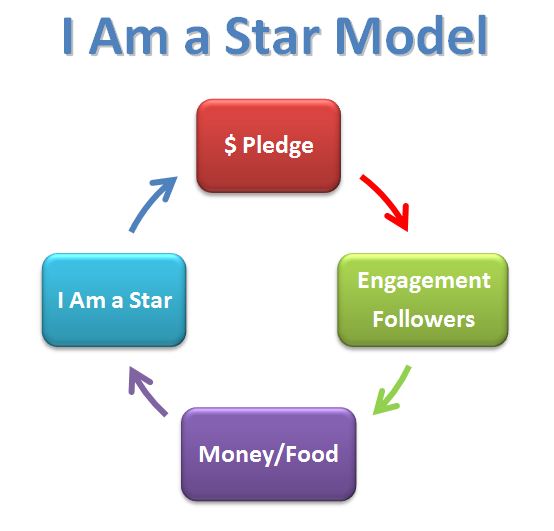
For non-profits and businesses alike, ARC has adopted an effective model that uses social media for community building and fundraising.  It begins with an issue and then a highly strategic and goal-oriented response with built in performance measures.  In this case, ARC began with the famine crisis, formed its “Star” campaign, secured a pledge and then used the pledge to build a community, awareness and money.   But equally important in the campaign is ARC’s target of a goal and a deadline—50,000 engagements by August 11.  The goal gives the campaign a mechanism by which ARC and its followers can measure progress, and the deadline gives it urgency for people to act.

Figure 1

But most important, ARC has now built a sustainable community for Somalia.  By generating upwards of 30,000 additional followers to its “Star” campaign, it can now use that community as leverage to gain more pledges, more engagement, and distribute more food.  (Figure 1)  It becomes a circular model for future campaigns and famine relief—and all of it as the TV lights shift to the latest Twitter trend.

“I think we all know that famines come and people see it on the news and then a year later it’s hard to remember it all,” said Wordsworth.  “So I think that what we’re trying to do is keep Somalia in the forefront of people’s minds.”

Feisty the Seal: Anatomy of a Duluth Flood Meme

22 Jun

Meme \`meem\ n:  an idea, behavior, style, or usage that spreads from person to person within a culture 

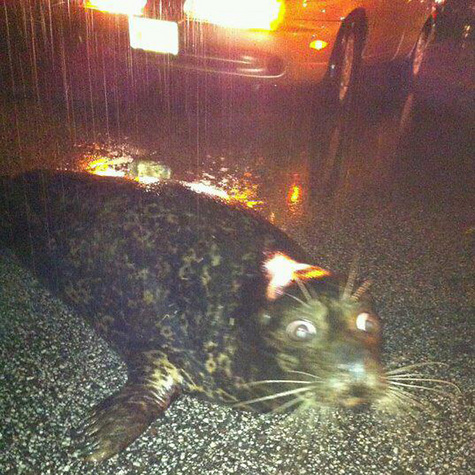
Figure 1 – Feisty the harbor seal captured on June 20th on Grand Avenue in Duluth by Elli Buchar.

The lens by which the world viewed the Duluth flooding disaster this week was actually viewed through a sympathetic set of eyes.  Never mind that they belonged to a nearly blind harbor seal named Feisty.

When 10 inches of rain fell on the bluffs that anchor the city of Duluth, Minnesota the runoff cascaded down its hills with the force of a dozen rivers at spring break-up.  The rushing water in the middle of the night on June 20th swallowed cars, roads, homes and even the Lake Superior Zoo.  The raging floods drown eleven animals and flooded out the pen holding two aging and sight impaired seals named Feisty and Vivien.  At the height of the disaster in the middle of the night, no one knew the plight of the zoo animals until Ellie Buchar saw something unusual along Grand Avenue—Feisty.  She snapped a picture, shared it online, and within a matter of hours this nearly blind seal became the vision by which the rest of the world viewed the disaster. (Figure 1)

Just how powerful was this meme?  I was standing along Olney Street interviewing Gene Swanson who was in danger of losing his house to the raging King’s Creek when my phone rang.  It was one of my news producers at her computer monitor from 170 miles away wanting to know why I wasn’t at the zoo?   Never mind the people desperately trying to save their homes and lives.   “What about the animals?” demanded the producer.  (I could give a dozen journalistic counter arguments–but that’s another post at another time.)

Feisty’s story is a case study in contagion and memes in this new age of social media.   It provides a unique pathway for understanding why they become so powerful.

In this case, social psychologist Jaap van Ginneken would argue that Feisty served as what he calls a strong replicator.  Such replicators evoke an emotion that cause people to take notice and share.  Image plays an essential role—the strongest replicators have child-like images with large eyes.  Finally, the replicator must be positioned in an unexpected way—a surprise.

Feisty’s image on Grand Avenue fit perfectly into the model:

  • Strong Replicator: stressed animal
  • Child-like face: helplessness
  • Surprise: found in middle of street 

    Figure 2

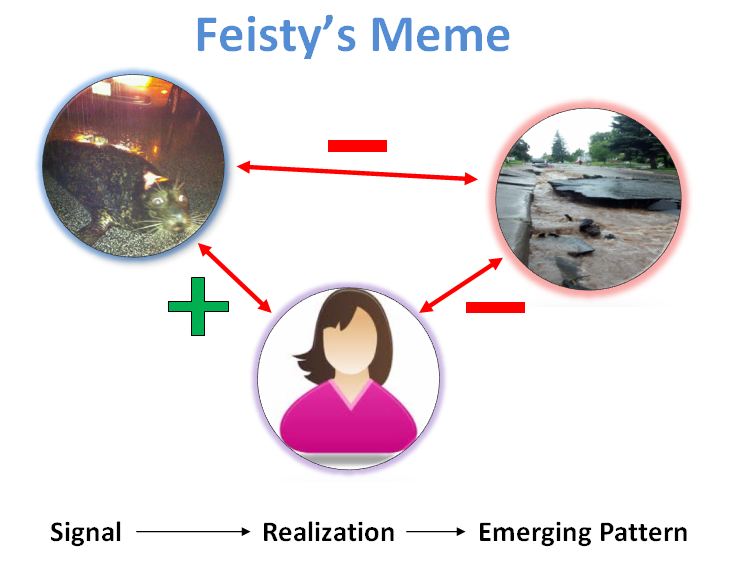
The image served as a critical signal to viewers, especially women that something was happening.  This signal is the beginning of a cognitive cycle where the viewer forms a positive association with Feisty and in context forms a negative association with the floods.  (Figure 2)  When the viewer hits the “send” button on their computer and others share, a meme is born.

That’s essentially what happened on July 20thand why a helpless animal has become the face of such a human disaster.

Figure 3 – Feisty in her new temporary home at the Como Park Zoo in St. Paul, MN

It should come as no surprise that Feisty’s viral picture is exactly why she and her half-sister are now safe and recovering at the Como Park Zoo in St. Paul.  When Como’s zookeepers saw her viral picture they immediately called the Lake Superior Zoo offering help.  Several hours later both seals and a polar bear were traveling to their new temporary home.  (Figure 3)

Como’s Sr. Zookeeper Alli Jungheim says they’re all feeding and adjusting well to their new home.  “We’ll take care of them like they are our own,” said Jungheim.

For now the seals are safe.  But, there’s so much more work to ensure the rest of Duluth is safe, too.