
Archive | Social Media Trends RSS feed for this section

Changing Plays: The Vikings New Stadium Strategy

8 Nov

                The game is called football.  But what the Minnesota legislature is playing is closer to hardball.  With no stadium bill gaining traction for the Minnesota Vikings, no agreement on a public funding mechanism, and with the clock ticking on the Metrodome lease, the Vikings are about as suspended as a slow motion replay of Gary Anderson’s field goal kick in the ’99 NFC Championship game.   This time they need a better outcome. 

                After 11 months of failing to gain a first down in the legislature, the Vikings are calling an audible.  Instead of running straight at their opponents, they’re taking a page out of the Packer’s playbook and leaping into the stands.  For the first time in their quest for a new stadium, they’re making their appeal directly to Viking’s fans.   The new strategy has just been unveiled in a two-minute web video. 

                The video is not only slick and likeable, but a very strategic communication move on the part of the Vikings.  The strategy jumps from the screen in a very logical and smart manner.  Their main strategic objective is to use both nostalgia and jobs as the touch points for talking directly to Minnesotans. 
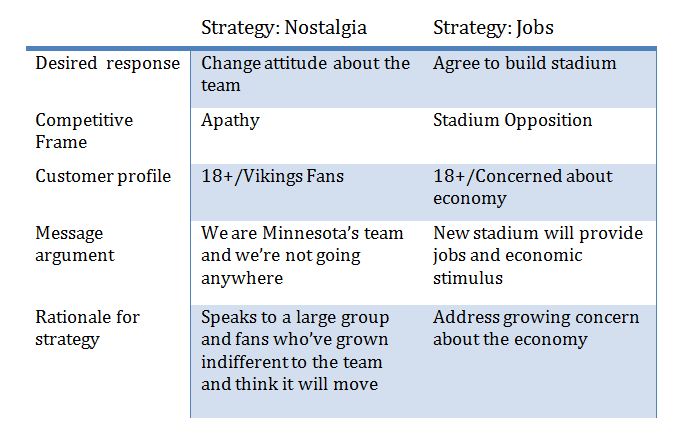
Figure 1 - Vikings Video Strategy

               The chart at the right diagrams exactly how the video achieves this. (See Figure1) The Vikings competition at the moment is apathy among fans and people who oppose building a new stadium.  What the Vikings clearly need to accomplish is to change attitudes about the team’s commitment to Minnesota in addition to convincing the public that a new stadium will be good for the economy.  The video cleverly uses old highlight reels to make an emotional appeal and then collides it against the rational appeal of job creation.   The result is a communication message that is enjoyable and smart.

                So too is the channel.  A two-minute video is too long and too expensive for a TV advertising flight, but as a web video it targets the very audience the Vikings most need—their own fans. 

Figure 2 - Duncan Watts, Journal of Consumer Research, Dec. 2007

               In today’s world of social media, the genius of such a release invites Vikings fans and loyalists to become stadium evangelists and spread the message themselves.  Rather than a direct one-way message from a traditional ad campaign, marketing researcher Duncan Watts observes that it flows dynamically among many sources and doesn’t have to originate from thought leaders or authority figures. (Figure 2)  In this model the most important influencers are friends. 

                According to Vikings Vice President of Public Affairs Lester Bagley, that’s exactly the rationale behind the new strategy.   “This video signals the launch of a broader communications campaign where we want to take the case for a new stadium more directly to the public,” said Bagley.  “The goal is to deliver accurate information, dispel misinformation and arm and mobilize our supporters.”

                The Vikings are clearly running out of time.  It’s late in the fourth quarter, the team is now hoping their fans can not only catch the ball, but lateral it to others to run into the end zone.

Answers From Facebook About Cyber-Bullying

24 Oct

             Cyber-bullying may be one the hottest topics facing teenagers and even their parents.  Recent studies from Pew Research indicate as many at 1 in 3 teenagers who spend time online have already experienced some form of online harassment.  The report found that 32% of all online teens have been the targets of persistent online bullying such as threatening messages, unauthorized postings of pictures and the spread of rumors through online connection.

            With such research as the backdrop, Minnesota Senator Amy Klobuchar sponsored a forum at Augsburg College in Minneapolis to address questions about cyber-bullying and help her form some direction in possible legislation.

            Among the panelists were Lynn Miland, a parent whose 15 year old daughter was bullied by fellow students.  Also present was U of M professor Shayla Thiel-Stern who has studied cyber-bullying, and Nicky Jackson-Coloco, a public policy manager with Facebook.

            It is exceptionally rare to have one-on-one access to a Facebook representative.   Mrs. Jackson-Coloco’s advise to parents of teenagers I believe is so important that I’ve put together a series of questions and answers from my interview that couldn’t meet the time restrictions of television news.

Nicky Jackson-Coloco, Facebook Public Policy Manager

Q:  What should parents be talking to their Kids about in using Facebook?

A: “I think a lot of the messages we give our kids about how they operate in the offline world applies to the online world.  Things like don’t talk to strangers, and on Facebook you shouldn’t be afraid to not accept friend requests from people you don’t know.”

Q:  How do you report bullying on Facebook?

 A:   “A lot of times we tell our kids if there’s a problem report it to an adult, tell somebody.  And on Facebook that means use our reporting infrastructure.  We have report buttons all over the site and when a report is filed it’s confidential and Facebook looks at it and takes immediate action or as quickly as possible.”

 Q:  Tell your kids they don’t have to friend everyone on Facebook.

 A:   “I really believe that in the same way you wouldn’t ask a stranger to come into your house, or your child shouldn’t get into a car with somebody he or she didn’t know, you shouldn’t accept friend requests from people you don’t now on Facebook.  You know I think there are times when you accept requests from friends of friends or maybe you talk to someone because they are going to a university that you want to go to and you want to connect with them, that’s one thing.  But people that you don’t know you should never accept a friend request.” 

 Q:  How should parents talk to their kids about passwords?

 A:  “You should never share your password with anyone on Facebook or otherwise with anybody.  Even if it’s your best friend because that gives people access to your account and your information and access to present yourself in ways that you wouldn’t want.”

Q:  What’s appropriate age for child to have a Facebook page?

A:  “Any teenager has to 13 years old to use the site and I think a lot of parents don’t know of that rule that you have to be 13.  But I think there’s no specific age.  I think it depends upon the parent and the family, and some families have media policies where here’s how much television you can watch, here’s how much time you can spend online and here’s how we feel about you using social networks. And for some people that may be 13 and for some people that may be 15, and for some people that could be even later.  But I think the key is to have conversations about social media with your kids even before they get on Facebook.  And its not just about  Facebook, it’s about whenever you’re on line how do you want to portray yourself.

     The information that you post online about yourself and the way that you portray yourself can be seen by lots of different people and sometimes in ways that you don’t realize.  So, it’s how you conduct yourself online and that’s a conversation that you can have far earlier than 13.  But I really think the appropriate age for teens to be on Facebook is when the teen and the parent decide it’s the right time.”

Q:  As a parent, should you friend your teenage children on Facebook?

A:  “I think there are probably relationships where there are no trust issues and people feel comfortable not being friends on Facebook.  But I certainly think it’s reasonable to say, ‘Hey, in the same way that I want to know the friends that are coming over to our house and who you’re going out with on a Friday night, I’d really like to understand who you’re in touch with online.  It’s not that I don’t trust you, it’s because I love you and I’m concerned about your safety.  And say, ‘Listen when you turn 18 I don’t need to be your friend anymore.’”

Q:  If you’re being bullied on Facebook, how do you report it?

A:  “So on Facebook there are report buttons on almost every page of the site.  So if somebody is doing something that is in appropriate or violates our policy they click a report button and there’s a little flow that tells them how the report can be filed.  It’s very, very simple, it takes just a few seconds, and it’s really important that teens know that reports are confidential.  We take a look at those reports and we take the most egregious ones and look at those first. And then we triage and look at the other things we need to look at.”

Q:  How can you block someone from bullying you on Facebook?

A:  “So, if a teen is being bullied on Facebook, we have a feature.  They can hit the block button and it will cut off all communication with that person and you wont be able to contact them at all on Facebook.  And I actually think this is a great feature because in the real world, there’s sort of no stop feature, where it prevents that person from having any contact with you, and we do have that on Facebook.”