
Archive | Topical News RSS feed for this section

Nixon and Vietnam, A Veterans Day Legacy

15 Nov

(UPDATE – 9-29-12: our documentary segment on Geoff Steiner has just won the 2012 Emmy Award for best single military story)

*          *          *


The past collided with the present this week and the crash reminds us of the tragedy that was Vietnam.

On the eve of Veterans Day, the Nixon Presidential Library released a recording of the former president dictating his account of talking to Vietnam War protestors at the Lincoln Memorial in the pre-dawn hours of May 9, 1970.  The president had a sleepless night after giving a nationally televised news conference a few hours earlier on the progress of the war.   By Nixon’s own account he went to the Lincoln sitting room in the White House to listen to some Rachmaninoff when he was approached by his personal attendant Manuel Sanchez.  Sanchez was a recently naturalized Cuban refugee and new to Washington and the White House.  Feeling melancholy, Nixon asked him if he had ever seen the Lincoln Memorial at night.  Sanchez admitted he hadn’t, so Nixon gathered a small group of secret service agents and off they went—into history.

What Nixon didn’t anticipate was running into a group of wide-eyed college students who had driven all night from upstate New York to protest against the war.  Just five days earlier National Guard troops opened fire on a similar group of protestors at Kent State University and killed four students.   In his Dictabelt recording Nixon admits he awkwardly tried to make small talk, but it quickly turned to the war:

“As I tried to explain in my press conference that my goal in Vietnam was the same as theirs, to stop the killing and the war, to bring peace… I know most of you, that probably most of you think I’m an S.O.B., but I want you to know that I understand just how you feel.”  – Richard Nixon, 1970


On the very morning Nixon was trying to justify the war, a 19 year old Marine from Minnesota was performing his duty to carry it out.  Geoff Steiner landed in Vietnam prior to the Tet Offensive in 1968.  Sixteen thousand U.S. soldiers lost their lives that year.   By 1970, he was a battle scarred survivor of a war with seemingly no end.   Coming home was hardly any easier.   Like many Vietnam veterans Steiner suffered from post traumatic stress disorder.   The scars ran too long and the pain too deep.   Finally, one day he put a gun to his head, but instead of finding a bullet, he found God.

Vietnam Veteran Geoff Steiner with producers Rod Rassman and Mark Anderson

Today, Steiner is a Chaplain who quietly passes the time on 40 acres of land near Cushing, Minnesota.   He is a loner who is hardly alone.  Several times a week Steiner walks through the early morning mist with a shovel, a seedling, and a prayer.   He plants trees in honor of the men who never came home and those who did come home but never found their inner peace.

“When I bought this land, there wasn’t a tree in sight,” said Steiner.   “Now, I have thousands of them.”

This is exactly where Nixon and Steiner collide.  Nixon wanted to end the Vietnam War through “peace with honor.”  Steiner simply wants honor with peace.   He lives it every day.

And that’s exactly why we met on Veterans Day among the living memorial now growing on his rolling Minnesota land.  I teamed up with producers Mark Anderson and Rod Rassman to profile Steiner for part of an upcoming film on veterans called “11-11-11.”  The film will portray a day-in-the-life of veterans on the very day that we honor their service.   We think Steiner not only has a great story to tell, but is an American worth knowing.

That’s why it’s so ironic that on Veterans Day this year we heard two voices on Vietnam, one from the present and one from the past.  The oxides on Nixon’s tape recording have faded with time, the scratchy audio a reminder of a reel that only plays in the echo chamber of history.   Geoff Steiner needs no recording; the legacy of Vietnam is on permanent replay in his mind.  He has his trees, but they will never completely hide the horrors of war.

*               *               *
 

Changing Plays: The Vikings New Stadium Strategy

8 Nov

                The game is called football.  But what the Minnesota legislature is playing is closer to hardball.  With no stadium bill gaining traction for the Minnesota Vikings, no agreement on a public funding mechanism, and with the clock ticking on the Metrodome lease, the Vikings are about as suspended as a slow motion replay of Gary Anderson’s field goal kick in the ’99 NFC Championship game.   This time they need a better outcome. 

                After 11 months of failing to gain a first down in the legislature, the Vikings are calling an audible.  Instead of running straight at their opponents, they’re taking a page out of the Packer’s playbook and leaping into the stands.  For the first time in their quest for a new stadium, they’re making their appeal directly to Viking’s fans.   The new strategy has just been unveiled in a two-minute web video. 

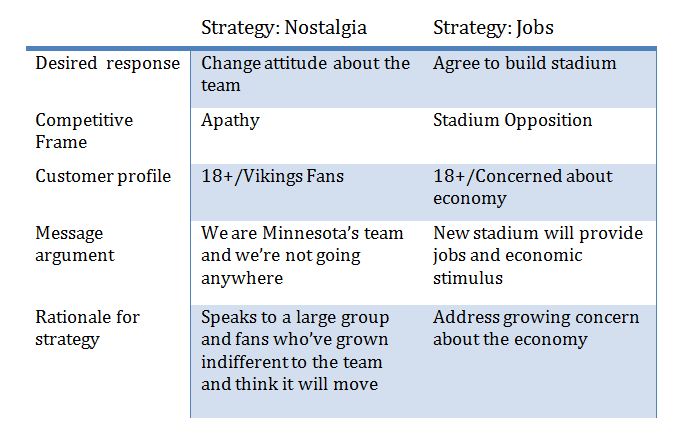
                The video is not only slick and likeable, but a very strategic communication move on the part of the Vikings.  The strategy jumps from the screen in a very logical and smart manner.  Their main strategic objective is to use both nostalgia and jobs as the touch points for talking directly to Minnesotans. 

Figure 1 - Vikings Video Strategy

               The chart at the right diagrams exactly how the video achieves this. (See Figure1) The Vikings competition at the moment is apathy among fans and people who oppose building a new stadium.  What the Vikings clearly need to accomplish is to change attitudes about the team’s commitment to Minnesota in addition to convincing the public that a new stadium will be good for the economy.  The video cleverly uses old highlight reels to make an emotional appeal and then collides it against the rational appeal of job creation.   The result is a communication message that is enjoyable and smart.

                So too is the channel.  A two-minute video is too long and too expensive for a TV advertising flight, but as a web video it targets the very audience the Vikings most need—their own fans. 

Figure 2 - Duncan Watts, Journal of Consumer Research, Dec. 2007

               In today’s world of social media, the genius of such a release invites Vikings fans and loyalists to become stadium evangelists and spread the message themselves.  Rather than a direct one-way message from a traditional ad campaign, marketing researcher Duncan Watts observes that it flows dynamically among many sources and doesn’t have to originate from thought leaders or authority figures. (Figure 2)  In this model the most important influencers are friends. 

                According to Vikings Vice President of Public Affairs Lester Bagley, that’s exactly the rationale behind the new strategy.   “This video signals the launch of a broader communications campaign where we want to take the case for a new stadium more directly to the public,” said Bagley.  “The goal is to deliver accurate information, dispel misinformation and arm and mobilize our supporters.”

                The Vikings are clearly running out of time.  It’s late in the fourth quarter, the team is now hoping their fans can not only catch the ball, but lateral it to others to run into the end zone.

PR Failure: When Good Brands Like Applebee’s Refuse To Join The Conversation About Bad News

1 Oct

            Mistakes come in all packages.  This one comes on a 5 x 11” piece of paper.

            The slick color direct mailer went out to 10,000 customers with a nice $5 coupon.  The mailer trumpets a newly remodeled Applebee’s in Maple Grove, MN.  Any marketing executive would tell you it’s a great and efficient “activation” driver to bring lapsed users into the restaurant.  Tragically, the headline on the back of the mailer launches another driver: Buzz.  And this buzz is not good.

            Here’s the headline:  “REDISCOVER YOUR WHITE MAPLE GROVE APPLEBEE’S!”

Applebee's Mailer

            It speaks for itself.  Applebee’s did not.

            Several irritated viewers contacted us about the mailer wondering how could the neighborhood restaurant be so insensitive?  It turns out it was a printing
mistake.   Similar mailers were created earlier in the year for the reopening of the Applebee’s in White Bear Lake, MN.  Applebee’s believes the printer didn’t quite
interchange all of the words.

            When Fox 9 contacted the corporate spokeswoman, there was no apology and little explanation.  My colleague Erik Runge, a good and seasoned reporter, was stunned.  He inquired about getting an interview from someone at Applebee’s explaining the error and was denied.  He then asked about getting a written statement and again—denied.

            There are some basic rules about crisis management.  One of them is get ahead of the discussion.  But the most important rule is to become a part of the discussion.  Applebee’s corporate silence is equivalent to sticking its head in the sand.   By not becoming a part of the narrative, they let everyone else—including their customers and the media—create the narrative for them.  Once that happens, they have lost control of their brand.

             Those of us who are Applebee’s customers know it as a good neighborhood restaurant chain with great service.  The tragedy is it’s painfully obvious that the spokeswoman in the corporate office is not committed to the brand or its soul.

            She needs to be force-fed some PR soul food.  And then she needs to be fired.

A Case of the Disappearing Middle Class Job Market

17 Sep

            If every economic report comes with a list of footnotes, I just found one that deserves to move to the front of the narrative.  This footnote comes with high hopes and a stack of resumes.

            Her name is Jeannette Doss.  She’s unemployed and looking for a job.  She’s fluent in sign language and Spanish and has worked in the past as an interpreter.  This time she’s struggling to just find a job as a receptionist.

Jeannette Doss Looking for Work at the Hennepin Co. Jobs Fair

            “It’s very, very hard.  It’s very difficult.  There are lots of people out here.  And everybody is actually going for the same thing,” said Jeannette.

            She joined dozens of other unemployed workers at the Hennepin County Jobs Fair held at the Mall of America.  Representatives from 35 companies were on hand ready to accept applications.  Stir Crazy, a new restaurant opening at MOA needs to hire 160 employees.  Macy’s at Ridgedale Shopping Center is now hiring 250 seasonal workers for the holidays.   All are welcome job openings in a dismal economy that the experts actually call a recovery.  However, accept any of these jobs and one will struggle to pay the grocery bill.  Or the winter heating bill.  Or the mortgage.  Stir Crazy’s pay range is just $8-$13 an hour.

Figure 1: Recession Unemployment Recovery- BLS

            The reality of the New Economy is underscored by brand new data from the Bureau of Labor Statistics that shows the American worker is losing the war on wages.  For the month of August alone, pay dropped 2.3 percent from a year ago as consumer prices rose 3.8 percent.  It coincides with additional BLS research that shows the economic recovery is the slowest and most painful in modern times. (Figure 1)  The recessions of ’90-’91, ’81-’82, and the oil crisis recession of ’74-’75 all had recoveries that produced jobs at an exponentially faster rate than now.  The BLS notes that for the first time the employment ratio for women has fallen as fast as men.

            Which brings us back to Jeannette Doss, unemployed and having trouble finding a decent job at a decent wage.  Fortunately, she’s optimistic.

            “There are some prospects and I’m looking for call backs,” said Doss.

            And while you ponder Doss’ fate ponder this, too.  CEO pay in 2011 has risen 23 percent.

Bridging The Memories of 9-11: One Man’s Mission to Never Forget

10 Sep

            It began with a single American flag. 

            The stars and stripes on this day stood not just for freedom, but for defiance, resolve, and honor.  The man holding and waving the flag pole high above the Main Street Bridge in Coon Rapids, Minnesota was Daniel Hanson.  With a long white beard and wavy grey hair, he looked like Santa in search of a sleigh.  In reality, he was a statement in search of a cause.

            The cause found him.  It was 9-11.

            Every September 11th for the past five years, Hanson has been waving his flag on the bridge and every year he is joined by a growing crowd of firefighters, police officers, soldiers, families and children. 

            “We want to remember what happened to our country on that day, we don’t want anyone to ever forget,” said Hanson.

            “But we want to be able to honor those men and women that have made the ultimate sacrifice for our country.”

            That’s why this year, on the tenth anniversary of the terrorist attacks, Hanson and Coon Rapids firefighters are turning their simple bridge display into a grand community commemoration.

Daniel Hanson and Coon Rapids Fire Captain Ken Boelter standing next to a section of I-beam from the World Trade Center

           Starting at 1 p.m. on Sunday, September 11th at Coon Rapids High School the city is holding a special ceremony to honor the 9-11 anniversary with a piece of the Twin Towers as a center piece.  The Coon Rapids Fire Department has acquired a section of I-beam from the ruins of the former World Trade Center that they’ll dedicate on Sunday at the high school and then lead it on a procession to Fire Station 1 where they’ll mount it in a permanent memorial to the victims of 9-11.

            Firefighters will also have a Halligan tool belonging to FDNY unit Rescue 5.  The men of Rescue 5 stormed into the Twin Towers on the morning of September 11th, only one of them ever survived.  Their Halligan tool, a piece of equipment as ubiquitous as an axe, was among the only items ever recovered from the rescue team.  Their bodies were never found.

            For Coon Rapids Fire Captain Ken Boelter, the bent and weathered Halligan is a portal-like object.  Touch it, and it transports one into souls of the men who once carried it.

            “They would have carried this in that day,” said Boelter.

            The ceremonies at Coon Rapids High School will allow citizens to see and touch the Halligan tool and the World Trade Center’s I-beam. Boelter hopes they link people to the past in ways that forever shape the future. 

            “This is just a way to remember and a way to remember particularly the 343 New York City firefighters that died that day.” 

 Here is the schedule of events:

 1 p.m.             Event starts, public viewing of I-beam and Halligan tool at Coon Rapids High School.

 2:00                Posting of color by honor guard

2:07                Flyover by 934th Air Wing

2:08                Speakers including: Anoka Co. Sheriff James Stuart, Sec. of State Mark Ritchie, Oklahoma City bombing survivor Clark Peterson, World Trade Center  family survivor Eric Aamoth, Fire Chief John Piper.

2:48                Dedication of I-beam

2:55                Bagpipes, CRHS Band & Choir

3:45                I-beam procession to Fire Station #1

The Terrible Toll of Alzheimer’s

27 Aug

Julie Allen, Alzheimer's Patint

    Jullie Allen knew something was wrong on the eve of a major business presentation five years ago.  She froze. 

     “For some reason I couldn’t make the changes and I couldn’t figure out what I needed to have in there,” said Allen. 

    She called the client and quit.  At 56 years old, it was her first sign that something was seriously wrong.  A year later she was diagnosed with Alzheimer’s disease.

    “When you get the diagnosis the first thing is it’s gone, I’m done. I’m going to sit in a chair, because you think about the old people who are sitting there,” said Allen.  The good news is she’s determined not to be one of those people—yet.

    Alzheimer’s takes its time.

  It’s taking its time on Glenn Campbell, too.  Since disclosing his own battle with Alzheimer’s earlier this year, the rhinestone cowboy is already losing his glimmer.  ABC’s Terry Moran gave us all a gift with his recent profile on Campbell.  The gift is being able to see the progression of Alzheimer’s in people we know and love.  When Moran asked Campbell and his wife Kim Woollen about Alzheimer’s, here was the response:

Campbell:     “I haven’t got it yet. In fact I don’t know where it came from?” 

Woollen: “Yes, you’ve been diagnosed with Alzmeier’s.”

Campbell:  “What?”

    Julie Allen can relate.  “It kind of is like a snake. I kind of just keeps eating more and more away.”

    The Alzheimer’s Association gives us a wonderful top ten list of what to watch for in our own loved ones:

  1. Memory changes that disrupt daily life
  2. Challenges in planning and problem solving
  3. Difficulty completing familiar tasks
  4. Confusion with time or place
  5. Trouble understanding visual images or special relationships
  6. New problems speaking or writing
  7. Misplacing things
  8. Decreased judgment
  9. Withdrawal from work or social activities
  10. Changes in mood or personality

    Tragically, there’s no cure.  But Dr. Richard Hodes of the National Institute of Aging within the National Institutes of Health says they are making significant progress.  I spoke with him at an Alzheimer’s panel put together by U.S. Senator Amy Klobuchar.

    “Perhaps one of the most important advancements that’s been made is the ability to identify stages of the disease far earlier than previously had been done,” said Hodes.  “So we no longer need to be able to depend upon diagnosis when the symptoms occur which makes if possible to possibly prevent symptomatic disease.”

    He admits there is a long way to go.  But Julie Allen is not wasting time.

    “To live with Alzheimer’s is to just plain live,” said Allen.

Abandoned by HP. Reflections of a Palm WebOS User.

19 Aug

                Abandoned.  Dejected.  Angry.  Aghhhhh. 

                As a long-time Palm products user, that about sums up my reaction to HP’s sudden decision to trash the products and software that for me always worked and met my personal and business needs.  HP’s decision to immediately stop marketing WebOS devices including the TouchPad and Pre smart phones is a blow to every one of us that use WebOS and thought it was a smart and user-friendly mobile platform.  A tool, not a toy. 

                I should have seen this coming.

                When HP bought Palm last year, mainly for its WebOS software, I cheered.   The Goliath HP, I thought, would be Palm’s (David’s) savior by offering superior marketing, merchandising and distribution.   The initial signs were promising.  When HP introduced the TouchPad tablet and the Pre 3 smart phone in January I cheered again.  Then, the wait.  It took six months for the TouchPad to appear on store shelves.  I’m still waiting to buy my Pre 3.  During this time it became painfully obvious that Goliath was a dinosaur.   The new Goliath is Apple.  HP, the once vaunted innovator had become nothing more than a lost commodities merchandiser.

                Where did HP go wrong?  Here’s the analysis of Horace Dediu writing in August 19th edition of Harvard Business Review Today: 

                “Consider how HP and Apple faced the changes of the PC market almost exactly ten years ago.

  • On September 3, 2001, HP announced that they would acquire Compac.
  • On October 23, 2001, Apple announced the iPod.

              The rest, they say, is history.”

              HP embraced the present.  Apple created the future—mobile.  By Acquiring Palm last summer, HP embraced the present one more time.  Apple was already working on the iPad2. 

             The lesson of Apple for all of us whether we’re in computers, customer service, perhaps even journalism is that the path to long-term success and profits is to create new categories and dominate them. 

             I will miss my Palm WebOS.  It really worked—for me.  But alas, by embracing WebOS maybe I too was embracing the present and not the future.  Lesson learned.

How Michele Bachmann Won, And How Tim Pawleny Lost

15 Aug

    The Iowa Straw Poll is in the record books.  Minnesota Representative Michele Bachmann pulled off a victory that three months ago seemed unimaginable.  How she beat the likes of established pols such as Ron Paul, Tim Pawlenty, and Newt Gingrich & Company speaks as much to modern product marketing as it does to effective electioneering. 

    Make no mistake, Michele Bachmann is a product with her own unique brand.  Bachmann differentiated herself among the GOP presidential candidates as the social conservative with “tude” and conviction.  Bachmann called it “authenticity.”  Whatever you call it, Iowa republicans bought it.   Tim Pawlenty spent two years and millions of dollars in Iowa and in the end all his candidacy sold  was canned corn.  Bachmann sold Tobasco Sauce. 

Google GOP Candidate Search in Iowa

Google GOP Candidate Searches

    Good brands and good marketers know there are several drivers to bring consumers to your product.  In the end, Bachmann won the straw poll on Buzz and Activation.  The number crunchers at Google have just released the data on which presidential candidates Iowans searched the web for leading up to the straw poll.  Bachmann lead the pack.  It wasn’t even close .  That’s Buzz.  But Bachmann was equally as effective in activating that buzz into votes.  Pawlenty may have had a superior tactical ground organization, but lacked the strategy to create any kind of buzz for his candidacy and certainly could not activate enough supporters to vote.  

    Tragically for Pawlenty, he’s finally achieved some differentiation from the rest of the presidential candidates.  He’s out.

Haiti One Year Later: Challenges and Hope

13 Jan

Ben & Elise Savage and their mother Kristen

            If earthquakes deliver despair, they also deliver hope.  The proof is in the eyes of Benjamin and Elise Savage.  Just two years old, they are among the youngest survivors of the earthquake that struck Port Au Prince, Haiti exactly one year ago. 

            But their story is much different that the million and a half survivors who now live on the streets or in make-shift relief camps.  Ben and Elise have a home.  Just as important, they have a family. 

            When the earthquake struck at exactly 3:53pm on January 12, 2010, Mike and Kristen Savage were a continent away, just two American parents waiting to adopt two children from Haiti.  Not just any children, they were waiting for Ben and Elise.  In the quake’s aftermath, time seemed to pass as fast a crumbling buildings. 

Kristen recalls the panic, “Thankfully within probably with 15 minutes of us finding out the earthquake had happened, we got a phone call saying that the children in the orphanage were safe.”  

The orphanage walls had collapsed, but the kids were all right. Today, both Ben and Elise are safely in Kristen’s arms inside her Savage, Minnesota home.

            For Daniel Wordsworth, it’s been a year of worrying about the children and adults left behind.  “It’s been an awful year, yes.”

            Wordsworth is the president of the American Refugee Committee, a Minneapolis based international relief organization with a large footprint in Haiti.  ARC has 15 international staff members on the ground in Haiti along with 200 paid local staff members all working to manage relief camps for the homeless. 

            From Wordworth’s view, the progress is slow.  “You have people that lost their homes, but before we can rebuild those homes we have to create an artificial environment with temporary shelters and temporary communities where we can locate those people while the long term reconstruction happens,” said Wordsworth.

            In the year since the earthquake though, reconstruction has barely begun.  Wordsworth estimates only five to ten percent of the debris has actually been removed.  Most of the effort he says, have been focused on establishing the camps.

            “I mean, the earthquake destroyed a city like Minneapolis.  Two-hundred thousand houses were destroyed in 35 seconds of the earthquake.  You can’t just rebuild that over night.  It takes more than a year.” 

            Hurricanes, riots and a cholera epidemic have not helped.  ARC’s perspective is that the next year will see greater progress in removing debris, even in areas where there’s only enough room for a wheel barrow.  Full recovery is perhaps 5 years away—provided there are no more earthquakes.

            For the Ben and Elise Savage, they get to live out their life far away from the destruction.  They are now part of an American family, but they’ll always be Haitians too.  Their new adoptive parents intend to make sure of it.  “Haiti is a part of the culture of our family,” said Kristen Savage.  “And something that I think we will want to remember and take part in for years to come.”

Answers From Facebook About Cyber-Bullying

24 Oct

             Cyber-bullying may be one the hottest topics facing teenagers and even their parents.  Recent studies from Pew Research indicate as many at 1 in 3 teenagers who spend time online have already experienced some form of online harassment.  The report found that 32% of all online teens have been the targets of persistent online bullying such as threatening messages, unauthorized postings of pictures and the spread of rumors through online connection.

            With such research as the backdrop, Minnesota Senator Amy Klobuchar sponsored a forum at Augsburg College in Minneapolis to address questions about cyber-bullying and help her form some direction in possible legislation.

            Among the panelists were Lynn Miland, a parent whose 15 year old daughter was bullied by fellow students.  Also present was U of M professor Shayla Thiel-Stern who has studied cyber-bullying, and Nicky Jackson-Coloco, a public policy manager with Facebook.

            It is exceptionally rare to have one-on-one access to a Facebook representative.   Mrs. Jackson-Coloco’s advise to parents of teenagers I believe is so important that I’ve put together a series of questions and answers from my interview that couldn’t meet the time restrictions of television news.

Nicky Jackson-Coloco, Facebook Public Policy Manager

Q:  What should parents be talking to their Kids about in using Facebook?

A: “I think a lot of the messages we give our kids about how they operate in the offline world applies to the online world.  Things like don’t talk to strangers, and on Facebook you shouldn’t be afraid to not accept friend requests from people you don’t know.”

Q:  How do you report bullying on Facebook?

 A:   “A lot of times we tell our kids if there’s a problem report it to an adult, tell somebody.  And on Facebook that means use our reporting infrastructure.  We have report buttons all over the site and when a report is filed it’s confidential and Facebook looks at it and takes immediate action or as quickly as possible.”

 Q:  Tell your kids they don’t have to friend everyone on Facebook.

 A:   “I really believe that in the same way you wouldn’t ask a stranger to come into your house, or your child shouldn’t get into a car with somebody he or she didn’t know, you shouldn’t accept friend requests from people you don’t now on Facebook.  You know I think there are times when you accept requests from friends of friends or maybe you talk to someone because they are going to a university that you want to go to and you want to connect with them, that’s one thing.  But people that you don’t know you should never accept a friend request.” 

 Q:  How should parents talk to their kids about passwords?

 A:  “You should never share your password with anyone on Facebook or otherwise with anybody.  Even if it’s your best friend because that gives people access to your account and your information and access to present yourself in ways that you wouldn’t want.”

Q:  What’s appropriate age for child to have a Facebook page?

A:  “Any teenager has to 13 years old to use the site and I think a lot of parents don’t know of that rule that you have to be 13.  But I think there’s no specific age.  I think it depends upon the parent and the family, and some families have media policies where here’s how much television you can watch, here’s how much time you can spend online and here’s how we feel about you using social networks. And for some people that may be 13 and for some people that may be 15, and for some people that could be even later.  But I think the key is to have conversations about social media with your kids even before they get on Facebook.  And its not just about  Facebook, it’s about whenever you’re on line how do you want to portray yourself.

     The information that you post online about yourself and the way that you portray yourself can be seen by lots of different people and sometimes in ways that you don’t realize.  So, it’s how you conduct yourself online and that’s a conversation that you can have far earlier than 13.  But I really think the appropriate age for teens to be on Facebook is when the teen and the parent decide it’s the right time.”

Q:  As a parent, should you friend your teenage children on Facebook?

A:  “I think there are probably relationships where there are no trust issues and people feel comfortable not being friends on Facebook.  But I certainly think it’s reasonable to say, ‘Hey, in the same way that I want to know the friends that are coming over to our house and who you’re going out with on a Friday night, I’d really like to understand who you’re in touch with online.  It’s not that I don’t trust you, it’s because I love you and I’m concerned about your safety.  And say, ‘Listen when you turn 18 I don’t need to be your friend anymore.’”

Q:  If you’re being bullied on Facebook, how do you report it?

A:  “So on Facebook there are report buttons on almost every page of the site.  So if somebody is doing something that is in appropriate or violates our policy they click a report button and there’s a little flow that tells them how the report can be filed.  It’s very, very simple, it takes just a few seconds, and it’s really important that teens know that reports are confidential.  We take a look at those reports and we take the most egregious ones and look at those first. And then we triage and look at the other things we need to look at.”

Q:  How can you block someone from bullying you on Facebook?

A:  “So, if a teen is being bullied on Facebook, we have a feature.  They can hit the block button and it will cut off all communication with that person and you wont be able to contact them at all on Facebook.  And I actually think this is a great feature because in the real world, there’s sort of no stop feature, where it prevents that person from having any contact with you, and we do have that on Facebook.”