Celebrating SCOTUS Gay Marriage Ruling – Brands That Got it Right and Wrong

30 Jun

 SCOTUS Tweets Blog Pix        Perhaps the only thing that has shifted faster than public opinion on same-sex marriage is the number of brands that have embraced it.

         When the Supreme Court released its landmark decision, many of America’s leading brands were ready.  They instantly posted visual content on social media with the sole intention having people share it—and boost brand awareness. 
Picture 1 - Orbitz Super Bowl XLVII tweet

Picture 1 – Orbitz Super Bowl XLVII tweet

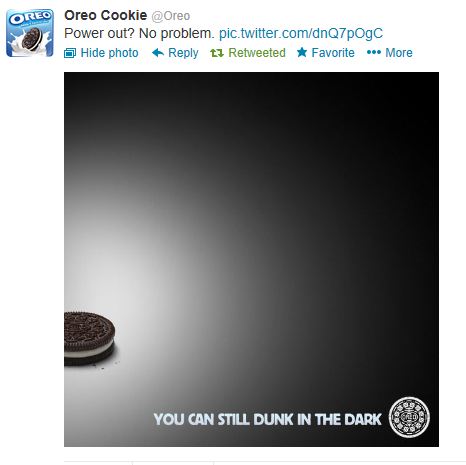
         Ever since Oreo’s pulled off the social media hit of the new millennia with its “dunk in the dark” tweet during the Super Bowl XLVII power blackout, brands have been keen to never again get left in the dark themselves. (Picture 1)

         But jumping on the social media bandwagon creates some inherent risks—especially with such a polarizing issue.  The Supreme Court may have eliminated the legal roadblocks to same-sex marriage, but social acceptance will still be fought in many corners of the country, even many curb cuts of the neighborhood.   Brands face risks on two fronts.  First, they don’t want to come off as opportunists simply trying to sell a product.  Second, they don’t want to alienate a segmented customer base that may be opposed to same-sex marriage.

       Some of the brands that took to Twitter immediately after the SCOTUS decision were very strategic and measured.  Among those that got it right was Delta Airlines.  Where many brands seemed to make their congratulatory messages about themselves, Delta wanted to say something about their employees.  Classy. 

        The branding archetype that is Coca-Cola spoke volumes without saying anything at all.  It didn’t have to.  More than any other global brand, Coke has stood for diversity since it taught the world to sing more than 40 years ago.  Its minimalist tweet represented everything we’ve come to expect and respect about Coke.

         Strong brands have the leverage to make bold statements.  General Mills’ Cheerio’s brand made such a statement more than a year ago when it introduced to America “Gracie” and her mixed race family.  Diversity has become part of the Cheerio’s brand ethos, which is why it was only fitting for it to have something to say about marriage too.

         Maytag may have been the most metaphorically clever.  The two Maytag repairmen are not only “perfect together,” they’re also a subtle reminder that their washers and driers also complete each other. 

         Target is another leading brand that thinks long and hard about messaging.  In this case they built an interactive GIF to say something about marriage and Target.

         Orbitz took a strategically different approach aimed at community building.  Their social media campaign may seem self-serving, but it’s actually an inclusive message promoting interactivity with the brand and offering  a valuable reward—a free vacation.   

          But there were also swings and misses.  Among them, Procter & Gamble.  Its attempt at supporting the Supreme Court ruling was really all about selling soap and toilet paper.

          Likewise with Jet Blue.   Its message seemed to be an afterthought complete with a stock picture. 

          Kellogg’s should get credit for being ready when the Supreme Court decision came down, but their message clearly seemed equally as focused on selling Corn Flakes.

          Social media is always risky especially on polarizing issues.  But as these brands show, there’s a fine line between striking a chord and being tone deaf.

The Coat Hanger TV Blooper — The Making of a Viral Video

6 Apr

     It was just a stupid clothes hanger.  That was pulled from a stupid suit.  That became a stupid video.  That has now been viewed more than two million times.      

     Admittedly, in my role as a TV news guy I’ve shared with our viewers dozens if not hundreds of viral videos.   I never expected to be part of one.   

Picture 1 - Fox 9 Meteorologist Steve Frazier's hanger

Picture 1 – Fox 9 Meteorologist Steve Frazier’s hanger

      The on-air mishap of my colleague Steve Frazier pulling a wire hanger out of his suit I can assure you was no stunt.  If Steve was guilty of anything, it was rushing to simply make his camera shot.  But within hours Steve was getting calls from Italy and our assignment desk was fielding inquiries from the UK’s Guardian newspaper.   Then there was NBC’s Today show, Ellen, TIME, The Huffington Post and The Weather Channel.      

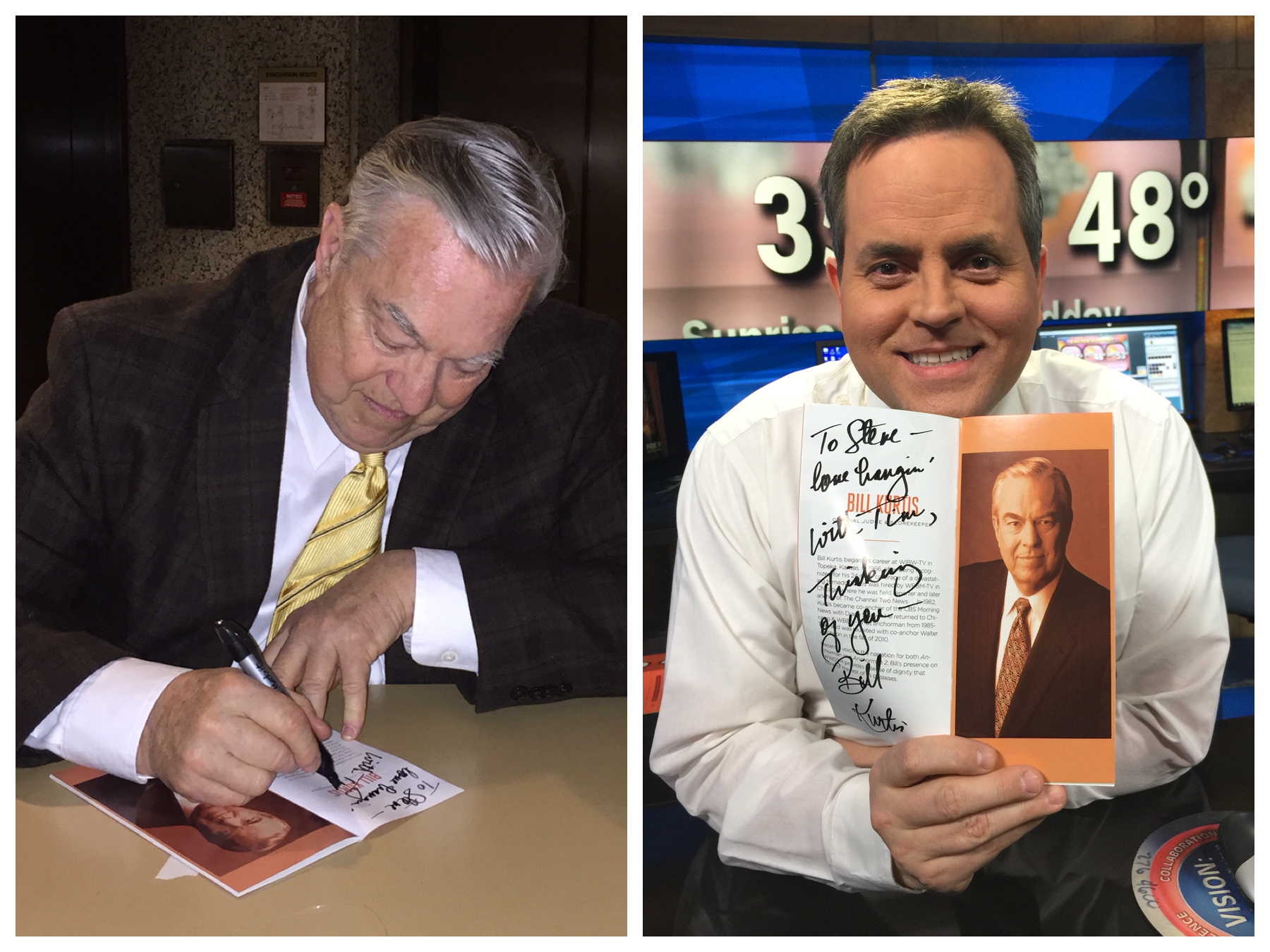
     The coat hanger gaffe became such a cultural phenomenon that it even became a question on the NPR news quiz show Wait, Wait, Don’t Tell Me.   I happen to know this because I was on vacation and in the audience with my family at the Chase Auditorium in Chicago.   When the question was read to P.J. O’Roarke, my teenage daughters cheered—I just wanted to disappear into the seat.   Then, when I approached scorekeeper Bill Kurtis and host Mike Pesca after the show, Pesca laughed and said, “You work with Steve Frazier!”  (Picture 2) 

Picture 2 -

Picture 2 – “Wait, Wait” score keeper Bill Kurtis writing a fan letter to Steve Frazier

      What I now call “hanger gaffe” is not only a statement on 21st century media culture, it’s also a useful case study on what makes videos go viral.   Advertising and consumer behavior researcher John Eighmey offers an outstanding index of factors that affect the propensity to share content.   Videos though, are unique.   With that in mind I’ve constructed my own viral video model that contains five essential factors.  (Figure 1)

Figure 1

Figure 1

      Accessibility:  This is basic and essential.  The video needs to exist on an accessible and sharable channel such as YouTube and increasingly Facebook.      

      Familiarity:  The scenario must be recognizable.   In this case, a television newscast where the audience has already formed its own set of expectations about what happens in a news program.      

      Authenticity:  Is it real, genuine, and not staged?      

      Surprise:  A sudden event or occurrence that deviates from normal expectations.  In this case Steve pulling the hanger from his jacket.      

      Enjoyment:  An emotional response.  Entertainment or outrage.      

     The model essentially needs all of these elements to come together for a video to go viral.   But the model also closely follows the long established Appraisal Theory of consumer behavior. (Figure 2)  In this case the viewer makes a cognitive assessment of video which leads to an emotional response.  The response forms attitudes on actions including whether to “like” the video or share it among friends.  Likewise, the emotional response can also lead to outage depending upon the content of the video—such as a violent police arrest. 

Figure 2

Figure 2

      To be honest there are several contributing factors as to why Steve’s mishap became a temporary world-wide sensation.    Among them is the fact that everyone loves TV news bloopers.  There’s a reason why they’re a staple on late night comedy shows from David Letterman to Jimmy Fallon—viewers love to see presumably credible people make mistakes.   In this case it was a big part of the enjoyment factor.     

      As for the viral video model, Steve’s “hanger gaffe” fits it like a good hanger.   We’ve certainly had our fun.   And now… on with the news.

Facebook Video vs. YouTube – Why Brands Should Now Upload Directly to Facebook Timeline

3 Mar

Facebook vs Youtube Graphic     Facebook has recently changed the way it integrates video into your feeds and timelines and it has vast implications for engagement and views.

      Under its former protocol, one could link a video from YouTube, Vimeo, or another channel such as Videolicious into a post.  Facebook would then integrate a small video frame for the viewer to click or touch.

      Fast forward to the present.  Videos now uploaded directly to Facebook appear as native content that auto-plays in the user’s timeline.  Users or followers no longer have to click or touch to view the video.  The changes are critically important  for brands, including news outlets that thrive on engagement, activation, and sharable content.

     With this change in the digital landscape, I conducted a simple experiment.  As a news anchor and reporter I routinely create short videos on my iPhone using Videolicious to post on Facebook alerting our followers to the stories we will have in the evening newscast.  I call it “Tim’s Phoning It In.”  Recently, during the course of two nights I posted one video as a Videolicious link, the next night’s report was uploaded directly to YouTube as a native video.

      Here is the Video from January 30th posted as a link.

      This is the post the next night as a native Facebook video.


       The methodology was fairly simple.  The videos were posted each night at 7:45 p.m. with the results measured at 10:15 p.m. the same night.  The results showed significant increases in both reach and views with the native YouTube video receiving an 855% increase in views from the night before. (Figure 1) 

Figure 1

Figure 1

      In full disclosure, there are limitations to this experiment.  Among them is the potentially different Facebook user-ship rate between the two nights.  Additionally, the second video may have been perceived as simply more compelling content than the one posted the previous day.  Also, the potential of snow in the forecast during the night of the native Facebook video posting could have been a supplemental motivating factor.  But I strongly suspect the auto-play feature of the second posting played a significant role in the increased exposure. 

Figure 2 - Socialbakers.com

Figure 2 – Socialbakers.com

       This hypothesis is tested as major brands are already making the shift from YouTube to Facebook.   Data tracked by Socialbakers shows how increasingly brands are now posting more video content to Facebook than they are to YouTube.  (Figure 2)

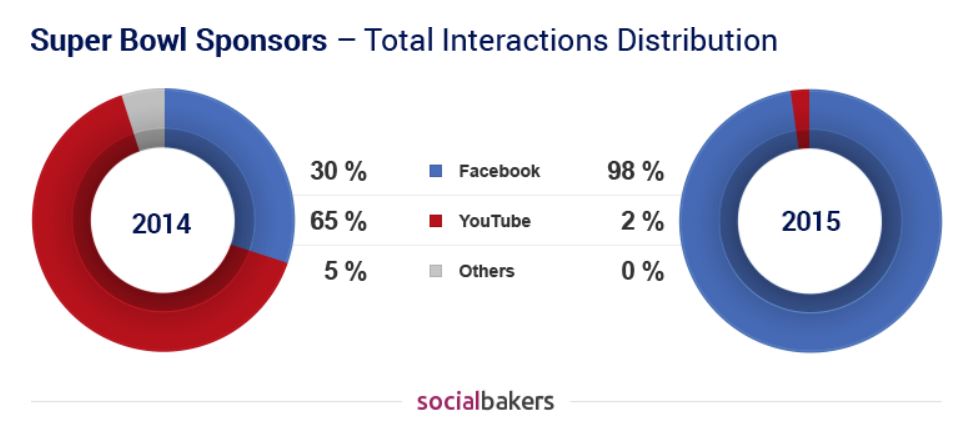
     Additional research from Socialbakers shows how Facebook videos dominated during the most social event of the year—Super Bowl XLIV.  Super Bowl sponsors found overall engagement with followers on Facebook overtook YouTube for the first time. (Figure 3) 

Figure 3 - Socialbakers.com

Figure 3 – Socialbakers.com

      That’s not to say YouTube is no longer important.   YouTube is still the channel brands need to have a presence on because of its search functions.  Additionally, longer format videos are ideally suited for YouTube whereas Facebook holds the advantage with shorter messaging that’s meant to be perishable—in other words, needs to be seen now.   In this case Facebook is ideal for news videos and brands running time sensitive marketing promotions.  The landscape is changing so rapidly that AdAge now includes Facebook videos in its weekly advertising engagement report.

       The changes are big and offer brands, and yes, news organizations new opportunities in reaching their followers.

When Super Bowl Ads Are Fun and Strategic

27 Feb

Super Bowl 15 3     The Budweiser puppy is finally home and Doritos showed how with a little ingenuity, pigs really can fly.   The viewers of Super Bowl XLIX have crowned their favorite ads and picked their winners and losers.   But for many advertisers, this is more than a popularity contest.  It’s also their chance to make a unique statement to a targeted audience and asking them to make a specific decision.

     Perhaps the two most creatively strategic ads where ironically from car brands.  Both Fiat and Mercedes Benz used their 60 second TV time-outs to launch new products and showcase them directly to men at opposite ends of the economic ladder. 

      For Fiat, that new product is a sexier, pumped-up, all-wheel drive version of its sub-compact 500, called the 500X.  And, it found a rather creative way to take something small and grow it into something… big.

https://www.youtube.com/watch?v=YAcLViTHDOo

     Mercedes Benz took a different but equally strategic approach by segmenting upper income men with a message about speed and breaking away from pack of bulky luxury cars.

https://youtu.be/oF–p4Dkv_Q

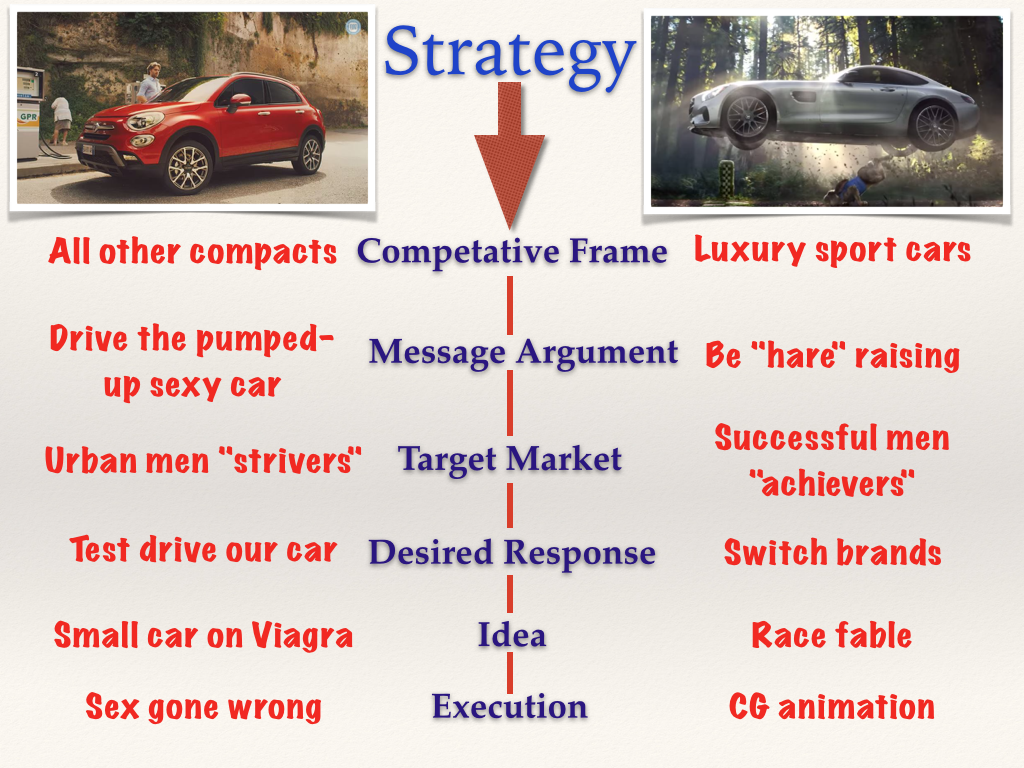
      These ads did more than entertain.  Both used well recognized story lines to serve as a metaphor to make a highly strategic statement to potential buyers. (Figure 1)  Fiat’s target audience is young urban men who have not yet climbed the economic ladder but want to look smart, hip and slightly sophisticated in their purchases.  With a starting price of $20,000 the Fiat 500X ideally fits into their budget with Fiat making the value proposition that this is the pumped-up sexy car to showcase their lifestyle. 

Figure 1

Figure 1

      Mercedes Benz makes a similar argument, but clearly aimed at highly affluent men who want to live life in the “faster lane.”   Priced at $130,000 this is a car that has a very narrow market segmentation within the luxury car category but makes but makes the appeal that the owner will drive a new race—and be seen differently among his peers.  

Figure 2

Figure 2

      The goal of any advertisement is to drive interest and ultimately sales.  As product introduction ads, initial research suggest they were high successful at placing viewers into the top of the marketing funnel.  Data from Google Trends suggest an exponential increase in web searches on both cars immediately after the Super Bowl.  (Figure 2)

      It helps that both ads have also been viral hits on YouTube gathering millions of more views.  Let’s face it, they’re fun.  And when advertising can be fun and strategic their power only increases.

Best Ads of 2014 — How Storytelling Mattered

31 Dec

Collage 2

              Exemplary advertising always leads the consumer on a journey.  Often times that journey leads to the decision to buy a product.  In 2014, some of the best ads created journeys to affect attitudes and beliefs about brands and causes.  Their messages didn’t just aim for our heads, they also aimed for our hearts.

                 I’ve compiled a short list of six video advertisements that represent some of the most strategic brand messaging of 2014.  There are other lists of the most viewed, most shared, and most popular, this is simply a compilation of transformational messaging that used narrative storytelling to achieve a specific brand objective.

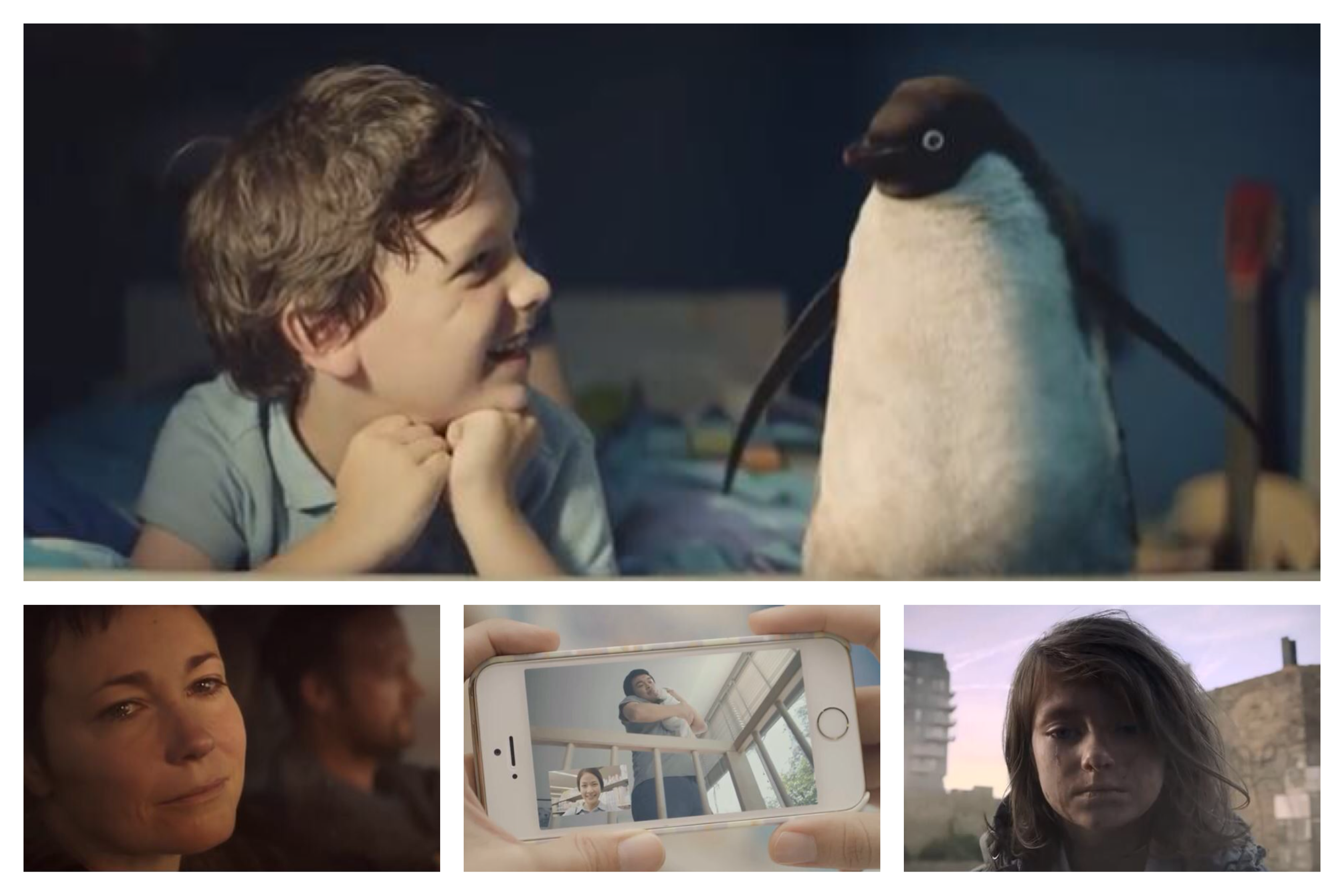
                 First on the list is a commercial from a brand American’s have never heard of, in a language they can’t speak, yet its message is universal.   DATC is an Indonesian telecom company trying to position itself in a hyper-competitive market.  Instead of creating a western-style campaign staking a claim on price, network coverage, or reliability, DATC’s agency Y&R instead crafted a narrative to lead the viewer on a smart, emotional journey called “The Power of Love.”

              The ad shows how technology can’t replace love, but it can uniquely connect people in moments of love.  The desired action DATC wants consumers to make is to use their phones and network to never miss a loving moment.

                 Chevrolet’s Silverado pickup truck this year made an equally brave and powerful ad.  It leveraged its considerable brand equity to make a statement about cancer–without speaking a word. 

                 The silent schema of a solemn ride down a country road forces the viewer to think deeply about what is, and what is not happening.  The three most powerful cues: the shaved head, the teary eye, and the embraced hands.  Together they force the viewer to create their own story, form a new attitude and create the belief that they can take action by supporting the American Cancer Society.  The underlying message is not about the truck, but the journey of strength the truck allows one to take. 


                SaveTheChildren had a daunting task in 2014.  It had to find a way to make the world care about a war that western leaders want no part of.  In this case, they constructed a narrative that could be about the day in the life of any child in any country.  But this not any country, it’s Syria. 

                Its powerful schema leads the viewer on a second-by-second journey of conversion from comfort to conflict.   It uses Appraisal Theory to force one to see the child as if it were their own daughter.  The goal of the ad is to elicit an emotional response that confronts our own beliefs and attitudes about the Syrian War.

                John Lewis is a British department store that has become as well known for its holiday commercials as Macy’s has for its Thanksgiving Day parade.  Once again, John Lewis did not disappoint.

                 The brilliance of this year’s ad uses a little boy’s imaginary penguin named Monty to become the human metaphor of love and sharing.  Think Calvin & Hobbs. The result is a touching narrative about the power of imagination in giving–and the department store that can make it happen.


               The World Cup soccer games produced the year’s most viral advertisements, but the one that I will argue created the most power came from the Bank of Chile. 

               Chile’s soccer team was placed in the same World Cup division as top-seeded teams Netherlands and Spain.  Soccer fans called it the “death group” because no other teams survived.  In this case, no men were better suited carry the Chilean flag than the trapped Chilean miners who stared down death and won.  The salient message from the Bank of Chile is that it is the bank which can build impossible dreams.

Figure 1 - Means-Ends Model

Figure 1 – Means-Ends Model

                 Finally, the 2014 Winter Olympics crowned a new series of world-class athletes, but the BBC created gold of its own for a cognitively powerful advertisement promoting its broadcast coverage of the games. 

                 Both the BBC and the American network NBC used a means-end model in how they promoted their Olympics coverage. (Figure 1)  NBC appealed to humanity where the BBC used mythology.   Its man vs. nature promotional approach set up its coverage to beckon the viewer to witness immortality in the making–becoming one with the Gods.  That’s powerful.


                  We’ve come a long way from the great recession when risk averse consumer messaging was all about boosting immediate sales.   In the past two years brands once again feel free to think strategically about positioning themselves along the consumer’s emotional curve to create relationships and sharable moments to last beyond the next quarterly report.  The result is advertising that’s not just gutsy, but smart, and yes, fun!

Mo’ne Davis Throws a World Series Strike for Girls… and Chevy

28 Oct

       From a distance of sixty feet and six inches, the pitch was money.  Actually, it was Mo’ne.  A strike, right down the middle.  It came from a girl, just 13 years old.  And by the end of game four of the World Series, it was just the first of several strikes that made Mo’ne Davis the advertising world’s latest pitchwoman. 

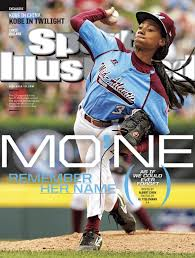
Mo'ne Davis on the cover of Sports Illustrated, August 19, 2014

Mo’ne Davis on the cover of Sports Illustrated, August 19, 2014

         To say Davis has had a good year would be as much of an understatement as saying Derek Jeter did nothing remarkable this season. As a pitcher for Philadelphia’s Taney Dragons Little League team, she not only took her fellow players to the Little League World Series, she became the first young woman to pitch a shutout in the series.  In the process she graced the cover of Sports Illustrated. 

        She’s a chief marketing officer’s dream product endorsee.  The challenge however, is how does a brand align itself with such a story maker without coming off as taking advantage of her good fortune for commercial gain?  After all, she’s still a child.  Complicating matters are strict NCAA endorsement rules should she one day become a college athlete. 

Mo'ne Davis is "Throw Like a Girl"

Mo’ne Davis is “Throw Like a Girl”

        Most marketing officers would use Davis to craft a story about their brand.  Chevrolet instead crafted a story about Davis.  It hired acclaimed film maker and renowned New York Yankees fan Spike Lee to create a short documentary about Davis, her coach, and her family.  The documentary called “Throw Like a Girl” makes no direct product pitch.  It does however feature a new Chevy Malibu in the closing scene with a full screen tag line, “Chevrolet celebrates Mo’ne Davis and those who remind us that anything is possible.”

        Chevy also broke down the footage into 60-second ad that aired throughout game four after she threw out the first pitch.

       The documentary and ad together loosely follow’s Richard Baggozi’s Theory of Trying by making the viewer think about their own attitudes of success and failure.  In this case, one’s attitude toward trying is leveraged by Davis’ story of success.  It’s a powerful psychological framework f0r influencing attitudes towards success and the beliefs that it can actually happen. 

Figure 1

Figure 1

        But more important, the campaign is an example of transformational communication.  Instead of using information to affect a consumer decision, it uses emotion.  By forming a positive feeling with Mo’ne Davis’s story, the viewer also forms a positive association with the brand who helped showcase the story—in this case a car company that  wants to transport people to their dreams.

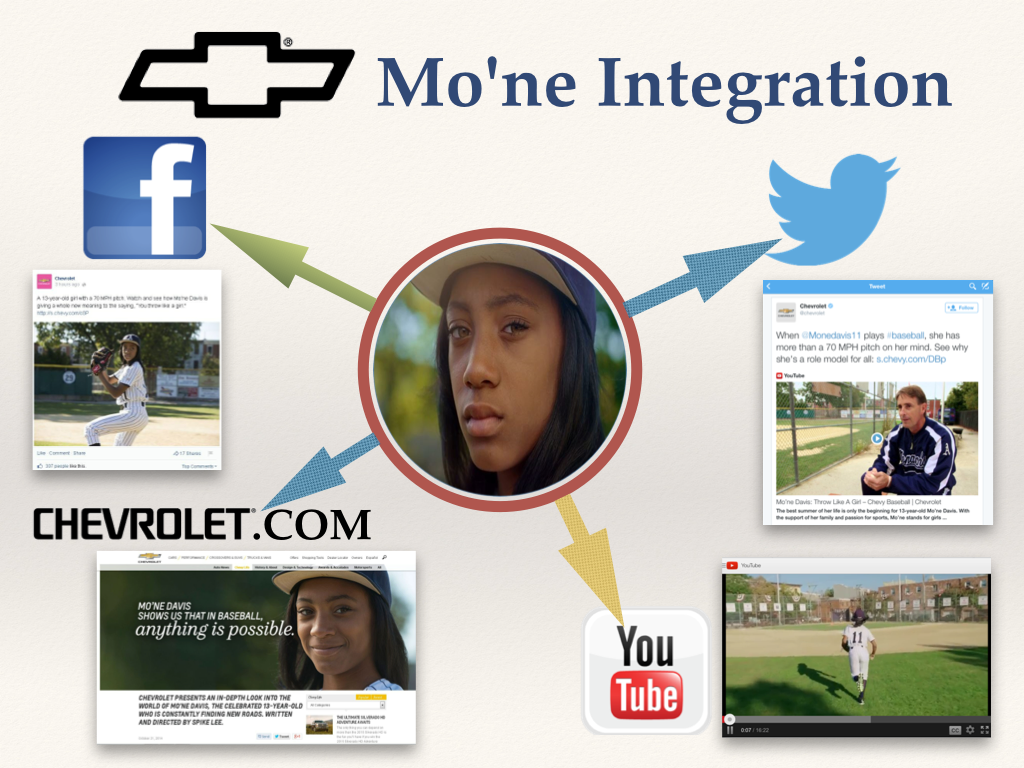
        It’s not just a clever strategy, Chevy also used smart tactics.  It spread the “Throw Like a Girl” ads in a flight throughout the night’s World Series game to ensure broad exposure.  Additionally Chevy integrated the message across its social media channels. (Figure 1)

        The strategy by Chevrolet speaks clearly as to how marketers are embracing brand journalism as a tool to reach and engage audiences in new ways.  Davis threw the perfect pitch, but Chevrolet brought us along for the ride—with its badge on the tailgate.

The Power of Love — When Great Advertising Aims for the Heart

29 Aug

Power of Love Collage

       There’s something going on in Thailand.  As global players in the mobile telecom industry bombard consumers with messages on speed, coverage and pricing, a Thai company is appealing to consumers’ hearts. It’s not the first.

         DTAC has just released a new advertisement based on the insight that technology has limits.  The schema is something we’re all familiar with: how to calm a crying baby.  The ad produced by Y&R is a text book example of transformative communication.  The power of this approach is that instead of overtly selling a product, it instead makes the consumer feel a connection to the brand.  In this case, that feeling is the power of love.

        DTAC’s campaign is just the latest in a series ads to come from Thai wireless companies that are all based on the communicative theory of emotion—or appraisal theory.

        Truemove-H and its agency Ogilvy & Mather released a similarly powerful campaign that I have argued was one of the top ads of 2013.  Like “The Power of Love,” Truemove’s ad is based upon the social goal of paying life forward.  In this case it created a time-lapse schema with the proposition that “Giving is the Best Communication.”

        In both ads there is no up-front unique selling proposition.  Their power is in how they lead the viewer on an emotional journey to form a resolution to take action. (Figure 1)

Figure 1 - Applying Appraisal Theory to Truemove-H's "Giving" advertisement.

Figure 1 – Applying Appraisal Theory to Truemove-H’s “Giving” advertisement.

        In DTAC’s ad, it shows how technology can’t replace love but it can uniquely connect people in moments of love.  The desired action is to use DTAC phones to never miss a loving moment.   As for Truemove, its ad demonstrates power of giving and the emotional conclusion to give by communicating through Truemove’s network.

        Together they are two powerfully transformative and strategic ads from two companies brave enough to be different and stand out in the marketplace.

The Ads of World Cup… Move Over Super Bowl

14 Jun

World Cup Collage

              For decades, advertising in America’s NFL Super Bowl has long been considered the grand prize for the world’s biggest brands.  American football has just been left in the locker room.

                If one measures viral video sharing, World Cup Soccer has already won the trophy.  Unruly Media tracks social media movement of advertisements.  Its data shows the top-five World Cup ads have already drawn more than 6.1 million shares worldwide.   By comparison, the top-five Super Bowl XLIII ads drew 2.9 million shares.   The World Cup games have only just begun and their advertisements have already out-performed Super Bowl exposure by 210%.

McDonald's World Cup commercial

McDonald’s World Cup commercial

                 Much like the marketing in the Super Bowl, ad agencies and their brands are using some of the same theoretical communication concepts in targeting viewers.   Long time University of Minnesota advertising researcher John Eighmey likes to call the main concept “likeability of the ad.”   That is, if you like the advertisement, you’ll like the brand.  It plays off Balance Theory where congruity is formed between the viewer, the ad, and the advertiser.   That’s why so many of these ads are constructed to entertain rather than drive a hard selling proposition.

                One of the top World Cup ads that successfully plays off this theory comes from Nike.  It’s actually a short movie that uses Disney-like animation featuring soccer super stars Zlatan and Neymar Jr.  It’s an easily digestible good vs. evil schema that plays off of Nike’s well established brand of empowerment.


                The Bank of Chile has produced perhaps the most emotionally powerful ad of the games.  Chile’s soccer team is placed in the same World Cup division as the titanic teams of Netherlands and Spain.  It’s called the “death group.”  In this case, no men are better suited to sell the argument of fighting death than the very Chilean miners who stared at death and won.  The salient message from the Bank of Chile is that it is the bank which can help build impossible dreams.


                This kind of advertising forum is tailor-made for soft drink brands.  Pepsi has long aligned itself with youth—the Pepsi Generation.  In this ad Pepsi zeros in on its roots once again driving home the message that Pepsi provides the rhythm of fun to live in the moment.

                McDonald’s could have spent its World Cup marketing budget on selling burgers.  Instead it’s selling soccer and kids who are “Loving it.”  McDonald’s is making the bet that viewers will love this ad and love them back in return.


                Finally, Castrol is out to show that it too has a trick play up its cylinder head.  This video short pitting man against machine has already scored with fans who have viewed it more than 15 million times.

https://youtu.be/-fABEDIsemk

                 These are just five advertisements in a long list of brands vying for attention.   But they’ve already shown their viral communication power on the world stage.

Cross-Channel Integration – How The White House Made D-Day More Than a Speech

13 Jun

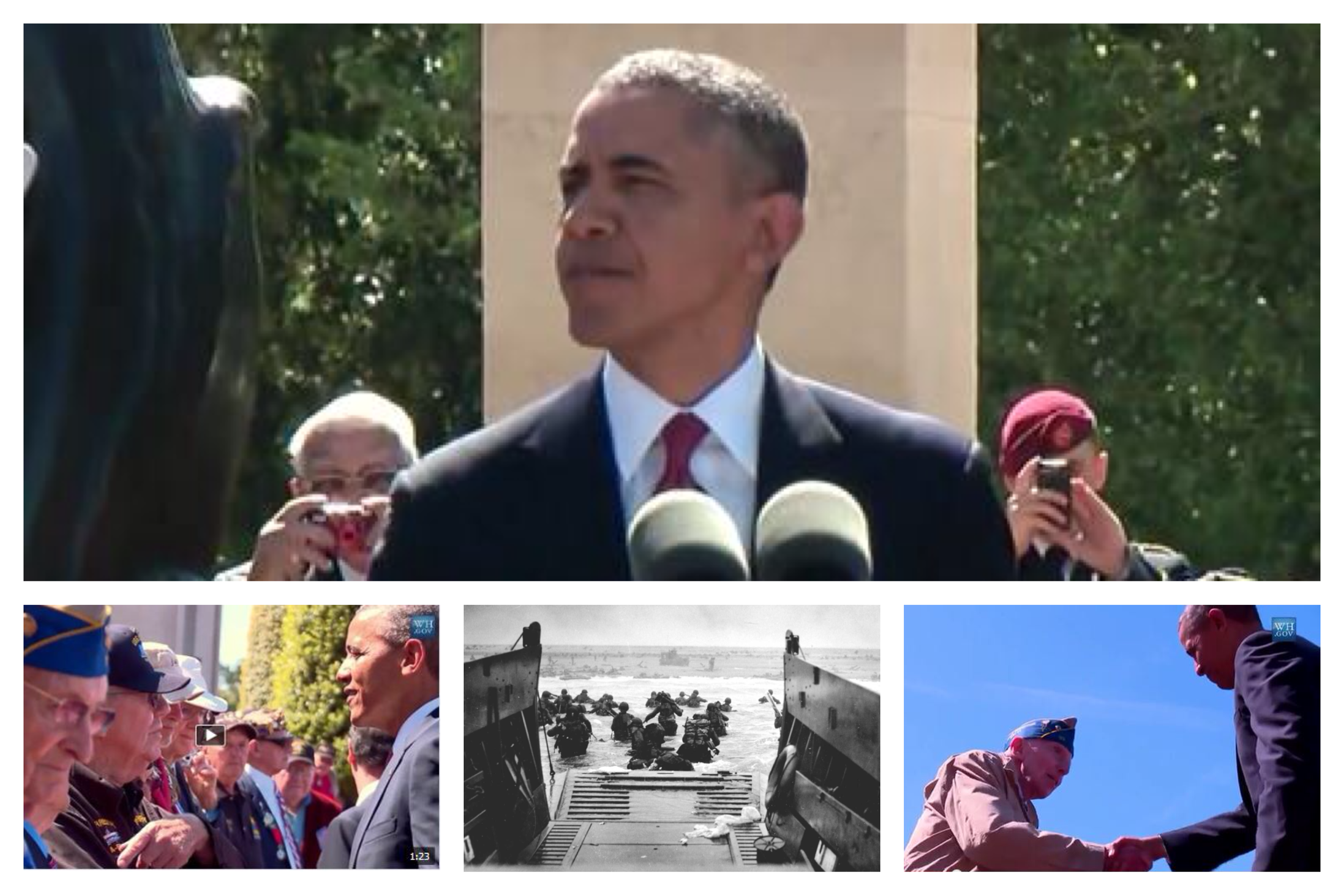
Obama D-Day Collage

       It’s a case of old school vs. new school communication.  Plato vs. Zuckerberg.  That is, speech vs. social media.  But in reality the two can and should complement each other and the White House communications team has just given another example of how to use and integrate these new channels to amplify an important message.  In this case D-Day.

      In many respects, President Barack Obama’s speech in Normandy was itself a teaching machine.  Filled with powerful rhetorical imagery and metaphoric values, he used the world’s oldest form of communication to commemorate and honor the past and reassure the future.

      The president’s opening line was itself masterful in its metaphoric power:

                   If prayer were made of sound, the skies over England that night would have deafened the world.”

 His second sentence was equally illustrative in its imagery:

“Captains paced their decks. Pilots tapped their gauges. Commanders poured over maps, fully aware that for all the months of meticulous planning, everything could go wrong: the winds, the tides, the element of surprise — and above all, the audacious bet that what waited on the other side of the Channel would compel men not to shrink away, but to charge ahead.”

      Gathered among an audience of D-Day veterans and foreign leaders the president had three clear goals in this address.  First, to remember and acknowledge sacrifices paid on the beaches of Normandy and to keep the story alive.  He did it in the form of a rhetorical challenge:

                   Whenever the world makes you cynical — stop and think of these men.”

     Second, the president needed to reassure America’s European allies that it’s un-waivered in its commitment to a free continent.  Finally, he had to acknowledge the continuing sacrifice U.S. service members are still giving in a post 9-11 world:

“And as today’s wars come to an end, this generation of servicemen and women will step out of uniform. They, too, will build families and lives of their own. They, too, will become leaders in their communities, in politics, in commerce and industry — the leaders we need for the beachheads of our time. God willing, they, too, will grow old in the land they helped keep free. And someday, future generations, whether seventy or seven hundred years hence, will gather at places like this to honor them — and to say that these were generations of men and women who proved once again that the United States of America is and will remain the greatest force for freedom the world has ever known.”


D-Day Blog WH Facebook

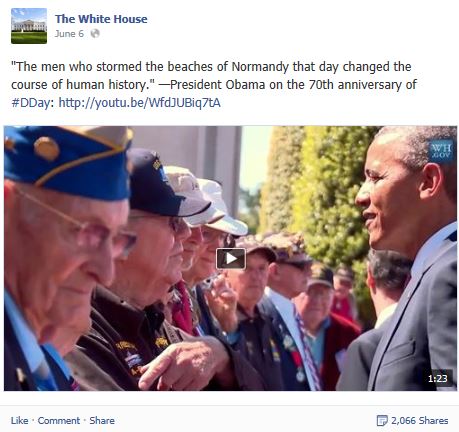
Figure 1 – White House Facebook post of the D-Day event linking to a YouTube video.

        For a president severely struggling at home and in congress, it may have been one of his better moments.  But the challenge for the White House was not letting the message disappear into the sands of Normandy.  Major media coverage significantly helped.   But as an established brand, the White House also controls its own messaging, and in this case it tactically coordinated and integrated the D-Day message across multiple media channels to ensure it was targeted to a series of narrow audiences for the widest possibly reach. (Figure 1)

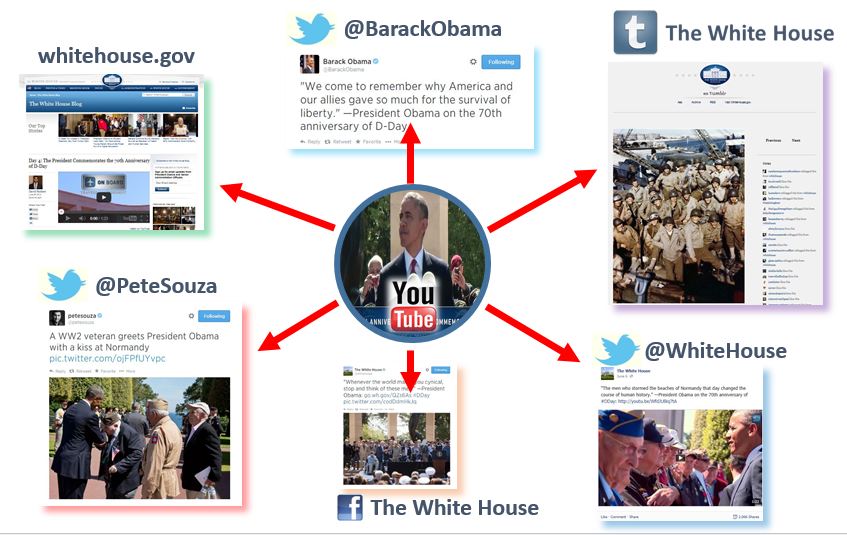
         First and foremost, was the YouTube video of the speech.  But the White House communications team also targeted separate messages, pictures, and excerpts of the speech to individual social media channels. (Figure 2)  The multi-channel integration creates a hub and spoke network to target individual audiences where they live in social media.  

Figure 2 - The White House cross-channel integration profile.

Figure 2 – The White House cross-channel integration profile.

    In an age of modern communication it’s a smart strategic use of social media to amplify a message and engage participation.  If there was any fault in this particular strategy, it’s in the fact that the communications team should have tactically posted more images and messages throughout the day with a more coordinated effort in each post to link and drive audiences to the blog and the YouTube speech.   In that respect, it’s one miscue an otherwise disciplined communications team.

      It doesn’t have to be a presidential speech.  The lessons for brands, corporate communication teams and non-profits alike are profound.  Compelling content doesn’t have to live and die in a single space.   Integration across multiple channels is key—and often free.  The White House team gives a useful strategic road map for communicators to follow.

“The Heart Can Never Mess You Up” — Speech Lessons From a Once Homeless Marine

4 Jun

      On paper, it was no contest.  The speakers list contained a short agenda of polished politicians and accomplished CEOs.  And then there was Jerry Readmond.

      “I have but one wish right now, that my anti-depression pill would kick in,” said Readmond.

      Those were his first words.

Former homeless veteran Jerry Readmond standing outside the historic Fort Snelling horse stables that will be converted into affordable housing for homeless veterans.  (Photo by Rod Wermager)

Former homeless veteran Jerry Readmond standing outside the historic Fort Snelling horse stables that will be converted into affordable housing for homeless veterans. (Photo by Rod Wermager)

       Hardly the opening line of a master orator.  And therein lies its simple genius—honesty.

       Jerry Readmond is a former Vietnam War Marine who long ago stopped carrying a rifle and instead carried a burden.  What the war didn’t break, inner demons did.  He spent time walking and living on the streets of Minneapolis, another member of our national embarrassment called the homeless veterans club. 

       If not for the Marine Corps instilling in him a life-long sense of pride and adaptability, Readmond admits he might not have survived. 

      That’s exactly why Readmond was added to the speakers list at the recent ground breaking for 58 new affordable apartments for homeless veterans at Fort Snelling.  The fact that he’s a Marine gives him respect.  His one-time homelessness gives him standing.  Aristotle called it ethos, or credibility.  But the pathos, or emotion was about to come from the soul.

      “I don’t read from notes, because the heart can really never mess you up.” Readmond said.

      He didn’t need notes. All he needed was a narrative, and his heart gave him one.  Here are some of the excerpts:

      “I asked Senator Hubert Humphrey one time, ‘Where does it start?’ And he shook my hand.  And having been here today and witnessing this, it hit me.  After all these years, it starts with a handshake.  There have been many, many, many, many hands shook here.

      “We can build all the buildings we want for our veterans, but I hope when we leave here you will think of this one word:  Affordable.  I’m in a place right now, I have my social security and I have my compensation from the V.A., the first and the fifteenth.  My rent is going to be over a thousand dollars a month and I was homeless.  I just want to be not a perfect example, but I like to be an example because I got my housing through HUD VASH [Housing & Urban Development – Veterans Affairs Supportive Housing].  That’s why I’m so passionate about this.  It takes the honor and the courage and the strength of a warrior to ask for help, that’s why we have a hard time getting them in the door. 

Jerry Readmond walking through the building that will be converted into affordable housing.  (Photo from Rod Wermager)

Jerry Readmond walking through the building that will be converted into affordable housing. (Photo by Rod Wermager)

      “That’s what we’re all doing here.  Martin Luther King, ‘I had a dream.’ And everybody that’s going to fill these halls and walk the grounds will able to say instead of living down by the river or under a bridge… every winter I just get scared.  Really, really, really scared. How many are they going to find under a bridge or down by a river, or in the bush, dead because they froze to death. 

     “Now I know when Martin Luther King said, ‘I have a dream.’  And, for me it is my dream would be that we can fill as many of these buildings here as possible with affordable housing. That we can build affordable housing all over.  When President Obama was first elected he said that he wanted to eliminate veteran homelessness.  And I thought to myself one word and it was short: right.  But by golly, it’s happening. 

      “But it was the handshake.  God bless our veterans and God bless the United States of America.”

      Pity any speaker who has to come next.  In this case, it was Minnesota’s U.S. Senator Al Franken.

     “Don’t anyone ever let me follow Jerry again,” said Franken.

Jerry Readmond and U.S. Senator Al Franken.  (Photo by Rod Wermager)

Jerry Readmond and U.S. Senator Al Franken. (Photo by Rod Wermager)

     Readmond’s were the only words anyone remembered.  Readmond aimed for the heart, everyone else aimed for the talking points.

     The lessons for speech givers and communicators alike are profound.  Powerful persuasion comes in the emotional metaphors delivered by people who have credibility.  In this case, it came from a disheveled man wearing a USMC t-shirt.