Archive | Features-Human Interest RSS feed for this section

Nixon and Vietnam, A Veterans Day Legacy

15 Nov

(UPDATE – 9-29-12: our documentary segment on Geoff Steiner has just won the 2012 Emmy Award for best single military story)

*          *          *


The past collided with the present this week and the crash reminds us of the tragedy that was Vietnam.

On the eve of Veterans Day, the Nixon Presidential Library released a recording of the former president dictating his account of talking to Vietnam War protestors at the Lincoln Memorial in the pre-dawn hours of May 9, 1970.  The president had a sleepless night after giving a nationally televised news conference a few hours earlier on the progress of the war.   By Nixon’s own account he went to the Lincoln sitting room in the White House to listen to some Rachmaninoff when he was approached by his personal attendant Manuel Sanchez.  Sanchez was a recently naturalized Cuban refugee and new to Washington and the White House.  Feeling melancholy, Nixon asked him if he had ever seen the Lincoln Memorial at night.  Sanchez admitted he hadn’t, so Nixon gathered a small group of secret service agents and off they went—into history.

What Nixon didn’t anticipate was running into a group of wide-eyed college students who had driven all night from upstate New York to protest against the war.  Just five days earlier National Guard troops opened fire on a similar group of protestors at Kent State University and killed four students.   In his Dictabelt recording Nixon admits he awkwardly tried to make small talk, but it quickly turned to the war:

“As I tried to explain in my press conference that my goal in Vietnam was the same as theirs, to stop the killing and the war, to bring peace… I know most of you, that probably most of you think I’m an S.O.B., but I want you to know that I understand just how you feel.”  – Richard Nixon, 1970


On the very morning Nixon was trying to justify the war, a 19 year old Marine from Minnesota was performing his duty to carry it out.  Geoff Steiner landed in Vietnam prior to the Tet Offensive in 1968.  Sixteen thousand U.S. soldiers lost their lives that year.   By 1970, he was a battle scarred survivor of a war with seemingly no end.   Coming home was hardly any easier.   Like many Vietnam veterans Steiner suffered from post traumatic stress disorder.   The scars ran too long and the pain too deep.   Finally, one day he put a gun to his head, but instead of finding a bullet, he found God.

Vietnam Veteran Geoff Steiner with producers Rod Rassman and Mark Anderson

Today, Steiner is a Chaplain who quietly passes the time on 40 acres of land near Cushing, Minnesota.   He is a loner who is hardly alone.  Several times a week Steiner walks through the early morning mist with a shovel, a seedling, and a prayer.   He plants trees in honor of the men who never came home and those who did come home but never found their inner peace.

“When I bought this land, there wasn’t a tree in sight,” said Steiner.   “Now, I have thousands of them.”

This is exactly where Nixon and Steiner collide.  Nixon wanted to end the Vietnam War through “peace with honor.”  Steiner simply wants honor with peace.   He lives it every day.

And that’s exactly why we met on Veterans Day among the living memorial now growing on his rolling Minnesota land.  I teamed up with producers Mark Anderson and Rod Rassman to profile Steiner for part of an upcoming film on veterans called “11-11-11.”  The film will portray a day-in-the-life of veterans on the very day that we honor their service.   We think Steiner not only has a great story to tell, but is an American worth knowing.

That’s why it’s so ironic that on Veterans Day this year we heard two voices on Vietnam, one from the present and one from the past.  The oxides on Nixon’s tape recording have faded with time, the scratchy audio a reminder of a reel that only plays in the echo chamber of history.   Geoff Steiner needs no recording; the legacy of Vietnam is on permanent replay in his mind.  He has his trees, but they will never completely hide the horrors of war.

*               *               *

 

The Power of the Narrative

27 Oct

Every good story has a beginning, middle, and end.  This story begins with a note from a long lost friend needing a small favor.

My old colleague Cortney Napurski always had sharp skills and big ambitions.  She’s more than proven it in the past four years, no longer the young journalist just out of college.  During that time she’s chased dreams while the rest of us chased paychecks.   And all the while she became the kind of young woman who no longer fits on a one page resume: a Londoner, master’s graduate, and a mother.

Now, she’s chasing another dream called a PhD.  It’s also where her note fits in asking for a letter of recommendation for a research grant.  What Cortney hopes to prove is that literature is a better tool at teaching history than by forcing kids to memorize dates, facts and names from a text book.   In other words, she’s attempting to prove what her journalism background has instinctively taught her—the instructional power of the narrative.  The best journalism has always been a collection of verifiable facts woven into narrative form.   Narratives are the glue by which humans cognitively communicate and connect with one another.  There’s a reason why the Anasazi carved petroglyphs, why Homer wrote poems, why Jesus told parables—because they work.

We use narratives to sell and define products, presidential candidates, even ourselves.  They tell the story of our lives, even our careers.  As a reporter, I’ve written hundreds of narratives.  But ask my colleagues about the one that perhaps best defines me as a storyteller, and they’ll most often say it’s a little ditty called Motown.   It’s a memorable gem I had the honor to co-write with NPPA National Photographer of the Year Andy Shilts.


What Motown Adams teaches us is that we all have a story to tell.   Motown’s story is one of redemption.  Watch it once and you’ll remember him forever.

And that’s exactly why my friend Cortney is onto something.  If literary narratives from the early 20th century can elicit the same connection and emotion, then Cortney is hypothesizing they can also become an effective teaching tool that connects students to the people, culture, events, and higher level values of that time.

In the process, Cortney is writing her own narrative.  She has a great beginning.  I can’t wait to see where she goes next…

Steve Jobs and the Power of Self-Actualization

15 Oct

            Search the Apple Apps Store on a brand new iPhone 4S and one will find 424 applications to “create.”  There are no apps for “conformity.” 

            Mark it up to the lasting legacy of Steve Jobs.

             The Apple co-founder who lost his battle with cancer last week developed technology devices that allowed people to easily create things.  He dared us to be different.  Nothing expressed it more than Apple’s ad copy when Jobs returned to Apple in 1997.

“Here’s to the crazy ones. The misfits. The rebels. The troublemakers. The round pegs in the square holes. The ones who see things differently. They’re not fond of rules. And they have no respect for the status quo. You can quote them, disagree with them, glorify, or vilify them. About the only thing you can’t do is ignore them. Because they change things. They push the human race forward. And while some may see them as the crazy ones, we see genius. Because the people who are crazy enough to think they can change the world, are the ones who do.” (Apple Inc.)

             What Jobs tapped into was the psychological notion of self-actualization.  Everyone has the power to change themselves and those around them, what Jobs and Apple did was design the technology to make it happen.  In the process he asked us not only to think differently, but to create differently.  Break out of the box. 

             On the day of Job’s passing, we did just that at Fox 9.  We left our $30,000 video camera in the trunk and instead pulled out our iPhone and iPad. 

            The genius of the culture Apple has created is in the loyalty of its customers.  If Jobs created any legacy it’s in the notion that people want technology that easily helps them be who they are.  The proof is in the web traffic scores since the announcement of the iPhone 4S. 

Web page traffic for Apple, Verizon, and ATT

            Visits to Apple’s site are up nearly 50%, 24% at ATT, and 19% at Verizon Wireless, two of the dominant service providers for the iPhone.   All three expect record sales.

            Admittedly, it creates an interesting paradox that the company which has pushed people to become individuals has them lining up like Lemmings.  But what this is really all about is a dominant brand idea.  In a world that too often settles for “me too,” Steve Jobs taught us to say, “I am…”


The Price and Weight of Freedom

5 Oct

            If it’s true that freedom bears a heavy price, then it comes in a heavy box, too.

            In this  case freedom’s box weighs 135 pounds and is delivered by UPS.  Sixty years ago, it was delivered by the U.S. 8th Air Force.   A B-24 crew member by the name of Wally Grotz was among the brave airmen who delivered freedom to the people of Poland in the form of heavy bombs raining down on the Nazi’s.   For his bravery, he paid an equally heavy price: shot down, captured, and imprisoned.

U.S Airman Statue by Polish Artist Zygmunt Wujek

               “Freedom is a wonderful thing and you don’t know what it really is until you don’t have it anymore,” said Grotz.

            The German Luftwaffe sent Grotz to the infamous Stalag Luft IV near Koszalin, Poland.    By the end of the war it would house 7,000 American POW’s.   He spent two months there before the Germans forced him and hundreds of other prisoners on a 500 mile march to Berlin.  Grotz was among the few to survive the march.  The Russians and British finally liberated him as they closed in and the Third Reich collapsed.

            Grotz never forgot the experience.  Neither did Poland.  When the Pomerania region of Poland dedicated the old Stalag Luft IV site as a memorial in 2006, Grotz was the only living American POW to return.  They raised a statue to the airmen of the U.S. 8th Air Force but the sculptor, Zygmunt Wujek, wanted to give Grotz something more.  This week if finally arrived—the box of freedom.

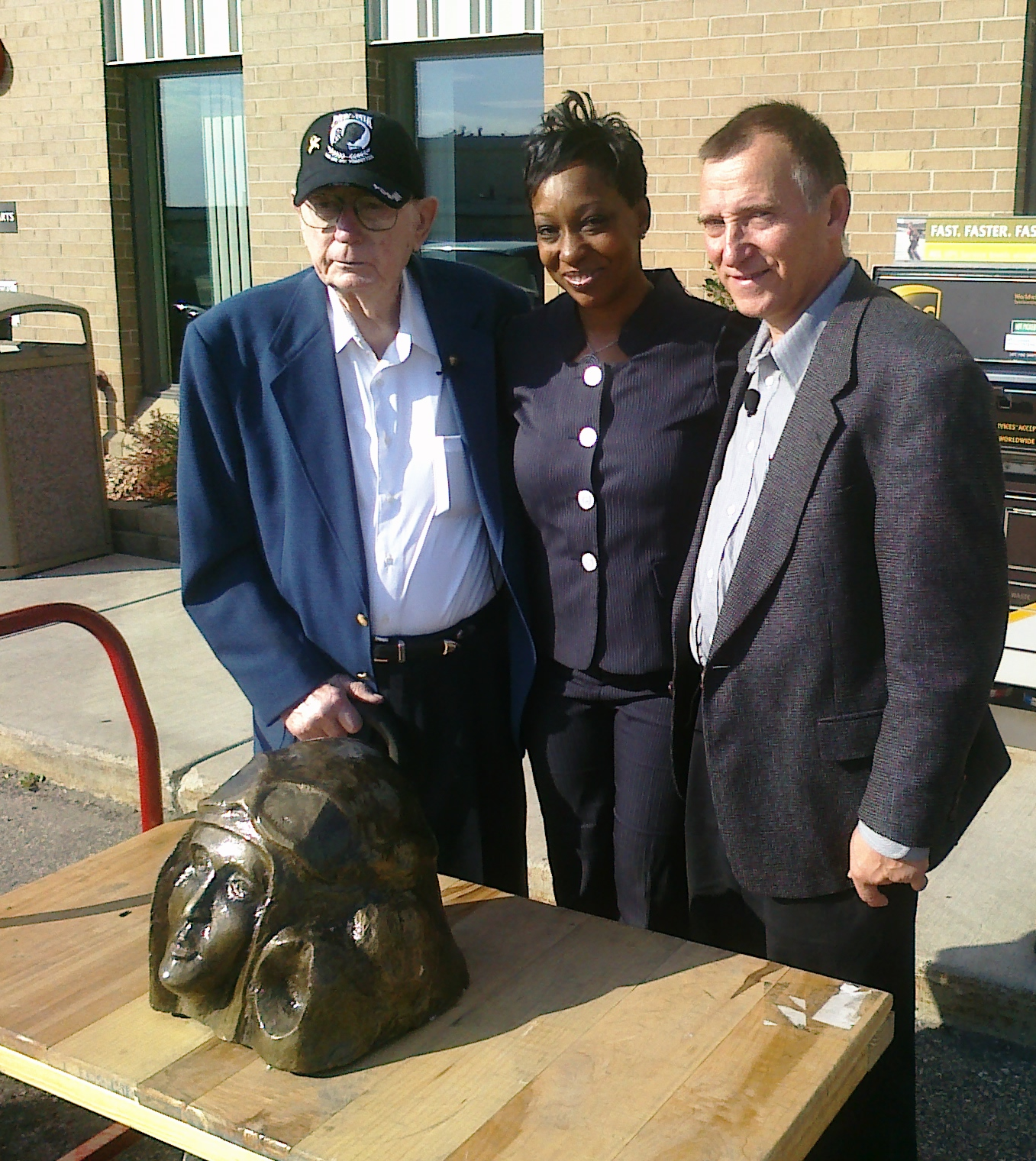
            It took two hammers and a crowbar for Wally and his son Jim to pry open the box’s green wooden slats.  They pulled at the packing Styrofoam like curious kids on Christmas morning to finally reveal the surprise.  There, gleaming in the October Minnesota sun was a bronze bust of an American airman.  An exact replica of the statue dedicated at Stalag Luft IV in Poland.  To the Pole’s it might as well be their version of the Statue of Liberty.

            When the artist told Grotz of his gift, he was stunned.  “I asked them, how so much appreciation after 60 years?  He said, ‘it took us a hundred and 25 years to get our freedom and we appreciate it.’”

            As a former POW, Grotz is one of the few of us in America who uniquely understands.  “There’s just a few of us left who actually remember what these poor Polish people went through,” said Grotz.  “Five years under the Nazi’s and then from 1945 until the end of the cold war under the communist rule.”

Former POW Wally Grotz, UPS Sales Representative Lisa Anderson, and Wally's son, Jim Grotz
Former POW Wally Grotz, UPS Sales Rep Lisa Anderson, and Wally’s son, Jim Grotz

                 Grotz has accepted the sculpture on behalf of all his fellow 8th Air Force veterans.  He intends to display it in the lobby of the Veterans Hospital Minneapolis.  Then, on Veterans’ Day he and his family will drive it to the 8th Air Force Museum in Pooler, Georgia where curators will display the sculpture among its permanent collection.

            Grotz’s family, especially his son Jim could not be more humbled.  “I think it’s a very fitting tribute to all veterans of this country that people of a small region of the world would come back after the fact and say, ‘Thank you veterans for having made us a free nation,’” said Jim.

            Yes, freedom has a price.  In this case it comes with deep gratitude, and a box that can no longer carry it.

Are We Serving Our Customers’ (Viewers’) Mindset?

3 Sep

            The Associated Press alert that chimed on my newsroom computer a few years ago was short and direct.  “Bulletin: Jeane Kirkpatrick has died.”

            I leapt from my desk and shouted across the room to my 5 p.m. newscast producers, “Folks, we have to add an important story. Jeane Kirkpatrick is dead!”

            The silence was deafening.

            Then came the puzzled, if not predictable reply shouted back.

            “Who’s Jeane Kirkpatrick?”

            One of our senior investigative reporters sitting just a desk away burst out laughing and then buried his head in his hands in disgust at what he just heard.  How can anyone in the news business, the very scribes of contemporary history, not know of the first woman U.S. ambassador to the United Nations?

            I walked over to his desk and said, “Dude, we gotta cut her some slack, she wasn’t born yet when Reagan made her a diplomatic rock star.” 

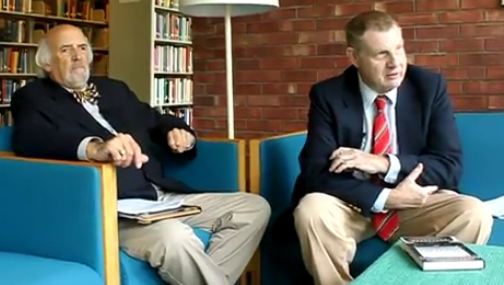
Mindset List Creators Tom McBride and Ron Nief

           That little newsroom narrative serves as a wonderful introduction to one of my favorite rites of fall, Beloit College’s Mindset List.  Before school starts each September, Beloit Professor Tom McBride along with the college’s former Public Affairs Director Ron Nief trot out a list of social and experiential realities that have shaped the lives of incoming college freshmen.  The list is meant to give educators insights into the mindset of their students so there can be more productive classroom learning and dialogue.  The list is not only instructive for college professors, it’s also useful for businesses, advertisers, marketing executives, and yes, even news organizations.  http://www.youtube.com/embed/J4HJ6EHb3CI?rel=0

          Among the most useful insights from this year’s mindset list of our future customers are these:

      1.  There has always been an Internet ramp onto the information highway.

      9.  “Don’t touch that dial!” …what dial?

     12.  Amazon has never been just a river in South America.

     30.  Dial-up is soooooo last century.

     37.  Music has always been available via free downloads.

     63.  They won’t go near a retailer that lacks a website.

            The takeaways?  They’re connected, mobile, and consume on their schedule, not the schedule we make for them.

            Those very insights mirror portions of my own research on viewers of Fox 9 News in Minneapolis, Minnesota.  In a survey of 1116 viewers, 42 percent indicate they use the internet to access Fox 9 News content at least three to five days a week.  Twenty-two percent visit Fox 9 online every day.   Even more significant, 40 percent of Fox 9’s online audience indicates they access the station’s news content through a mobile device. 

Viewers Accessing Fox 9 Through Mobile Devices

            The implications for news organizations and businesses alike could not be more clear.  Our customers are changing and so are their mindsets.  This year’s entering class of 2015 is symbolic of the new generation of emerging consumers. They no longer shop exclusively at stores with shelves and they will not wait until 9 p.m. to watch the latest news—especially from a traditional TV set.  Those of us in legacy industries trying to reach our customers through traditional platforms and channels are in peril of becoming irrelevant in our own mindset.

            Yes, today’s next generation of consumers may not know who Jeane Kirkpatrick was, but they know how to find out on their smartphones.  The question is, will be there to tell them?

The Terrible Toll of Alzheimer’s

27 Aug

Julie Allen, Alzheimer's Patint

    Jullie Allen knew something was wrong on the eve of a major business presentation five years ago.  She froze. 

     “For some reason I couldn’t make the changes and I couldn’t figure out what I needed to have in there,” said Allen. 

    She called the client and quit.  At 56 years old, it was her first sign that something was seriously wrong.  A year later she was diagnosed with Alzheimer’s disease.

    “When you get the diagnosis the first thing is it’s gone, I’m done. I’m going to sit in a chair, because you think about the old people who are sitting there,” said Allen.  The good news is she’s determined not to be one of those people—yet.

    Alzheimer’s takes its time.

  It’s taking its time on Glenn Campbell, too.  Since disclosing his own battle with Alzheimer’s earlier this year, the rhinestone cowboy is already losing his glimmer.  ABC’s Terry Moran gave us all a gift with his recent profile on Campbell.  The gift is being able to see the progression of Alzheimer’s in people we know and love.  When Moran asked Campbell and his wife Kim Woollen about Alzheimer’s, here was the response:

Campbell:     “I haven’t got it yet. In fact I don’t know where it came from?” 

Woollen: “Yes, you’ve been diagnosed with Alzmeier’s.”

Campbell:  “What?”

    Julie Allen can relate.  “It kind of is like a snake. I kind of just keeps eating more and more away.”

    The Alzheimer’s Association gives us a wonderful top ten list of what to watch for in our own loved ones:

  1. Memory changes that disrupt daily life
  2. Challenges in planning and problem solving
  3. Difficulty completing familiar tasks
  4. Confusion with time or place
  5. Trouble understanding visual images or special relationships
  6. New problems speaking or writing
  7. Misplacing things
  8. Decreased judgment
  9. Withdrawal from work or social activities
  10. Changes in mood or personality

    Tragically, there’s no cure.  But Dr. Richard Hodes of the National Institute of Aging within the National Institutes of Health says they are making significant progress.  I spoke with him at an Alzheimer’s panel put together by U.S. Senator Amy Klobuchar.

    “Perhaps one of the most important advancements that’s been made is the ability to identify stages of the disease far earlier than previously had been done,” said Hodes.  “So we no longer need to be able to depend upon diagnosis when the symptoms occur which makes if possible to possibly prevent symptomatic disease.”

    He admits there is a long way to go.  But Julie Allen is not wasting time.

    “To live with Alzheimer’s is to just plain live,” said Allen.

2010 Emmy Winner!

27 Sep

   The envelope please…

    If everyone has a story, Alice Smith has a life time of them.   Her view of the world may have been born with the dawn of the Great Depression, but she’s been determined never to let it become her sunset.  As the daughter of a dairyman in Rice Lake, Wisconsin, she became the farm hand her father so desperately needed in those dark days after the stock market crash.  It meant chores came before school.  A high school diploma was only a luxury that didn’t milk cows or help a struggling farm pay the taxes. 

    But Alice never gave up her dream.  At 88 years old, she went back to school to finally earn that high school diploma. 

    When photo Photojournalist Andy Shilts and I met Alice Smith, we knew we had a story.  Alice wasn’t just a good story, she was a great story.  She teaches us that it’s never too late to achieve your goals, and certainly never too late to learn.  Apparently the National Academy of Television Arts and Sciences agreed.  The story has just been honored with the 2010 Emmy Award for best single education story.