Archive | Topical News RSS feed for this section

Strategic Crisis Communications – How Fairview Hospitals’ Chairman Gets It.

1 Jun

It seemed like such a simple idea.  Then the Attorney General weighed in.

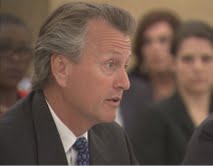
Fairview Health Systems Chairman Michael Mooty appearing at U.S Senate hearing on payment collecting practices at Fairview hospitals.

The idea was a basic business proposition.  Get the customer to pay for the services they need before walking out the door.  But in this case the business is a hospital and the customer is sick.

It is under that scenario that Fairview Hospitals in 2010 hired Accretive Health to help it recover more money from patients.  In an era of health care where costs are up and margins are down, the hospital system’s sustainability was increasingly dependent upon securing payment for the care it provided.  The “Revenue Cycle Agreement” between Fairview and Accretive Health ushered in a new culture at Fairview that often times focused on payment before care.

Minnesota Attorney General Lori Swanson

That’s where Attorney General Lori Swanson cried foul.  Her compliance review of Fairview’s contract with Accretive Health released on April 24th uncovered six volumes of alleged abuses and violations of federal law.  The evidence included internal Accretive Health emails that revealed how the aggressive bill collecting tactics led to some patients leaving the hospital in disgust before seeing a doctor.  In one affidavit, an employee describes how they were forced to obtain payments from patients in the emergency room or they would be fired. (Figure 1)

Figure 1 – Affidavit from MN Attorney General’s compliance review of Fairview hospitals and Accretive Health.

In almost every respect, it is another contemporary case study of an organization losing site of its core values and mission—in this case, the commitment to always put patient care first.

It’s perhaps fair to say that Fairview board chairman Charles Mooty never wanted to become the subject of such a case study.  But Mooty deserves some notice for his handling of the crisis and his attempt to take corrective action.

There are several hard and fast rules to effective strategic crisis management and communications:

  1. Cease and desist—stop doing what you’re doing.
  2. Apologize to those you’ve wronged—and mean it.
  3. Change your tactics.
  4. Communicate the change to employees and customers.
  5. Establish performance measures for how the change is working.

In a congressional investigative hearing this week, Chairman Mooty followed the script with near precision.  While testifying in a field hearing before U.S. Senator Al Franken, Mooty offered both contrition and a plan for moving forward. Here’s his very strategic response:

1. Cease and desist.

“We’ve stopped collecting past due balances and co-insurance payments in emergency departments, and we’re reviewing emergency department information and workflow processes.”

 “Fairview terminated its work with Medical Financial Solutions, a part of Accretive Health on January 6 of 2012 because of their failure to comply with the Attorney General’s billing and collection agreement.”

 2. Apologize.

“To those patients I offer my personal apology and firm commitment on behalf of the entire Fairview organization to regain your trust.”

3. Change tactics.

“We are reviewing and revising our training tools to ensure each patient interaction reflects Fairview’s core values.” 

 4. Communicate change.

“In addition to our termination of agreements with Accretive Health, we also have initiated better approaches for escalating patient, employee and physician concerns so that they receive prompt attention.”

 This last statement by Mooty perhaps telegraphs what may have been an critically important breakdown within Fairview.  Mooty told the Senate hearing no less than four times that Fairview was going to do a better job of listening to its stakeholders.  Attorney General Swanson’s investigation provided several documents that Fairview doctors and staff had expressed deep concern about the new payment collecting policies instituted by Accretive Health.  Mooty’s testimony strongly signals that those concerns either didn’t get communicated to Fairview leadership, or that leadership simply wasn’t listening.

One of Mooty’s most important changes came during the week before the Senate hearing when he and the board of directors decided not to renew the contract of current Fairview CEO Mark Eustis, the man who hired Accretive Health.  The board named Mooty as interim CEO sending a clear signal that it was breaking with the past.

While Mooty gave no clear indication of how Fairview intends to measure its progress, he clearly used a big stage to send key strategic messages to several key audiences, among them his patients, employees and the public.  But in this case his primary audience is government regulators.  If Mooty can’t convince them that he’s prescribed the right medicine, a more rigorous regimen will be forced from outside rather than inside.

The stakes are high.  So is Fairview’s credibility and trust.

Vikings Stadium Victory: The Power of Social Democracy

12 May

When the founding fathers guaranteed the right to petition government, they never conceived of Facebook or Twitter.  But the mass democratization that just occurred in Minnesota just may be what James Madison had in mind when he conceived of the Bill of Rights.

Artist rendering of a new Vikings stadium

In a stadium debate that was inexorably mired in partisan politics and collapsing like the Metrodome roof, Vikings fans took to the internet, social media and their phones to drive the votes in favor of building a new “People’s Stadium.”

To be sure, the Vikings and labor unions helped amass their fans and members to call and write their legislators.  But web analytics also show that there was a substantial organic movement among citizens.

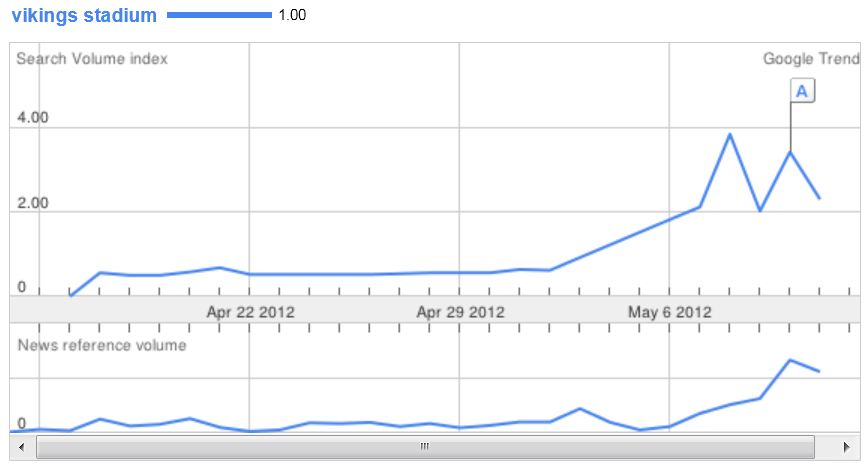
Figure 1- Google Trends

In the days leading up to the final stadium vote in the Minnesota legislature, there was a substantial groundswell in what digital analysts call “search” and “share.”  Google Trends data (Figure 1) shows the exponential rise in Minnesotans searching for information on the Vikings stadium leading up to the floor vote in the House of Representatives on May 7th.   Additionally, the number of unique page views to vikings.com also rose ahead of and during the vote. (Figure 2)

Figure 2 – Daily unique page views

But perhaps one of the Vikings’ more effective strategies was enlisting their more than 1.3 million Facebook fans.  It’s a strategy they’ve tried before.  With a post on May 4th, the Vikings asked their followers to contact their representatives. (Figure 3)

Figure 3 – Facebook Post, May 4th, 2012

That alone cannot explain why thousands of constituents followed through.  But there’s a theoretical framework that does.  It’s called Prospect Theory.   The theory was developed in 1979 by Princeton psychology professor Daniel Kahneman who later won the Nobel Prize in Economics.  In its simplest form, it holds that people are risk averse.  In the case of the stadium debate, Minnesotans in the end were more afraid of possibly losing the Vikings than they were about gaining stability in taxes and state finances.  There were plenty of worthy and important arguments about jobs, public debt, and voter referenda, but in the end it was fear of losing the Vikings—perceived or real—that perhaps carried the day.

At least one key lawmaker the acknowledged the importance of the social movement at the governor’s May 10th news conference following the final passage of the stadium bill.

“You made an incredible mark on your legislators, I can tell you,” said Sen. Tom Bakk.


Bakk told how lawmakers often times share with each other how many emails they get.  “You know, if you get six or eight on something, people talk about it.  I got 987 between 10 o’clock one night and 6 o’clock the next morning,” said Bakk.

That’s petition.  That’s power.  And it’s another example of the new rise in social democracy.

The Doolittle Raid on Tokyo–One Family’s Untold Story

13 Apr


President John F. Kennedy once wrote that “Victory has 100 fathers…”  This is a story about a victory that has at least one grandfather—my own.

Seventy years ago this winter, a small team of ordinary tradesmen helped another team of ordinary airmen achieve an extra-ordinary mission.  Together they changed two countries, and perhaps influenced the outcome of WWII.

Picture 1 – Former Northwest Airlines mechanic Philip Blotz. This picture is taken after enlisting in the U.S. Navy as an aircraft mechanic in 1944.

Philip Blotz was a new father and a young aircraft mechanic living in Minneapolis during the outset of the war. (Picture 1)  His apartment on 34thAvenue South was just a short ten block drive to Wold-Chamberlain Field where he worked as a ramp chief for Northwest Airlines.  The winter of ‘41-42 was as bitter as the start of the new war.  The temperature in the Twin Cities dropped to -20 in early January as a fresh blanket of snow covered the Minnesota prairie.  But as Blotz made his daily trek to the frozen air field a surprise was about to arrive in an early spring breeze from the west.  By the end of January a thaw had losened winter’s steely grip.  As Blotz turned to park his car at the mechanics hangar there was a spring gift any young aircraft mechanic would covet—a squadron of new B-25B Mitchell bombers. (Picture 2)

Picture 2 – One of Doolittle’s B-25B Bombers at the Mid-Continent Airlines Hangar in Minneapolis during the winter of 1942. (Courtesy: NWA History Centre)

The planning, work, and rework that happened in Minneapolis during the course of the next few weeks was all conducted under a blanket of secrecy as deep as the prairie snow.  The Army Air Corps had contracted with Mid-Continent Airlines to make significant modifications to the bombers.  The goal was to transform these medium-range aircraft into long-range cruisers.   The mechanics and the crew members of the 17th Bombardment Group were led to believe that the work was to enable the B-25’s to fly on U-boat patrols off the Atlantic coast.   The pilots were soon to learn otherwise.

One morning in Minneapolis, Army Air Corps Capt. Ted Lawson recalled in his book “Thirty Seconds Over Tokyo” how legendary aviator Jimmy Doolittle, then an Air Corps Lt. Colonel,  sent a trusted aide to gather up the pilots for a secret meeting.  Capt. Davey Jones locked the door in a Minneapolis hotel and told the men about an important mission that was under consideration by top brass.  The mission was unprecedented.  It was also daring and dangerous.

“Where?” somebody asked.

“I’m sorry, I can’t tell you any more,” Davey said.  “You’ve heard all the particulars I can give you .  Now who will volunteeer?  It’s perfectly alright if you don’t.  It’s strictly up to you.”

All of us volunteered.

– Ted Lawson in Thirty Seconds Over Tokyo

Two of Doolittle's B-25' awaiting extra fuel tanks at the Mid-Continent Airlines Hangar in January 1942  (Courtesy: Tom Norrbohm)

Picture 3 – This newly acquired photo shows two of Doolittle’s B-25’s awaiting the installation of extra fuel tanks at the Mid-Continent Airlines hangar in January 1942.  This is a critical photo for two reasons.  First, the tail number of the right aircraft matches the manifest of Doolittle’s after action report on the raid on Tokyo.  Second, the aircraft is clearly guarded by two armed sentries which speaks to the secrecy and security concerns of the fuel tank modifications.   (Courtesy: Tom Norrbohm)

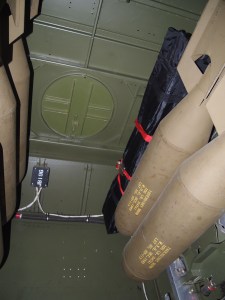
Back at the hangar, Blotz and the rest of mechanics were hard at work.  Air Force archives reveal how the men installed two additional gas tanks.  A 160 gallon rubber bag tank was fixed to the top of the bomb bay.  The bag tank completely blocked the crew from getting from one end of the aircraft to the other.  But after the gas was consumed and the fumes vented, the tank could be collapsed in-flight to clear the passage way.  Another 265 gallon steel tank was mounted inside the fuselage later to be replaced by a 225 gallon rubber-lined leak-proof tank.  (Picture 4)
Picture 4 - View of the top of the bomb bay of a B-25 where Minneapolis mechanics installed 225 gallon fuel tank.

Picture 4 – View of the top of the bomb bay of a B-25 where Minneapolis mechanics installed a 225 gallon fuel tank.

Wayne Snyder of the Northwest Airlines History Centre says the mechanics utilized every bit of free space on the bomber.  “They carried a lot of gasoline.  It was AV gas, very explosive and the fumes could be very dangerous.  Basically, every place they could put sizable tanks was a gasoline tank,” said Snyder.

The crews also installed bomb extension shackles made by the McQuay Company in Minneapolis.  They fine-tuned the 1,700 horsepower Wright Cyclone engines and readied the aircraft for flight.

By the end of February, 1942, Blotz and the rest of the mechanics had finished their work.  The airmen of the 17th Bombardment Group and their mission commander Jimmy Doolittle were just beginning.  From Minneapolis they flew to Eglin Field in Valparaiso, Florida where the airmen spent the next few weeks practicing short takeoffs and low-level bombing runs .

Picture 5 - This newly acquired photo is of plane #2242 at Wold-Chamberlin Field.  This B-25 was flown by Capt. Ed York and was the 8th plane to launch from the deck of the USS Hornet and the only plane to survive the raid on Tokyo.  Capt. York safely landed this aircraft a Russian airfield about 40 miles north of Vladivostok. This same aircraft is seen in Picture 4 along side the Mid-Continent Airlines Hangar.  (Courtesy: Tom Norrbohm)

Picture 5 – This newly acquired photo is of plane #2242 at Wold-Chamberlin Field.  This B-25 was flown by Capt. Ed York and was the 8th plane to launch from the deck of the USS Hornet and the only plane to survive the raid on Tokyo.  Capt. York safely landed this aircraft at a Russian airfield about 40 miles north of Vladivostok.  This same aircraft is seen in Picture 4 along side the Mid-Continent Airlines Hangar. (Courtesy: Tom Norrbohm)

On March 31st, just sixteen of the B-25’s were loaded onto the deck of the USS Hornet (CV-8) aircraft carrier in Alameda, California.  The next day Admiral William Halsey steamed the task force out to sea.  At last, Doolittle gathered his volunteer crew togehter and finally revealed their mission: Tokyo.

As Halsey navigated the task force toward Japan, Doolittle set the launch date for the midnight hours of April 19th.   But war, as life, seldom follows plans.  A Japanese fishing trawler came in contact with the task force on the morning of the 18th.  Fearing it had radioed the mainland with a warning putting the task force at risk, Halsey and Doolittle launched the raid 10 hours early and 400 miles further out to sea.

Picture 6 – Tim & Matt Myklebust of the Commemorative Air Force in the cockpit of the B-25J “Miss Mitchell.”

If there’s anyone who knows what Doolittle’s men were about to experience, it’s a group of avid fliers in St. Paul, Minnesota.  Twice a week, volunteers with the Minnesota Wing of the Commemorative Air Force gather to maintain and care for their own B-25 bomber.  It is one of just 42 remaining B-25’s in the world that are still flying.  What these volunteers know, what Doolittle’s men knew, is that the Mitchell gives the pilot and co-pilot a narrow, limited forward view.   The plane sitting level on its nose gear gives the pilot a clear view of the horizon, but not what’s immediate in front of him. (Picture 6)  Sit in the cockpit along with the CAF’s Matt Myklebust and it becomes horrifyingly clear that the only thing Doolittle and his men would have seen was the ocean rising and falling with the swell of the heavy seas.  The end of the carrier deck would have been nowhere in sight—no way of knowing if you were about to fly or plunge into the ocean.

“And that carrier is pitching up and down,” explains Myklebust.  “And you got to sit there with all your might at full power and release the brakes on the high pitch to get off the deck.”

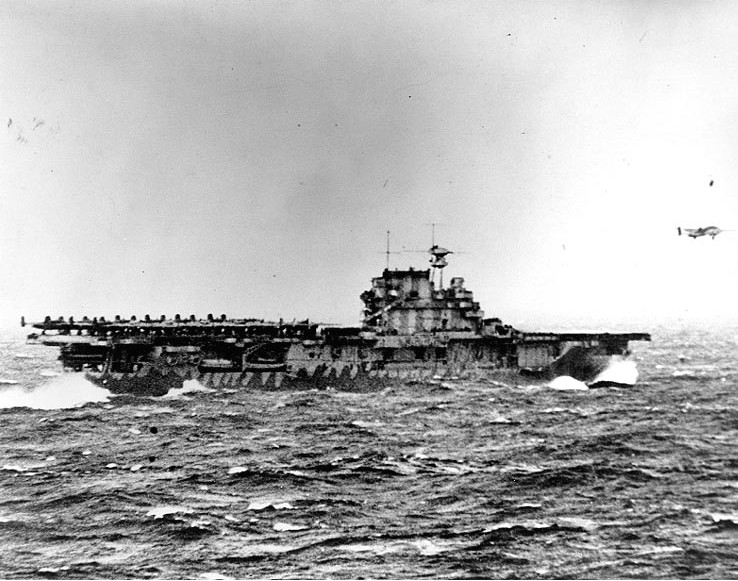
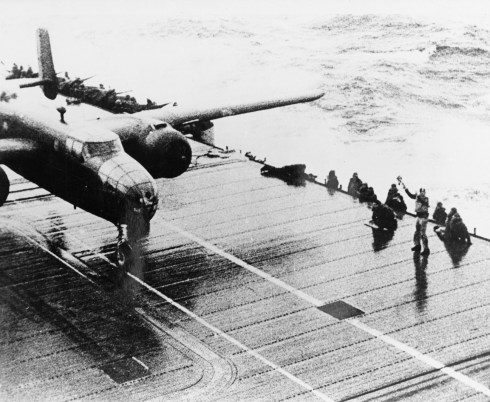
Picture 7 – Launch from the USS Hornet, April 18th, 1942.  (Courtesy: U.S. Archives)

Both history and archival film will forever record that Doolittle and his pilots not only successfully launched from the Hornet, they made it all the way to Japan. (Picture 7)  Nearly every bomber hit its primary targets and was met with surprisingly little Japanese fighter resistance.   In his report to the War Department Doolittle wrote, “The damage done far exceeded our most optimistic expectations.”

News of the raid spilled like ink from a barrel as papers around the world leaded the headlines in 72-point type.  Across Minnesota, word of the raid was as welcome as spring breakup–and a sign, too.  In a war seemingly as frozen and foreboding as Lake Mille Lacs, the Doolittle Raid was as much a welcome symbol of renewal as the call of the first loons of spring.  (Picture 8)

Picture 8 – Randal Dietrich of The 70 Years Project showing a newspaper headline reporting the raid on Tokyo.

“This was a lynchpin kind of moment in the war and these headlines reveal that,” said Randal Dietrich of The 70 Years Project.

Each day for the next four years, The 70 Years Project is chronicling WWII as it was reported in newspapers across Minnesota.  The headlines from the morning of April 18th may have trumpeted the news, but it told only half of the story. (Picture 9)

It would be weeks before the War Department would confirm the raid, but among a small group of Minnesota airplane mechanics, the pride was as bright as a polished wing panel.  To Northwest Airlines retirees, it is still one of the most storied chapters in the airline’s history.

“The people that had been involved in it had been very proud of their work to start with,” said former NWA mechanic Wayne Snyder.

Picture 9 – Minneapolis Morning Tribune, April 18th, 1942.  (Courtesy: The 70 Years Project)

“And for me to have that as one of the first stories I heard when I started at Northwest you could see that the people involved in it were very proud of their work and knew that they had contributed significantly to the war effort.”

As for my grandfather Philip Blotz, his small role in the Doolittle Raid was not his last contribution to the war.  Northwest Airlines would later send him to Wright Paterson Air Base in Ohio where he continued to service military aircraft.  In 1944 he enlisted in the U.S. Navy.  As grandchildren he would often regale us with the stories of the many fighter planes he maintained, how the F-4U Corsairs had bad landing gear hydraulics and how the F-6 Hellcats and the eventual F-8 Bearcats were the best planes in the air.  But somehow the stories always came back to Doolittle’s B-25’s.

To this day, the role these men played is one of the countless under-told stories of WWII.  It’s not just my family’s story to tell, Randal Dietrich believes it’s Minnesota’s story, too.

“Now a days we should all take some pride in that work was done here in Minnesota leading up to April of 1942 and enabled those fliers to launch that raid and change the direction of WWII from one of defeat to ultimate victory,” said Dietrich.

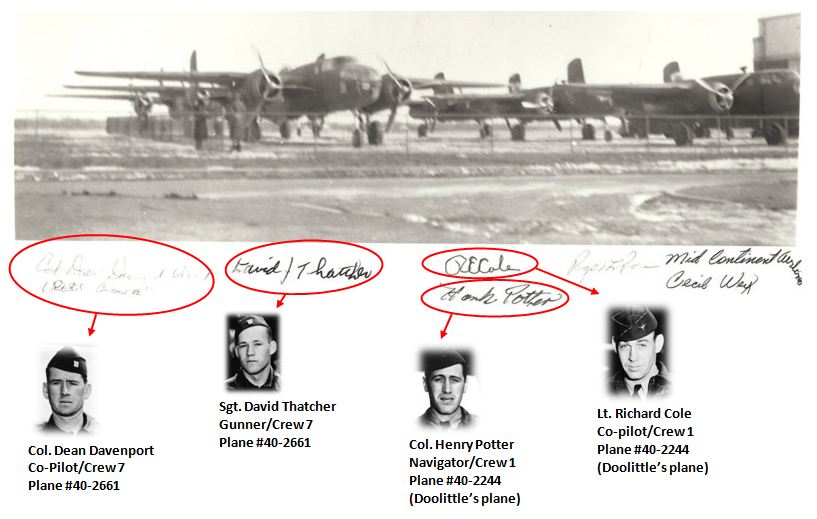
Picture 10 – B-25’s of the 17th Bombardment Group at the Mid-Continent Airlines hangar in Minneapolis as they were being retrofitted with extra fuel tanks for the raid on Tokyo.  The picture is signed by four crew members of the mission.  These signatures were most likely obtained well after the Doolittle raid by evidence of the fact that David Davenport signed his rank as Colonel.  Davenport would have been a lieutenant during the mission.  (Picture Courtesy: NWA History Centre)

Picture 11 – B-25’s at Mid-Continent Airlines Hangar in Minneapolis.  (Courtesy: NWA History Centre)
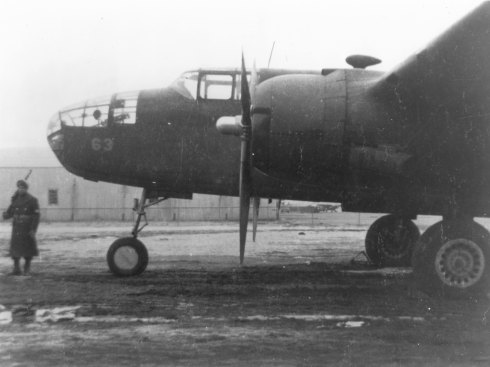
Another one of Doolittle's B-25's at Wold-Chamberlin Field in Minneapolis. This picture is significant for two reasons. First, it is taken inside the securty zone, perhaps by a contractor.  Second, is the presence of an armed sentry.  The sentry provides importance to the secrecry and military importance of the modificaitons being conducted on the B-25's.

Picture 12 – Another recently acquired photo of one of Doolittle’s B-25’s at Wold-Chamberlin Field in Minneapolis.  This picture is significant for two reasons.  First, it is taken inside the security zone, perhaps by a contractor.  Second, is the presence of an armed sentry.  The sentry provides importance to the secrecy of the modifications being conducted on the B-25’s.  (Courtesy: Tom Norrbohm)

Picture 13 – Another view of the one of Doolittle’s B-25’s at the Mid-Continent Airlines Hangar in Minneapolis – 1942.  (Courtesy: NWA History Centre)
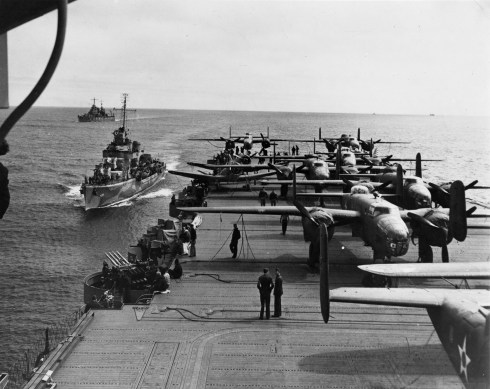
Doolittle's B-25's on the deck of the USS Hornet.  (Courtesy: US Navy archives)
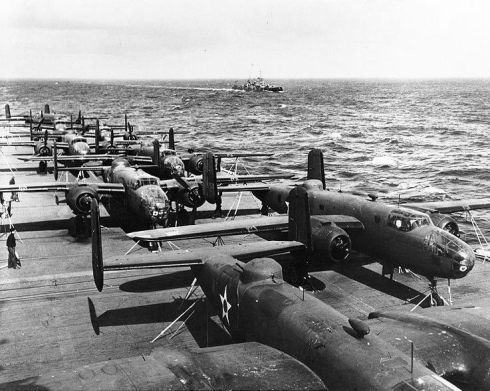
Picture 14 – Doolittle’s B-25’s on the deck of the USS Hornet.  (Courtesy: US Navy archives)

Doolittle's B-25's on the deck of the USS Hornet.  (Courtesy: US Navy archives)

Picture 15 – Doolittle’s B-25’s on the deck of the USS Hornet.  (Courtesy: US Navy archives)
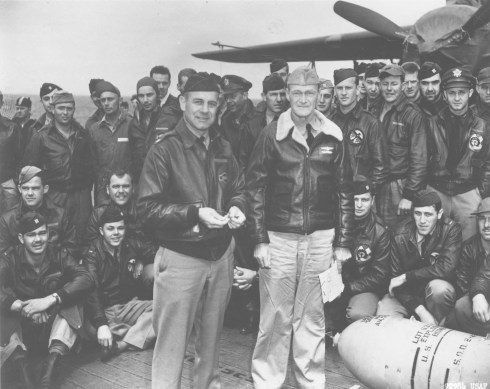
Lt. Col. Jimmy Doolittle accepts a medal from the skipper of the USS Hornet, Capt. Marc A. Mitscher. The medal, once given to a U.S. Navy officer by the Japanese, was wired to a 500-pound bomb for return to Japan "with interest." (Courtesy: US Air Force archives)

Picture 16 – Lt. Col. Jimmy Doolittle accepts a medal from the skipper of the USS Hornet, Capt. Marc A. Mitscher.  The medal, once given to a U.S. Navy officer by the Japanese, was wired to a 500-pound bomb for return to Japan “with interest.” (Courtesy: US Air Force archives)

Crew members loading 50-caliber ammunition into trays prior to their launch from the USS Hornet as members of the US Navy watch. (Courtesy:  US Air Force Archives)
Picture 17 – Crew members loading 50-caliber ammunition into trays prior to their launch from the USS Hornet as members of the US Navy watch.  (Courtesy: US Air Force Archives)

Raid picture taken from one of the B-25's over Tokyo  (Courtesy: US Airforce archives)

Picture 18 – Preparing to launch from the USS Hornet (Courtesy: US Navy archives)

One of Doolittle's B-25's launching from the deck of the USS Hornet on April 18th, 1942.  (Courtesy: US Navy archives)

Picture 19 – One of Doolittle’s B-25’s launching from the deck of the USS Hornet on April 18th, 1942.  (Courtesy: US Navy archives)
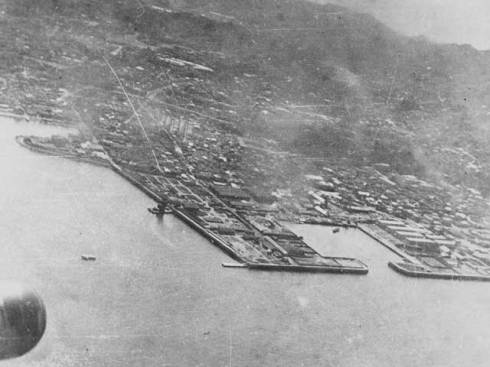
Picture taken from the cockpit of oneof the Doolittle Raiders over Tokyo.  (Courtesy: US Air Force archives)

Picture 20 – Photo taken from the cockpit of one of the Doolittle Raiders over Tokyo. (Courtesy: US Air Force archives)

Pink Slime — Anatomy of a Contagion

23 Mar

The gooey mess known as Pink Slime has suddenly become a public relations mess too.  But, how did it go from a food additive to a food disaster in record time?  A large part of the answer lies in the power of social memes and the ability of key audiences to spread it like a contagion.

Figure 1 - Pink Slime

Let’s break it down.  In this case, the food additive included in some forms of processed beef came with a descriptive slang name and an iconic image: pink slime. (Figure 1)

In its basic form, pink slime a substance made from the rendered connective tissues and intestines of cows.  Because those tissues are susceptible to e-coli contamination, they are processed with ammonium nitrate to kill the bacteria and act as a preservative.   For years the FDA has approved the additive as a safe filler for meat products.  But when an image and video of the substance appeared in the news reports in early March about its presence in school lunch hamburgers, pink slime became a household word as fast as parents could hit the “send” button on their computers.   As a Google Trends analysis shows, pink slime went viral in a matter of 24-hours and has not let up since. (Figure 2)

Figure 2 - Google Trends

Three key factors are involved here.  First, the image itself of the pink slime became what social psychologist Jaap Van Genneken would call a strong replicator.  In other words, it’s an iconic image that developed and sealed an emotion in the minds of the viewer.  In this case, the image leads to the very human response of questioning what this substance is doing in our food—especially our children’s food at school.

Second, the image sealed itself in the minds of an important audience.   That audience is mainly women, in particular, the mothers of school children.

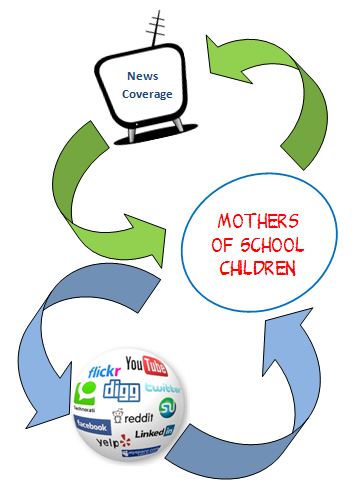
Third, these women not only saw the image of the pink slime included in stories in various news media, they spread the story to their friends and peer groups in social media.  My own audience research among social media users indicates that women are heavily invested in, and are heavy users of social channels.   They not only use social media as a way of discovering news from their friends, but to share news and issues that are important to them.   When this story broke, the image, the issue, and the salience to their children and families created its own perfect recipe for a modern-day social issue contagion. (Figure 3)

Figure 3 - Contagion Model

The result has been a sudden abandonment of meat products containing the so-called pink slime.  Several major grocery store chains have now said they have stopped ordering beef products containing the additive.   One of them is Twin Cities based SuperValue which owns and operates Cub Food stores throughout the Midwest.   Here’s its statement:

“We’ve heard concerns from many of our shoppers about the inclusion of finely textured beef in some of the ground beef products available at our stores. Effective today, we have made the decision to no longer purchase fresh ground beef products that contain finely textured beef.”  -SuperValue

            The power of the contagion lies in the statement’s first sentence.   Consumers spoke up.  SuperValue listened.  It’s a 21st century lesson in the speed of which issues closely tied to strong memes can spread, and the power of key audiences armed with a “send” button.

OutFOX Diabetes

11 Feb

             I’ve shared with people over the years my passion for finding a cure for Type-1 diabetes.

             I have two very good reasons.
             My oldest daughter Madison  was diagnosed at the age of three, our other daughter Emerson was diagnosed at twelve.  Two children.  Two lives filled with constant blood sugar monitoring and insulin injections.

OutFOX Diabetes Walk Team - Mall of America February 25h, 2012

             For more than a decade my family and I have been active within JDRF to help raise money to find a cure for Type-1 diabetes.  This year my family is joining the Fox 9 family to form a walk team called OutFOX Diabetes.   The Walk takes place February 25th at the Mall of America in Bloomington, Minnesota.  We don’t necessarily need walkers, but we need supporters.  If you’d like to be a virtual walker with us, click on the hyper link and make a donation to our team.

             We are making incredible progress toward finding a cure.  Last year JDRF spent $116 million on research and much of it is producing encouraging results.

             We are grateful to all who have helped in the past and continue to support the search for a cure.

Blessings,

Timothy

Can Google Predict the Minnesota Caucuses?

7 Feb

Ron Paul Trending Well in Minnesota

                It’s far from a scientific sample of the electorate, but Google has so far been a fairly reliable predictor of election results so far in the 2012 presidential cycle. 

                Google tracks what people search for online.  In a way, it’s a measure of groundswell and interest.  Marketers call it buzz.  When one mines the Google Trends data just for Minnesota in the past 30 days the search results show Ron Paul far and away has the most buzz. (Figure 1) 

Figure 1 - Minnesota Google Search Trends

               In the past six months I’ve observed how Google Trends served as a barometer for Michele Bachmann’s surprise win in the Iowa Straw Poll and Rick Santorum’s tight finish in the Iowa Caucuses.

                The latest scientific poll out by Public Policy Polling shows Rick Santorum with a substantial lead over Mitt Romney, 30-24%.  Newt Gingrich is next with 22% and 20% for Ron Paul.  In other words, PPP shows nearly the opposite results as Google.

                To be sure, Ron Paul has attracted a loyal following of younger supporters who have swamped every Minnesota campaign appearance in the past several days.  Paul has also trended very well in Google in previous presidential contests.  In fact, Google Trends showed him with the most buzz prior to the Iowa Caucuses.  However, he has not been able to convert that buzz into votes.  We’ll see if he’s able to accomplish that Tuesday night in Minnesota.

Susan G. Komen’s PR Disaster. What Went Wrong, and How it Could Have Been Prevented.

5 Feb

                The pink ribbon that ties together a breast cancer community managed to tie a pink noose instead. 

               Susan G. Komen somehow hung itself.  Somewhere, someone inside the organization cut the rope just in time.   But, it’s gasping for air.

                The tragedy in its decision to cut off funds to Planned Parenthood not only damaged the image of an exceptionally worthy organization and powerful super brand, it potentially threatened the lives of the some of very women it has promised to serve.  The question is, how did this happen? 

                The legal and moral arguments over the Komen’s initial decision to pull its grants from Planned Parenthood have been well documented.  Komen was getting increasing pressure from the right to life movement to no longer fund breast cancer screenings at an organization that also provides abortions.  How Komen responded to the pressure will be analyzed in case studies that compare it against such classic PR disasters as New Coke, and more the more recent debacles of ACRON, Go Daddy, and SOPA .   Each has its unique set of circumstances, yet each has its similarities.   They all lost track of their audience, their value proposition, and their soul.   But what compounded Komen’s disaster was the speed and means by which its stakeholders struck back.  Social media channels provided the platform and the echo chamber for the outrage to spread like a contagion.

                The outrage begins with what a significant number of Komen’s loyalists and evangelists viewed as a violation of trust.  Komen’s core mission is saving the lives of women.  It’s website boldly states, “Susan G. Komen for the Cure is fighting every minute of every day to finish what we started and achieve our vision of a world without breast cancer.”  It’s not just a credo, it’s a commandment. 

                Komen’s founder and CEO, Nancy Brinker proclaims, “We’re proud of the fact that we don’t simply dump funds and run.  We create activists—one person, one community, one state, one nation at a time—to try and solve the number one health concern of women.”

                But Komen’s announcement that it would suspend eligibility for further grants to Planned Parenthood for breast cancer examinations seemingly violated its core proposition and values.    Brinker attempted to argue in a YouTube video that the decision was not politically motivated.  But in a world where perception is reality, no one bought it.   Tragically, Komen, never saw it coming.


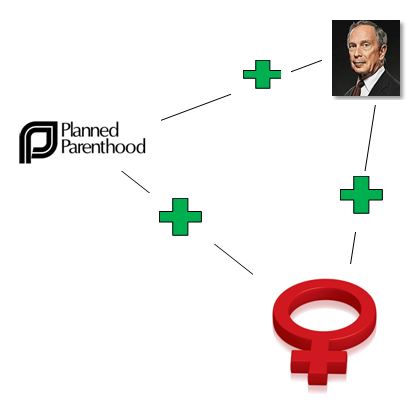
                From a pure communications analysis, Komen’s actions were incongruent with both with its mission and its constituents.  What it failed to take into account is that Planned Parenthood is also a regarded women’s health organization with considerable overlap among Komen’s own activists and volunteers.  I’ve created a simple heuristic model that shows the positive and negative congruencies between Komen, Planned Parenthood and women.  (Figure 1)

Figure 1 - Komen's Communications Incongruency Model

             Planned Parenthood has a loyal constituency of its own.  Among its supporters is New York Mayor Michael Bloomberg.  When Bloomberg took to Twitter and announced a $250,000 donation to Planned Parenthood, it leveraged more money and buzz. (Figure 2)

Figure 2 - New York Mayor Michael Bloomberg's Tweet

                What Bloomberg effectively achieved was a new congruency.  (Figure 3)  Women and donors who support both Planned Parenthood and Komen didn’t take to the streets, they followed Bloomberg and took to their smart phones and computers.  

Figure 3 - Mayor Bloomberg's Communcation Congruency Model

             The outrage in social media channels such as Facebook and Twitter spread faster than the opening steps of a Komen 3-Day event.   A little more than 24-hours after Brinker took to Youtube defending Komen’s actions, the organization issued an abrupt apology and restored funding to Planned Parenthood.  The carefully crafted message reads as follows:  “We want to apologize for recent decisions that cast doubt upon our commitment to our mission of saving women’s lives.”   In other words, they rediscovered their soul and their credo.

                 Which brings us back to Komen’s initial decision.  How would the course of events been different had the executive leadership made its decision based upon the organization’s core values and mission?  These are the same questions Komens  PR agency, Ogilvy, will have to ask as well.  In the coming days Ogilvy will have to craft a set of strategic messages to satisfy not just Komen’s supporters of Planned Parenthood, but those supporters who strongly oppose that fact that Planned Parenthood also provides abortion counseling.  The tragedy is that unless Ogilvy is working pro-bono, Komen will spend a huge sum of money on damage control that otherwise would have gone to breast cancer research.

                Komen will likely recover and catch its breath.  But it’s near death experience is a valuable lesson for organizations to constantly pay attention to their core values.  If not, in this new world order of social democracy, their followers will hold them accountable.

SOPA is Dead. Now What?

24 Jan

                Old school Washington just got a lesson new school democracy. 

                The outcry over the proposed Stop Online Piracy Act and the January 18th internet blackouts lead by Wikipedia was the information age equivalent of the shoot-out at the OK Corral.  This time Wyatt Earp was armed with a computer and millions of social media followers all firing cyber bullets at will.  The McLaury Brothers in congress never stood a chance.  SOPA and its companion Senate bill PIPA have been sent to a Boot Hill grave site.  Don’t expect daisies to pop up anytime soon.

              Social democracy won.  But perhaps just as important is what lost—intellectual property.

             The arguments on both sides were focused and compelling.  Among the most articulate voices against SOPA is a brilliant Twin Cities internet and social media entrepreneur, Tyler Olson of SMCpros.

             “SOPA fundamentally changes the internet,” Olson argues.

             What frightens Olson and thousands of savvy internet consultants and entrepreneurs like him is that SOPA would have allowed the U.S. Justice Department to shut down internet sites that unbeknown to them contained or linked to copyrighted and protected material, be it movies, music, books, software, or other creative content.

             “When the government, companies, individuals can request that anything be taken down it becomes an issue of freedom of speech, it becomes an issue of the Great Firewall of China which will now be potentially in the U.S.,” said Olson.  “And those are the things that go against the democracy of America.”

             Olson’s views have sympathetic support from at least one prominent media law expert.  University of Minnesota Law Professor Jane Kirtley says SOPA goes after a critically important issue in an unfocused way.

             “It’s using a sledge-hammer where a stiletto would be more appropriate,” said Kirtley.


             But lost in the outcry over censorship and First Amendment rights, were the rights of people to also protect the things they create.   Steve Cole is a jazz musician and recording artist who’s most recent album Moonlight has topped the Billboard jazz charts.  Cole is also chair of the music business department at the McNally Smith College of Music in St. Paul, Minnesota.

             “Of the music that is distributed through various channels only five percent we’re able to monetize.  So, if that doesn’t give you an idea of what a herculean problem internet piracy is I don’t know what would,” said Cole.

             I’ve included extended video Fox 9 interviews of both Kirtley and Cole making their arguments.

             The main target of the SOPA legislation was overseas websites that steal and distribute copyrighted material that have been untouchable to U.S. regulators. 

             “We’re trying to fix a system that is broken.  We’re trying to protect ourselves against violators of our intellectual property and their distribution too, and we don’t have a mechanism for enforcing that for overseas violators and this legislation does give us that ability,” said Cole.


             The SOPA legislation was largely backed by institutional content providers including the man who ultimately helps me may my mortgage.  (Disclosure statement: no one in my organization has been told to support a particular point of view on SOPA) NewsCorp Chairman Rupert Murdoch has been an outspoken supporter of SOPA for the same reasons as Cole.  As the owner of 20th Century Fox, Fox News Channel and the Wall Street Journal, Murdoch believes SOPA is needed to combat a growing culture where people believe everything on the internet is free—or should be.

             But there’s also another take on the debate and it come from James Allworth and Maxwell Wessel in the Harvard Business Review.  Their analysis is that the media giants are pushing SOPA to protect business models that are no longer nimble and innovative. 

             “SOPA is a legislative attempt by big companies with vested interests to protect their downside,” Allworth and Maxwell write. 

             Had SOPA passed congress, they argue it would likely cripple emerging digital businesses. “Start-ups will be less competitive in the United States and we’ll have effectively disabled one of the few remaining growth engines of the economy,” said Allworth and Maxwell.

             Every voice raises a significant issue.  In the end, creative content should and must be protected.  Our younger generation of internet users has to understand that not everything is free for their taking, copying, and sharing unless the creators of that content say they can.

             Which brings us back to the OK Corral.  Wyatt Earp won the day, but there will someday likely be another shootout.  Let’s hope congress, as Professor Kirtley suggests, comes to the corral with a scalpel instead of a sledge-hammer.

How Rick Santorum Pulled off the Iowa Caucus Upset

7 Jan

                The fall harvest in Iowa is long over, but GOP presidential candidate Rick Santorum managed to winnow a few extra bushels—of votes.   The caucus night celebrations and day-after headlines that trumpted Mitt Romney as the victor have been nullified by a certification count that  awards Santorum the winner by a mere 34 votes.   The history books will record Mitt Romney as the loser of the Iowa Caucuses and cast Ron Paul as the candidate who finally gained legitimacy.  But, Santorum’s last minute surge will likely be studied by campaigns and political scientists for years to come.

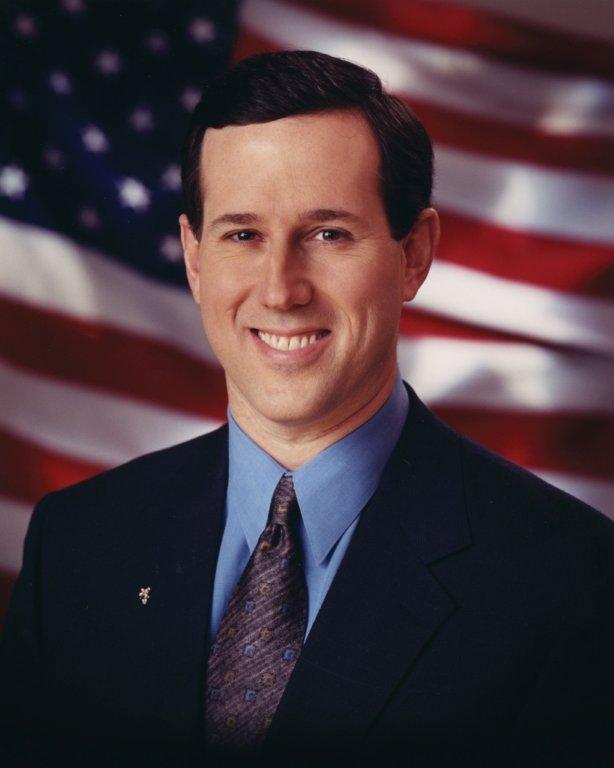
GOP Presidential Candidate Rick Santorum

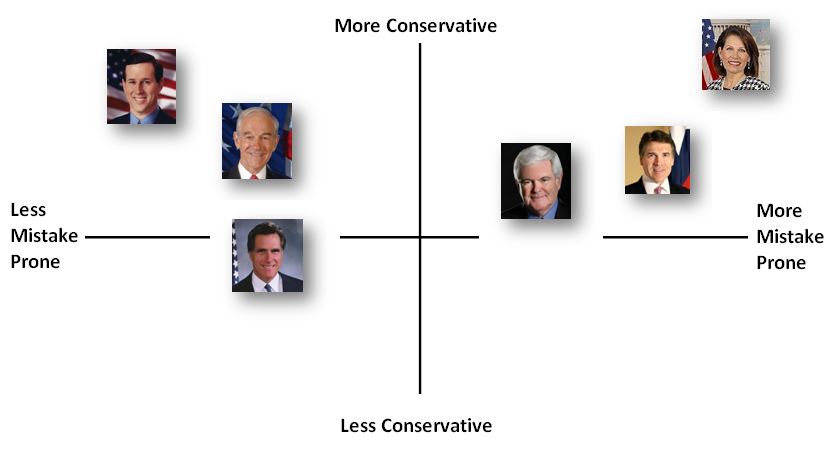
                From a marketing communications point of view, Santorum’s first place finish is a lesson in the importance positioning strategy, tactics and luck.  Santorum and his campaign successfully positioned himself as the social conservative who was consistently on message and disciplined enough to avoid mistakes.   In the words of my grandfather, a lifelong dairy farmer, Santorum avoided stepping in too many “sugar daddies.”  If you look at a perceptual strategy map of the major GOP candidates, Santorum carved out and maintained a unique position. (Figure 1)  He occupied the space on the map necessary for a candidate to succeed among Iowa’s GOP activists: consistently conservative and gaffe free.

Figure 1 - GOP Perceptual Map of Iowa Caucus Candidates

              It’s no accident that Romney, Santorum and Paul all finished in a near dead heat and everyone else as “also ran’s.”   That’s where a little bit of luck played a significant factor.  Michele Bachmann may have staked her claim as the most conservative candidate and an effective debater, but her perceived missteps on vaccines and other issues gravely affected her position on the perceptual map in the minds of voters.  Texas Governor Rick Perry, and former House Speaker Newt Gingrich didn’t fare any better.

             Santorum’s finish is also remarkable given the fact that he had little to no brand awareness in Iowa.   His surge in the weeks leading up to the caucuses came as a result of what marketers call an effective execution of product news and product experience.  In other words, his campaign staff and volunteers were able to effectively reach party activists with a message of how he was different and relevant.   Furthermore, his personal appearances gave potential voters a chance to experience the candidate and size up his message against their own values. 

Figure 2 - Google Trends Data Leading up to Iowa Caucases

             In my most recent post, I noted how Ron Paul was far and away leading the pack in buzz.   This too is another essential marketing driver.  The metrics in Iowa as measured by Google Trends showed Santorum gaining more web searches in the days leading up to the caucuses. (Figure 2)  It’s an important metric because it shows that people are yearning to discover more about the candidate.  In the end, Santorum was perhaps able to convert or activate more of that buzz into votes than was Paul. 

             The challenge now for Santorum and his campaign is trying to compete in two new markets.  New Hampshire, South Carolina and Florida are a long ways from the corn fields of Iowa.  Their voters have a different conservative value proposition will have their own perceptual map of where the candidates align.   In New Hampshire, every indication is that Mitt Romney has strong brand awareness and emotional bonds with GOP activists.  Those are powerful drivers for any challenger to overcome.  But Santorum clearly now has a degree of buzz.  What his campaign does with it and how it responds to the new scrutiny that will come could very well determine how long it takes for republicans to settle on a presidential nominee.

Ron Paul’s to Lose? How Google May Predict The Iowa Caucuses

31 Dec

            As we approach the Iowa Caucuses the GOP presidential candidates are making their closing arguments, but in many respects the party faithful are already voting—with their computers. The results present a fascinating web search tracking poll that could very well become a significant predictor of Tuesday’s winners and losers.

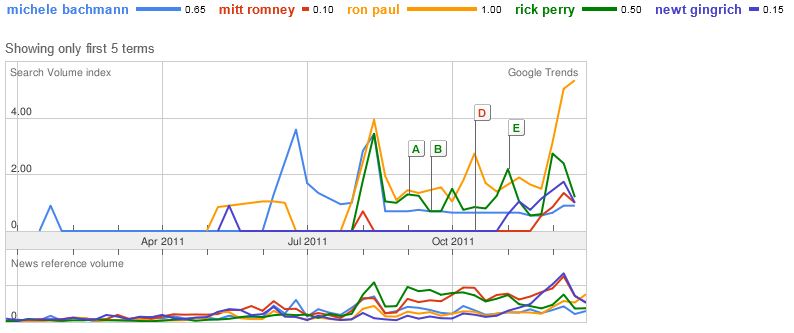
            Back in August, the folks at Google digested the internet search trends of Iowans leading up to the GOP Straw Poll. Native daughter Michele Bachmann dominated the search results and became the somewhat surprise winner of the straw poll. (Figure 1)

Google GOP Candidate Search in Iowa

Figure 1 - August Google GOP Candidate Searches in Iowa

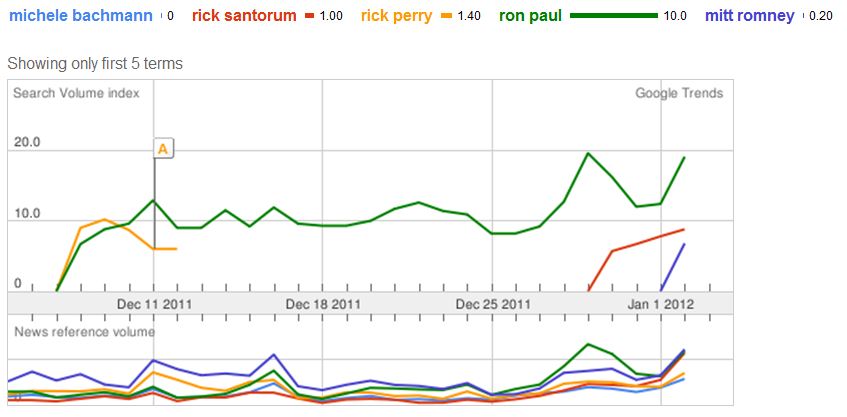
            But the latest Google data from Iowa paints a different story. Texas Congressman Ron Paul far and away leads the trend results with Bachmann significantly trailing. (Figure 2)

Figure 2 - Current Google GOP Candidate Searches in Iowa

            Paul is the only candidate who is trending up, everyone else is in a steep decline. In fact during the last 30 days in Iowa, Bachmann barely registers on Google Trends. Similar search data in August showed former Minnesota Governor Tim Pawlenty barely trending and in the end he failed miserably in the straw poll and promptly withdrew from the presidential race.

            In my August 15th post, I noted how Bachmann was like a product brand and successfully used two key marketing drivers to her advantage, buzz and activation. She was able to garner much needed attention by positioning herself as the outspoken native Iowan who saluted to the Tea Party flag. Most critically, she was able to activate that buzz into votes at the straw poll. Bachmann was the Tobasco Sauce in a field of corn heading for the canning factory.

           Five months later the trend results indicate Iowans feel burned and are searching for someone with less spice. Enter Ron Paul. He’s positioned himself as the Heinz 57 of the field—bold and authentic. He also has a consistent narrative.

GOP Presidential Candidate Ron Paul

            Hamline University analyst David Schultz has repeatedly made a compelling case that narratives win elections. Paul’s Libertarian narrative of less government and more individual freedom may represent views that are outside of the mainstream, but nevertheless have been authentically consistent. Meanwhile, Bachmann’s narrative and brand have both been eroded by unfocused campaign appearances and staff defections. Iowans through their search results seem to indicate they no longer have an appetite for hot sauce, but they certainly aren’t big on ketchup either. (Gingrich, Romney, Perry, and Santorum)

            Clearly, Paul has the buzz. What remains to be proven is if his brand is strong enough to activate that buzz into votes at Tuesday’s caucuses.