Badge of Honor—The Police Website That Will ARREST YOUR MIND.

26 Aug

The Milwaukee Police Department’s new website milwaukeepolicenews.com

That rumble just heard in the Midwest was Milwaukee’s former Police Chief Harold Brier turning in his grave.

The tough-as-nails chief ruled Cream City’s industrial streets for 20 years with shoe leather and shear force.  But now one of his successors has added a decidedly different weapon to his belt, one that is more strategic, social, and dare I say it—entertaining.

The result just may send that rumble through cyberspace as well.

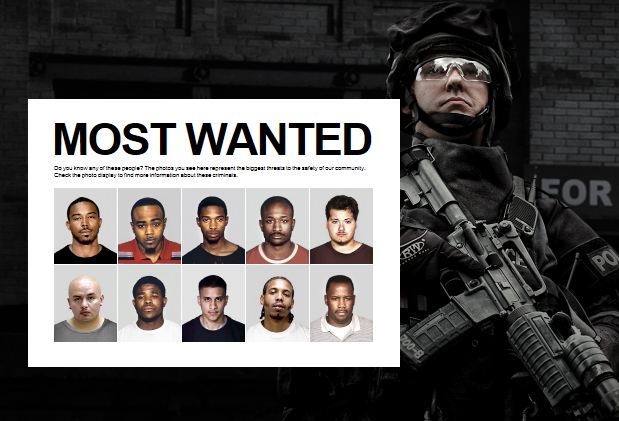
Milwaukee’s Most Wanted on milwaukeepolicenews.com

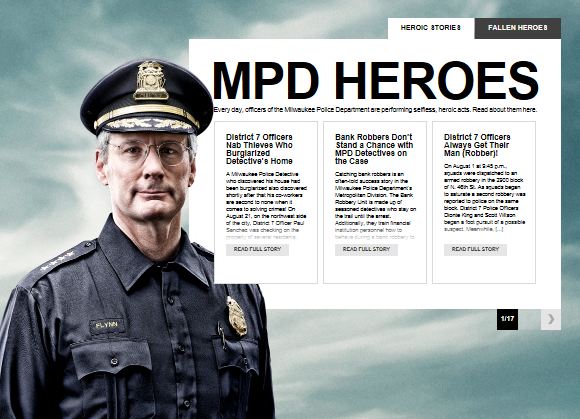
The new website just rolled out by Milwaukee Police redefines government communication.  The sleek design, easy navigation and bold 3D visual imagry effectively brands the department as crime fighters and invites the public to get involved through smart interactive content.

Scroll down the screen and the site takes the user seamlessly through calendar-based crime reports, statistics, Milwaukee’s Most Wanted, and sharable profiles of everyday heroes.

The heroes page on milwaukeepolicenews.com

According to AdAge, the website was the brain child of current Chief Edward Flynn who enlisted ad agency Cramer-Krasselt to help them create a website that people would want to visit.  The goal is to enlist citizens to “Be a Force” in their own neighborhoods by empowering them with easily accessible information about what’s happening along their own block.

The old chief in an older time would never have conceived of such a strategic communication weapon as this.  It begs every organization—government or not—to assess how many old chiefs it has stuck in the past.

Hail to the new chief.

A Diabetic’s Guide to Eating at the State Fair!

25 Aug


OK, it’s once again time for the annual trek to the 320 acres of fried food on a stick we call the Minnesota State Fair.

For most hearty Minnesotans, a visit to the fair is the one day where fun replaces common sense, where a balanced diet is as foreign as a balanced budget is to congress.

At the extreme risk of being “That Guy,” the fair poses a challenge for folks who really DO have to watch their diet.  As a parent of two children with type-1 diabetes, a day at the fair is a constant guessing game of how to insulin dose and carb-cover.  Get it wrong, and blood sugars go through the roof and the girls feel sick for the next day.  It’s even worse for cardiac patients who have to keep a keen eye on their fat and cholesterol.

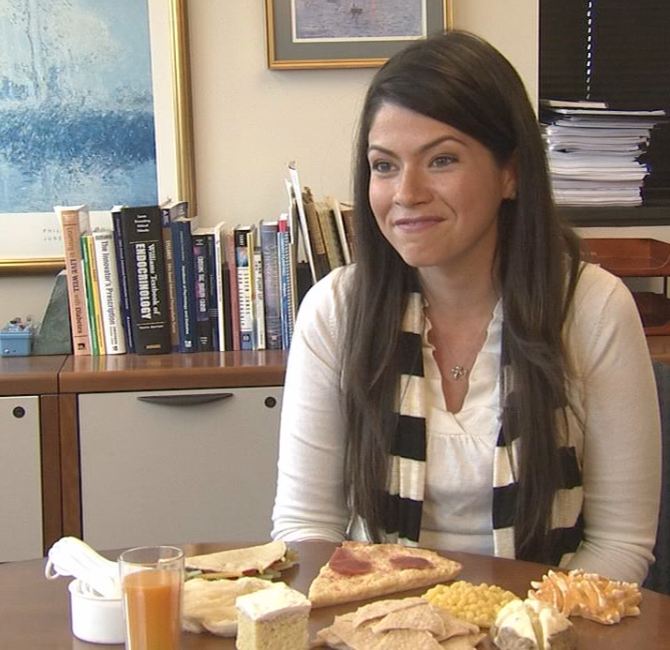
The dietitians at Park Nicollet’s International Diabetes Center have put together a wonderful Food Facts list to help us navigate the fair and still have a lot of fun.  Under the guise of ‘knowledge is power’ they’ve broken down the calorie, carb, and fat content of most of the major food items.

“They don’t need to derail their diet, they don’t need to feel like they’re stuck outside of the group and not enjoying anything,” said Park Nicollet dietitian Mary Ziotas Zacharatos.  “They’re able to eat the things that they like and have more awareness of what their putting in their mouth.”

Park Nicollet Dietitian Mary Ziotas Zacharatos says to enjoy the fair, go with a bunch of friends and share small samples of food.

One of biggest offenders is the Booming Onion.  At 1,565 calories it has 186 grams of carb and 84 grams of fat.

“Most people don’t think about it because it’s an onion and it’s got a little bit of batter on it. But it really could derail your diet,” said Zacharatos.

Those fried cheese curds are another food item to be aware of.  One little paper tray of those golden nuggets of heaven actually add up to 533 calories, and 34 grams of carb and another 34 grams of fat.

Believe it or not, a better choice is a corn dog.  At 210 calories, it only contains 25 grams of carb and ten grams of fat.  Zacharatos says it’s a nearly perfect blend of protein, carb and fat for walking around at the fair.

Zacharatos says you don’t necessarily have to avoid some of the higher calorie and carb food items, just SHARE them.

“The best part about the state fair is to go with a whole group of people and just try a bunch of different things.  That way you can enjoy everything,” said Zacharatos.

Social Media ROI — Turning “Likes” Into Cash For Somalia

10 Aug

“Though it’s only half a month away, the media’s gone.                           An entertaining scandal broke today, but I can’t move on.”                           – Helicopters, by Barenaked Ladies

Somali refugees recieving a sack of rice distributed by the American Refugee Committee in Mogadishu. (Courtesy ARC)

Like a flash in the night, they opened eyes.  The television lenses that zoomed in on Somalia a year ago focused the world’s attention on a devastating famine that killed 30,000 children in the span of just three months.  And then, with the click of a Klieg light they were gone.  Just another story, another crisis that turns on and off in a world preoccupied with the latest live trend on Twitter.

The reality for hundreds of thousands of refugees in Somalia is that survival is not a pop culture status update.  At the end of each day, the only status that matters is if they’re still alive.  But it led the Minneapolis-based American Refugee Committee to pose dire question—could it harness the power of social media to actually feed people?  Their answer has them converting “Likes” into food.

In the late summer of 2011, ARC in collaboration with the California design firm IDEO launched the I Am a Star for Somalia campaign.  The goal was to use social media to encourage people around the world to do small things to help ARC fight the famine.  By encouraging people to become part of the “Star” community, they were essentially asking them to take an inward view of the crisis rather than just watch it on TV.  This summer, ARC has advanced the campaign with the effort serving as a blue print for non-profits seeking to earn a return on investment in their social media ventures.

Paper chain hanging in the ARC headquarters in Minneapolis.

ARC secured a $50,000 pledge from Hormuud Telecommunications, Mogadishu’s largest phone provider, to support food distribution in ARC’s refugee camps.  But rather than simply accept a check, ARC designed a campaign to engage followers and build a broader community and awareness to the Somali crisis.  They tied the pledge directly into their “I Am a Star” efforts with the goal of gathering 50,000 Facebook engagements—each one generating a dollar from Hormuud’s pledge.

But ARC took it one step further.  For every engagement, volunteers build a link in a paper chain that is now spreads throughout the ARC headquarters.  Pictures and status updates are added on the progress of the chain which in turns builds more support from followers.

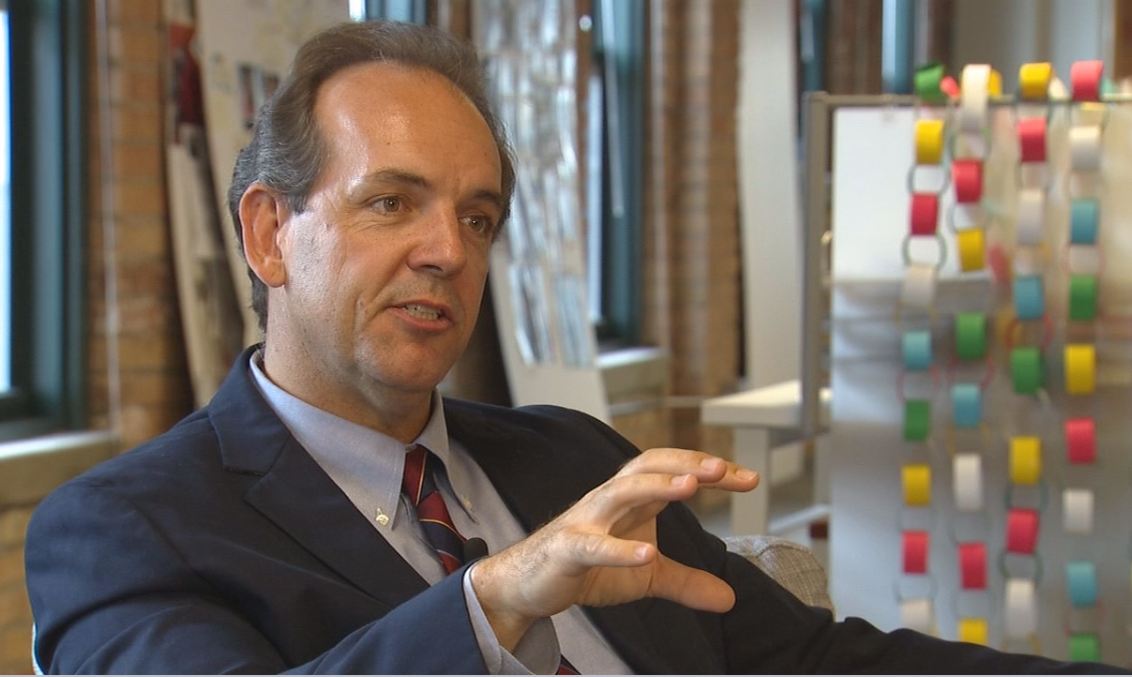
“To us I think they represent the links between people around the world who are showing solidarity for Somalia,” said ARC’s Daniel Wordsworth.

American Refugee Committee President Daniel Wordsworth.

“And I think it’s also a physical way that people can demonstrate their commitment but also a way for the people in Somalia to see people in Malaysia, Yemen, London and Sweden coming together in helping Somalia get through this.”

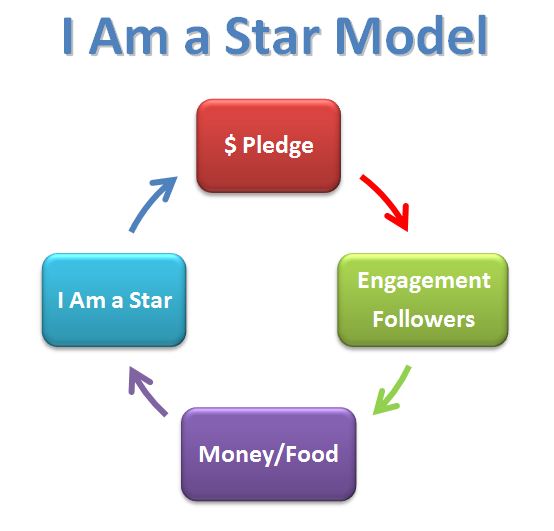
For non-profits and businesses alike, ARC has adopted an effective model that uses social media for community building and fundraising.  It begins with an issue and then a highly strategic and goal-oriented response with built in performance measures.  In this case, ARC began with the famine crisis, formed its “Star” campaign, secured a pledge and then used the pledge to build a community, awareness and money.   But equally important in the campaign is ARC’s target of a goal and a deadline—50,000 engagements by August 11.  The goal gives the campaign a mechanism by which ARC and its followers can measure progress, and the deadline gives it urgency for people to act.

Figure 1

But most important, ARC has now built a sustainable community for Somalia.  By generating upwards of 30,000 additional followers to its “Star” campaign, it can now use that community as leverage to gain more pledges, more engagement, and distribute more food.  (Figure 1)  It becomes a circular model for future campaigns and famine relief—and all of it as the TV lights shift to the latest Twitter trend.

“I think we all know that famines come and people see it on the news and then a year later it’s hard to remember it all,” said Wordsworth.  “So I think that what we’re trying to do is keep Somalia in the forefront of people’s minds.”

Twinkies Strikes Gold–The Best Olympics Ad You Wont See

1 Aug

Perhaps one of the best advertisements of the Olympics is one you won’t see on NBC.

The folks from Hostess have created a whimsical and brilliant social media film that simply says there are Olympians… and then there’s the rest of us.  And for the rest of us, there is a special golden reward—Twinkies.


The ad created by the Berstein-Rein agency takes the well established Theory of Trying and turns it on its head.  (Think Home Depot: “You can do it, we can help.)

But as fun as this ad is to watch, it’s also a strategically smart piece of communication and critically timed as Hostess goes through bankruptcy.  It targets every person who has tried at something and failed.  Because that includes most of us, it guarantees that fans of the ad will share it on social media.

Additionally, it speaks to what marketers would call lapsed users—consumers who haven’t bought Twinkies in a while. It reminds them that Twinkies are still here, still good, still golden.

So go ahead, treat yourself. (You know you want to)


Feisty the Seal: Anatomy of a Duluth Flood Meme

22 Jun

Meme \`meem\ n:  an idea, behavior, style, or usage that spreads from person to person within a culture 

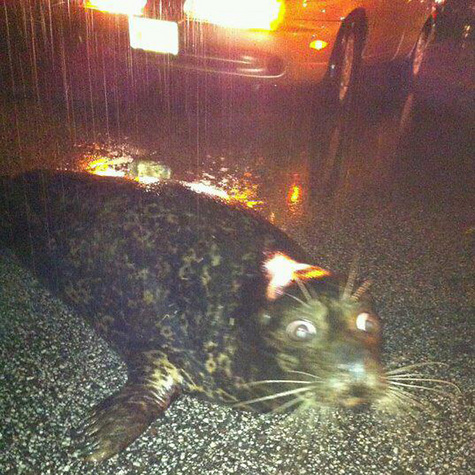
Figure 1 – Feisty the harbor seal captured on June 20th on Grand Avenue in Duluth by Elli Buchar.

The lens by which the world viewed the Duluth flooding disaster this week was actually viewed through a sympathetic set of eyes.  Never mind that they belonged to a nearly blind harbor seal named Feisty.

When 10 inches of rain fell on the bluffs that anchor the city of Duluth, Minnesota the runoff cascaded down its hills with the force of a dozen rivers at spring break-up.  The rushing water in the middle of the night on June 20th swallowed cars, roads, homes and even the Lake Superior Zoo.  The raging floods drown eleven animals and flooded out the pen holding two aging and sight impaired seals named Feisty and Vivien.  At the height of the disaster in the middle of the night, no one knew the plight of the zoo animals until Ellie Buchar saw something unusual along Grand Avenue—Feisty.  She snapped a picture, shared it online, and within a matter of hours this nearly blind seal became the vision by which the rest of the world viewed the disaster. (Figure 1)

Just how powerful was this meme?  I was standing along Olney Street interviewing Gene Swanson who was in danger of losing his house to the raging King’s Creek when my phone rang.  It was one of my news producers at her computer monitor from 170 miles away wanting to know why I wasn’t at the zoo?   Never mind the people desperately trying to save their homes and lives.   “What about the animals?” demanded the producer.  (I could give a dozen journalistic counter arguments–but that’s another post at another time.)

Feisty’s story is a case study in contagion and memes in this new age of social media.   It provides a unique pathway for understanding why they become so powerful.

In this case, social psychologist Jaap van Ginneken would argue that Feisty served as what he calls a strong replicator.  Such replicators evoke an emotion that cause people to take notice and share.  Image plays an essential role—the strongest replicators have child-like images with large eyes.  Finally, the replicator must be positioned in an unexpected way—a surprise.

Feisty’s image on Grand Avenue fit perfectly into the model:

  • Strong Replicator: stressed animal
  • Child-like face: helplessness
  • Surprise: found in middle of street 

    Figure 2

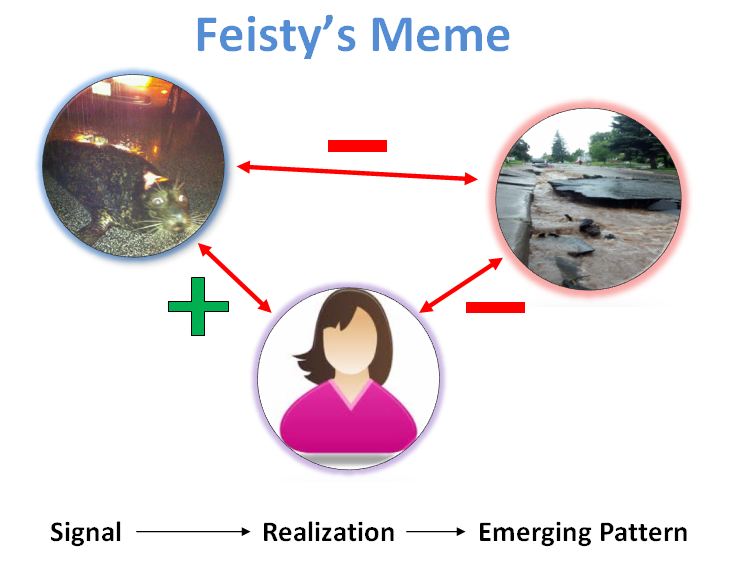
The image served as a critical signal to viewers, especially women that something was happening.  This signal is the beginning of a cognitive cycle where the viewer forms a positive association with Feisty and in context forms a negative association with the floods.  (Figure 2)  When the viewer hits the “send” button on their computer and others share, a meme is born.

That’s essentially what happened on July 20thand why a helpless animal has become the face of such a human disaster.

Figure 3 – Feisty in her new temporary home at the Como Park Zoo in St. Paul, MN

It should come as no surprise that Feisty’s viral picture is exactly why she and her half-sister are now safe and recovering at the Como Park Zoo in St. Paul.  When Como’s zookeepers saw her viral picture they immediately called the Lake Superior Zoo offering help.  Several hours later both seals and a polar bear were traveling to their new temporary home.  (Figure 3)

Como’s Sr. Zookeeper Alli Jungheim says they’re all feeding and adjusting well to their new home.  “We’ll take care of them like they are our own,” said Jungheim.

For now the seals are safe.  But, there’s so much more work to ensure the rest of Duluth is safe, too.

Facebook Usage Down. Why This is Not The End–Yet

14 Jun


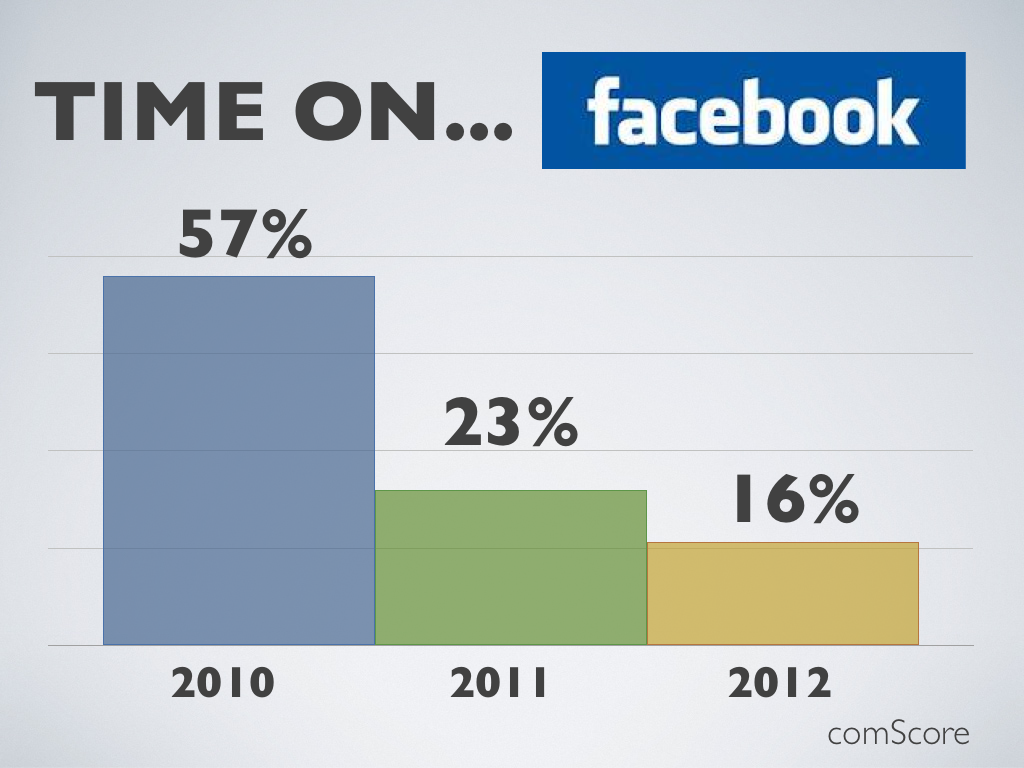
Figure 1 – April-to-April increase of user time per month on Facebook

The latest user research on Facebook indicates the dominant social media site is losing some of its luster.   A series of recent data sets indicates Facebook engagement is maturing and users may be losing a sense of the novelty that once came with the social networking site.

New research from the web analytics firm comScore Inc. shows that unique visitors to Facebook in April rose to 158 million, an increase of only 5% from the year before.  Its growth rate was down 24% from April of 2011 and 89% from April of 2010.

ComScore’s data obtained by the Wall Street Journal also shows a slowdown in growth rate of time spent on Facebook.   In April, users spent a little more than 6 hours a month on the site, an increase of 16% from the year before.  That compares to a 23% increase in April of 2011 and 57% in 2010.  (Figure 1)

Additional research from Reuters and Ipsos indicates 34% of Facebook users were spending less time on the site than they did just six months ago.   The phone survey of more than 1000 participants represented recall and was perhaps not as accurate of a measurement as the analytics study generate by comScore.

Nevertheless, they all tap into an insight that the fascination with Facebook may be peaking.

Among Facebook’s core users of young adults 18-35 there are mixed reviews.   Allysa Sajady is a 20-something grad student who still uses Facebook, but admits not as often. 


Jackie Randall is a dentistry student who no longer has the time to constantly update her friends.


The waning fascination with Facebook is easily explained with a nearly 100 year old psychological model known as the Wundt Curve. (Figure 2)

Figure 2 – Wundt Curve

Wilhelm Wundt created the model to help explain the newness of an idea or product.  In the model, the X axis (vertical) represents enjoyment, and the Y axis (horizontal) represents stimulus intensity or newness.  The curve portrays rising enjoyment as an idea or product is new and then falling enjoyment as the product becomes overly familiar.  The primary lesson from Wundt is that sustainable relationships are created when a familiar product is changed just enough to make the experience new again.  In other words, the optimum position on the curve is slightly outside the X & Y intercepts.

That’s exactly what Facebook has attempted to do by creating the new timeline feature and by acquiring the photo sharing application Instagram.  With those two moves Facebook is staking its claim on sustainable side of the Wundt Curve.   Yahoo and MySpace have floundered deep inside the curve.

For all of its sudden criticism, Facebook is still a behemoth brand.  ComScore notes that Facebook has already collected 71% of all 221 million U.S. internet users.  They spend more than six hours a month on Facebook far exceeding the four hours a month they spend on all of Google’s sites and the 3.5 hours they spend on Yahoo sites according to comScore.

For those who make a living following social media trends, Facebook is far from dead.

“Absolutely not,” said Dan Antonson of S-M-C Pros of Minneapolis.  “I think technology is always going to trend, it’s always going to change. And I think what we’re seeing is a shift, absolutely a shift in behavior.  But that shift doesn’t necessarily mean that Facebook isn’t working,” said Antonson.


In fact, for Antonson Facebook is working.  “I mean, when you look at some of these recent reports of one-in-five page views on the internet being Facebook, it’s hard to say it’s going away anytime soon.”

It may not go away, but the challenge for Facebook is to keep changing the experience enough to keep it new to the user.

GM and Ford — A Case of Two Facebook Strategies

7 Jun

General Motors recent announcement to stop buying advertising on Facebook may have been the backfire heard in agencies around the world.  GM didn’t just turn off the engine, it slammed the breaks with such force that it had the advertising industry and social media world bouncing off the air bags.  That tends to happen when any brand cancels a $10M buy.  GM argued the Facebook ads and were simply ineffective.

To be sure, social media is a constantly shifting platform that challenges brands in finding a cost effective way of using multiple social channels to target customers.  But as a customer engagement platform, is GM really using Facebook effectively to drive conversations with its customers?

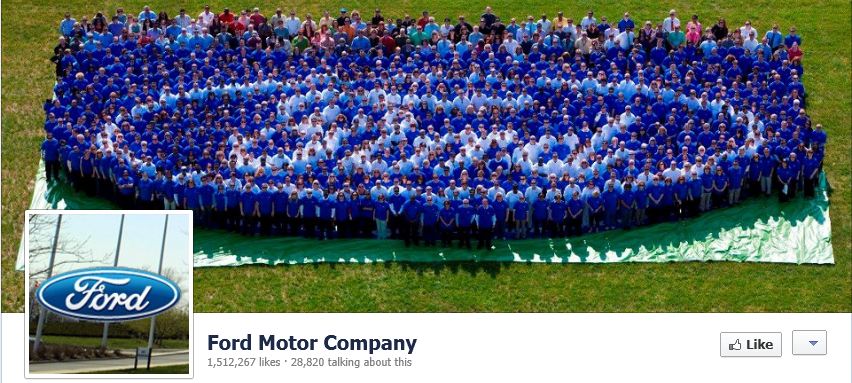
Figure 1 – Ford’s Facebook Cover Photo

Figure 2 – GM’s Facebook Cover Photo

Let’s start with a simple look at the Facebook cover photos of both GM and Ford. (Figures 1 & 2)  One of these pages immediately tells the user its company is about people, the other is about objects.  At its core, social media is about having relationships with other people.

Extensive research on social media engagement indicates a strong correlation between seeking gratification and fulfilling psychological needs.  Louis Leung found a significant draw to social media by people who needed recognition and empowerment.  Brand new research from the University of Boston shows that Facebook use is motivated by the need to belong and a secondary need for self-presentation.  Additionally, John Eighmey and Lola McCord established how the need for entertainment is vitally important to maintaining an online relationship.  But among the most important insights for brands comes from Mihaela Vorvorneanu at Purdue University whose research found a desire for consumer interaction with corporations on Facebook only if it gives them a badge of personal identity, or a tangible reward such as a discount on products or services.

Figure 3 – Ford’s Car Giveaway

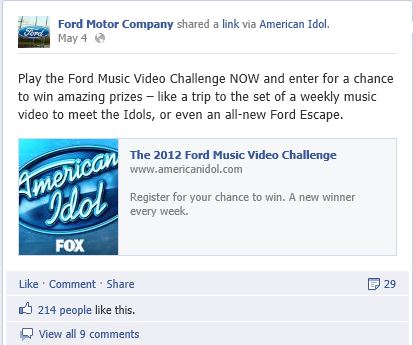
On the later point, Ford seems to deeply understand these motivations.  During the final week of its American Idol sponsorship on Fox, Ford ran a Facebook post inviting viewers to enter the Ford Video Music Challenge and have a chance at winning a new car.  (Figure 3)  Another engagement strategy by Ford is asking its followers to contribute their own ideas on topics such as designing their own Ford Fusion or what they’d do with the gas money they’d save if they owned an electric car.

Figure 4 – GM’s May Sales

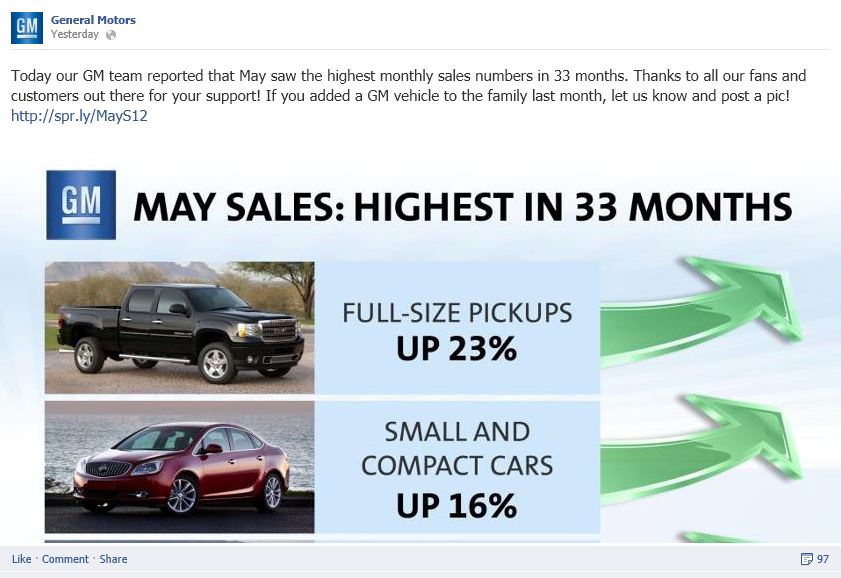
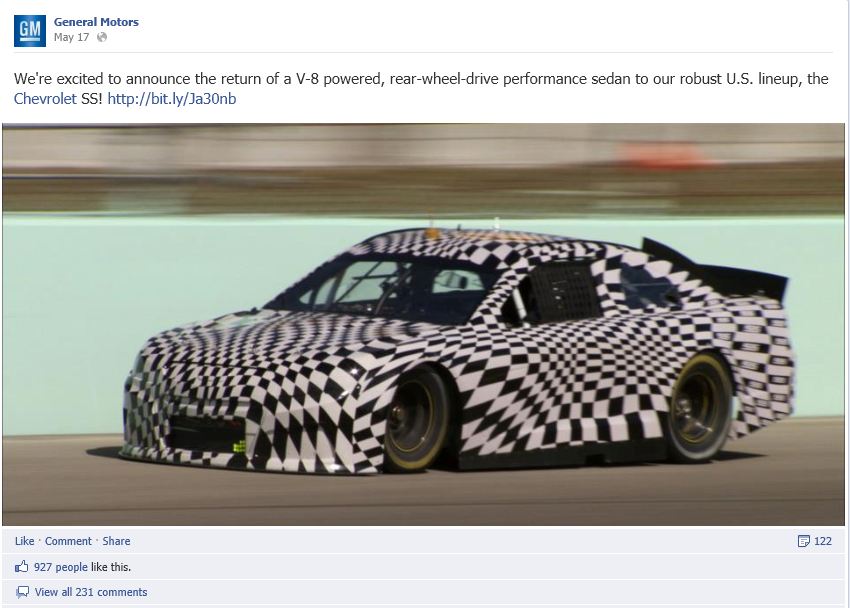
GM’s Facebook page tends to look more like a corporate newsroom site.  One recent posting trumpeted May’s sales growth. (Figure 4)  Another linked to a CNN.com interview GM CEO Dan Akerson.   While it all defends and defines the corporation, it’s not exactly the kind of content that invites a personal dialog with the brand.  In fairness, there are some moments of truly cool engagement, such as the picture it recently posted of the new top-secret Chevy SS prototype. (Figure 5)  The posting builds intrigue and anticipation at the same time serving as a sneak-peek reward for any GM Facebook follower.

Figure 5 – Chevy SS Facebook Post

The one thing GM has going for it is its social media maven, Mary Henige.  She is a walking, talking, one-woman evangelist for General Motors.  Henige has more energy than a fully charged Chevy Volt and is not afraid to use Twitter and various other channels to engage customers in the GM brand. (Follow Henige on Twitter @maryhenige)  One good example is the Facebook page for Chevrolet.  It uses more of the follower-involving content utilized by Ford to draw people into a relationship with the brand.

It could be reasonably argued that GM’s core customers have stronger emotional bonds to their individual car brands than to the corporation behind them.   In that regard it could make sense to let the GM Facebook page be more of a corporate PR blog.  But that’s not what social media is about, and GM may be missing an opportunity to make true relationship drivers of all of its social media channels.

Strategic Crisis Communications – How Fairview Hospitals’ Chairman Gets It.

1 Jun

It seemed like such a simple idea.  Then the Attorney General weighed in.

Fairview Health Systems Chairman Michael Mooty appearing at U.S Senate hearing on payment collecting practices at Fairview hospitals.

The idea was a basic business proposition.  Get the customer to pay for the services they need before walking out the door.  But in this case the business is a hospital and the customer is sick.

It is under that scenario that Fairview Hospitals in 2010 hired Accretive Health to help it recover more money from patients.  In an era of health care where costs are up and margins are down, the hospital system’s sustainability was increasingly dependent upon securing payment for the care it provided.  The “Revenue Cycle Agreement” between Fairview and Accretive Health ushered in a new culture at Fairview that often times focused on payment before care.

Minnesota Attorney General Lori Swanson

That’s where Attorney General Lori Swanson cried foul.  Her compliance review of Fairview’s contract with Accretive Health released on April 24th uncovered six volumes of alleged abuses and violations of federal law.  The evidence included internal Accretive Health emails that revealed how the aggressive bill collecting tactics led to some patients leaving the hospital in disgust before seeing a doctor.  In one affidavit, an employee describes how they were forced to obtain payments from patients in the emergency room or they would be fired. (Figure 1)

Figure 1 – Affidavit from MN Attorney General’s compliance review of Fairview hospitals and Accretive Health.

In almost every respect, it is another contemporary case study of an organization losing site of its core values and mission—in this case, the commitment to always put patient care first.

It’s perhaps fair to say that Fairview board chairman Charles Mooty never wanted to become the subject of such a case study.  But Mooty deserves some notice for his handling of the crisis and his attempt to take corrective action.

There are several hard and fast rules to effective strategic crisis management and communications:

  1. Cease and desist—stop doing what you’re doing.
  2. Apologize to those you’ve wronged—and mean it.
  3. Change your tactics.
  4. Communicate the change to employees and customers.
  5. Establish performance measures for how the change is working.

In a congressional investigative hearing this week, Chairman Mooty followed the script with near precision.  While testifying in a field hearing before U.S. Senator Al Franken, Mooty offered both contrition and a plan for moving forward. Here’s his very strategic response:

1. Cease and desist.

“We’ve stopped collecting past due balances and co-insurance payments in emergency departments, and we’re reviewing emergency department information and workflow processes.”

 “Fairview terminated its work with Medical Financial Solutions, a part of Accretive Health on January 6 of 2012 because of their failure to comply with the Attorney General’s billing and collection agreement.”

 2. Apologize.

“To those patients I offer my personal apology and firm commitment on behalf of the entire Fairview organization to regain your trust.”

3. Change tactics.

“We are reviewing and revising our training tools to ensure each patient interaction reflects Fairview’s core values.” 

 4. Communicate change.

“In addition to our termination of agreements with Accretive Health, we also have initiated better approaches for escalating patient, employee and physician concerns so that they receive prompt attention.”

 This last statement by Mooty perhaps telegraphs what may have been an critically important breakdown within Fairview.  Mooty told the Senate hearing no less than four times that Fairview was going to do a better job of listening to its stakeholders.  Attorney General Swanson’s investigation provided several documents that Fairview doctors and staff had expressed deep concern about the new payment collecting policies instituted by Accretive Health.  Mooty’s testimony strongly signals that those concerns either didn’t get communicated to Fairview leadership, or that leadership simply wasn’t listening.

One of Mooty’s most important changes came during the week before the Senate hearing when he and the board of directors decided not to renew the contract of current Fairview CEO Mark Eustis, the man who hired Accretive Health.  The board named Mooty as interim CEO sending a clear signal that it was breaking with the past.

While Mooty gave no clear indication of how Fairview intends to measure its progress, he clearly used a big stage to send key strategic messages to several key audiences, among them his patients, employees and the public.  But in this case his primary audience is government regulators.  If Mooty can’t convince them that he’s prescribed the right medicine, a more rigorous regimen will be forced from outside rather than inside.

The stakes are high.  So is Fairview’s credibility and trust.

Vikings Stadium Victory: The Power of Social Democracy

12 May

When the founding fathers guaranteed the right to petition government, they never conceived of Facebook or Twitter.  But the mass democratization that just occurred in Minnesota just may be what James Madison had in mind when he conceived of the Bill of Rights.

Artist rendering of a new Vikings stadium

In a stadium debate that was inexorably mired in partisan politics and collapsing like the Metrodome roof, Vikings fans took to the internet, social media and their phones to drive the votes in favor of building a new “People’s Stadium.”

To be sure, the Vikings and labor unions helped amass their fans and members to call and write their legislators.  But web analytics also show that there was a substantial organic movement among citizens.

Figure 1- Google Trends

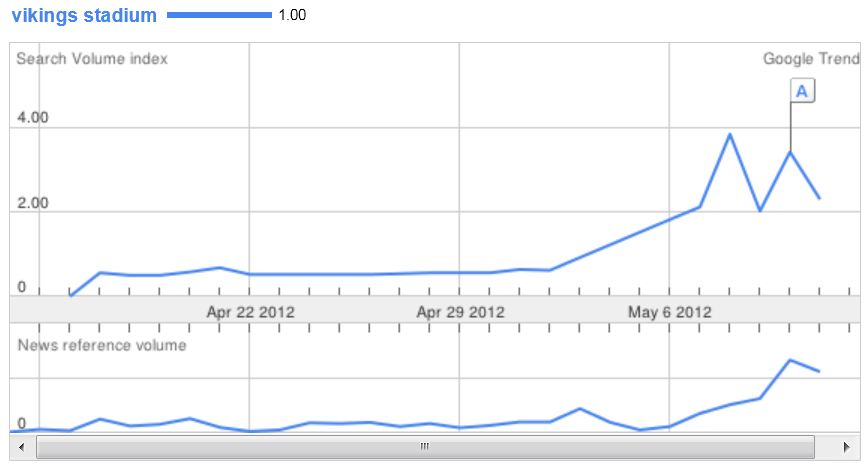
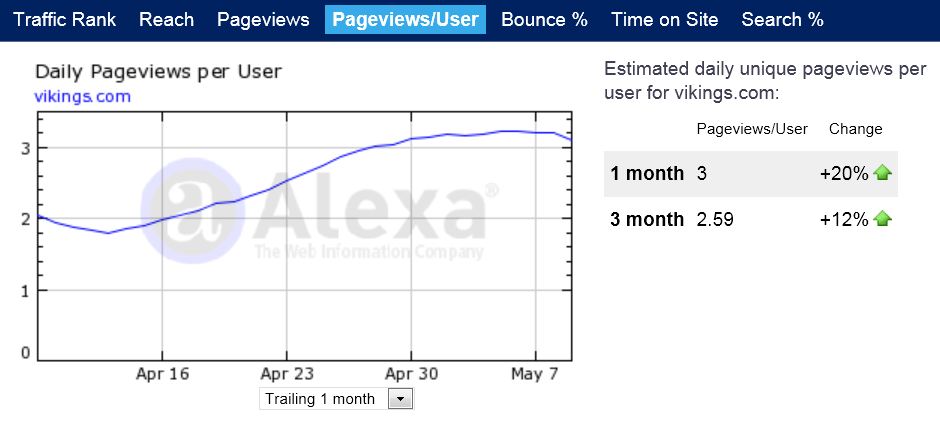
In the days leading up to the final stadium vote in the Minnesota legislature, there was a substantial groundswell in what digital analysts call “search” and “share.”  Google Trends data (Figure 1) shows the exponential rise in Minnesotans searching for information on the Vikings stadium leading up to the floor vote in the House of Representatives on May 7th.   Additionally, the number of unique page views to vikings.com also rose ahead of and during the vote. (Figure 2)

Figure 2 – Daily unique page views

But perhaps one of the Vikings’ more effective strategies was enlisting their more than 1.3 million Facebook fans.  It’s a strategy they’ve tried before.  With a post on May 4th, the Vikings asked their followers to contact their representatives. (Figure 3)

Figure 3 – Facebook Post, May 4th, 2012

That alone cannot explain why thousands of constituents followed through.  But there’s a theoretical framework that does.  It’s called Prospect Theory.   The theory was developed in 1979 by Princeton psychology professor Daniel Kahneman who later won the Nobel Prize in Economics.  In its simplest form, it holds that people are risk averse.  In the case of the stadium debate, Minnesotans in the end were more afraid of possibly losing the Vikings than they were about gaining stability in taxes and state finances.  There were plenty of worthy and important arguments about jobs, public debt, and voter referenda, but in the end it was fear of losing the Vikings—perceived or real—that perhaps carried the day.

At least one key lawmaker the acknowledged the importance of the social movement at the governor’s May 10th news conference following the final passage of the stadium bill.

“You made an incredible mark on your legislators, I can tell you,” said Sen. Tom Bakk.


Bakk told how lawmakers often times share with each other how many emails they get.  “You know, if you get six or eight on something, people talk about it.  I got 987 between 10 o’clock one night and 6 o’clock the next morning,” said Bakk.

That’s petition.  That’s power.  And it’s another example of the new rise in social democracy.