Archive | Branding RSS feed for this section

GM and Ford — A Case of Two Facebook Strategies

7 Jun

General Motors recent announcement to stop buying advertising on Facebook may have been the backfire heard in agencies around the world.  GM didn’t just turn off the engine, it slammed the breaks with such force that it had the advertising industry and social media world bouncing off the air bags.  That tends to happen when any brand cancels a $10M buy.  GM argued the Facebook ads and were simply ineffective.

To be sure, social media is a constantly shifting platform that challenges brands in finding a cost effective way of using multiple social channels to target customers.  But as a customer engagement platform, is GM really using Facebook effectively to drive conversations with its customers?
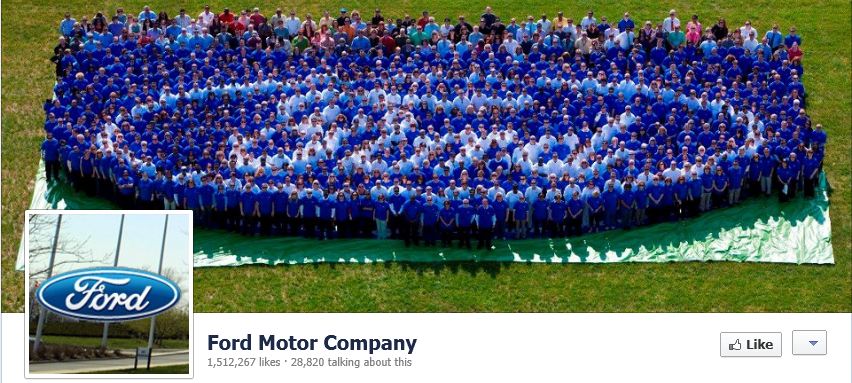
Figure 1 – Ford’s Facebook Cover Photo

Figure 2 – GM’s Facebook Cover Photo

Let’s start with a simple look at the Facebook cover photos of both GM and Ford. (Figures 1 & 2)  One of these pages immediately tells the user its company is about people, the other is about objects.  At its core, social media is about having relationships with other people.

Extensive research on social media engagement indicates a strong correlation between seeking gratification and fulfilling psychological needs.  Louis Leung found a significant draw to social media by people who needed recognition and empowerment.  Brand new research from the University of Boston shows that Facebook use is motivated by the need to belong and a secondary need for self-presentation.  Additionally, John Eighmey and Lola McCord established how the need for entertainment is vitally important to maintaining an online relationship.  But among the most important insights for brands comes from Mihaela Vorvorneanu at Purdue University whose research found a desire for consumer interaction with corporations on Facebook only if it gives them a badge of personal identity, or a tangible reward such as a discount on products or services.
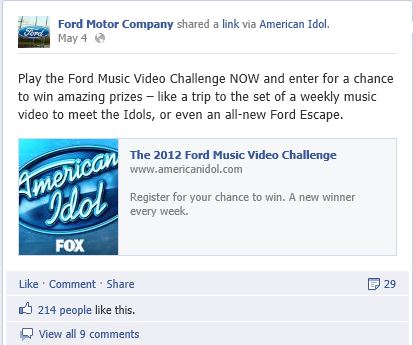
Figure 3 – Ford’s Car Giveaway

On the later point, Ford seems to deeply understand these motivations.  During the final week of its American Idol sponsorship on Fox, Ford ran a Facebook post inviting viewers to enter the Ford Video Music Challenge and have a chance at winning a new car.  (Figure 3)  Another engagement strategy by Ford is asking its followers to contribute their own ideas on topics such as designing their own Ford Fusion or what they’d do with the gas money they’d save if they owned an electric car.
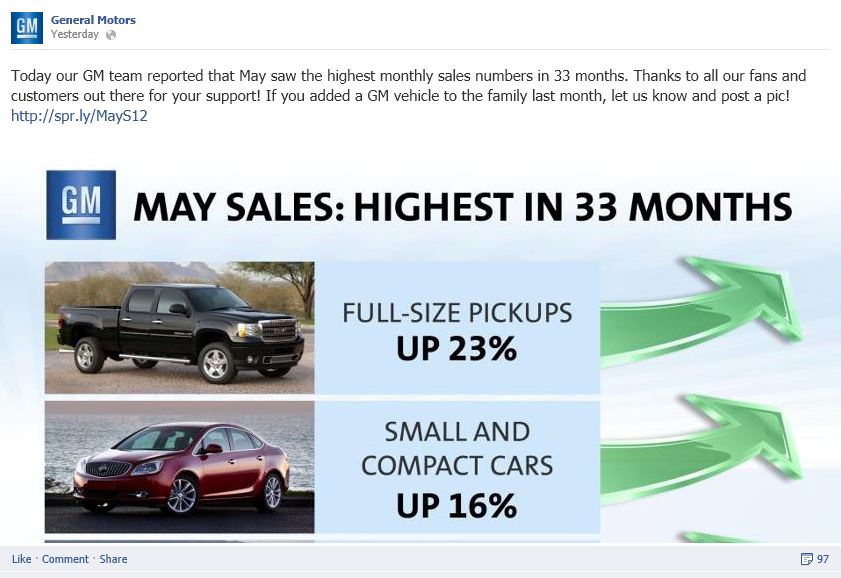
Figure 4 – GM’s May Sales

GM’s Facebook page tends to look more like a corporate newsroom site.  One recent posting trumpeted May’s sales growth. (Figure 4)  Another linked to a CNN.com interview GM CEO Dan Akerson.   While it all defends and defines the corporation, it’s not exactly the kind of content that invites a personal dialog with the brand.  In fairness, there are some moments of truly cool engagement, such as the picture it recently posted of the new top-secret Chevy SS prototype. (Figure 5)  The posting builds intrigue and anticipation at the same time serving as a sneak-peek reward for any GM Facebook follower.
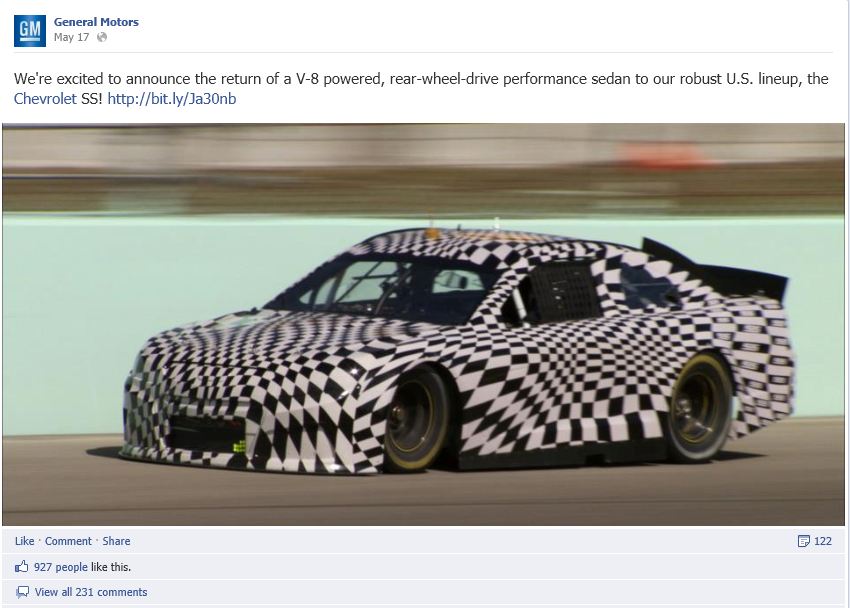
Figure 5 – Chevy SS Facebook Post

The one thing GM has going for it is its social media maven, Mary Henige.  She is a walking, talking, one-woman evangelist for General Motors.  Henige has more energy than a fully charged Chevy Volt and is not afraid to use Twitter and various other channels to engage customers in the GM brand. (Follow Henige on Twitter @maryhenige)  One good example is the Facebook page for Chevrolet.  It uses more of the follower-involving content utilized by Ford to draw people into a relationship with the brand.

It could be reasonably argued that GM’s core customers have stronger emotional bonds to their individual car brands than to the corporation behind them.   In that regard it could make sense to let the GM Facebook page be more of a corporate PR blog.  But that’s not what social media is about, and GM may be missing an opportunity to make true relationship drivers of all of its social media channels.
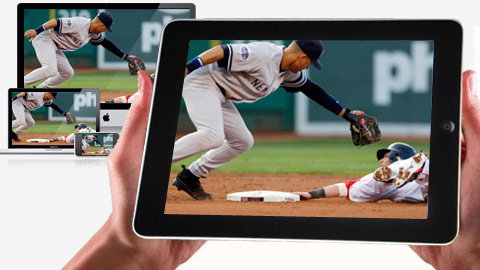
Screen Splitting—How Brands and TV News can Overcome Simultaneous iPad and TV Viewing Habits

28 Apr

It wasn’t long ago that the biggest enemy to television advertisers and programmers alike was the TV remote.  Ah, for the good old days.

New mobile technologies and platforms have given consumers virtually effortless and instant access to hundreds of competing communication channels.  And now we learn that they’re increasingly accessing these channels while actually watching TV—or not watching.  Welcome to television’s latest nightmare.  The monster keeping brands and programmers up all night isn’t necessarily getting bigger, it’s just multiplying.

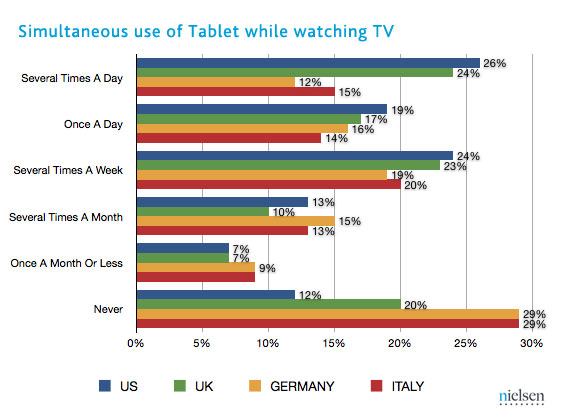
Two new data sets of consumer research provide valuable insights into how audiences are using media, often at the same time.  The behavior is called screen splitting.  It’s arisen from the explosive growth in mobile technology and even new platforms such as the iPad and tablet computing.  The Nielsen Company’s latest survey of connected device owners indicates depth of this new behavior.  Fully 88 percent of tablet owners and 86 percent of smartphone owners said they used their device while watching TV at least once during a 30 day period.  For 45 percent of the American tablet owners, screen splitting was a daily event, 26 percent said they simultaneously used their tablet while watching TV several times a day. (Figure 1)  The data was similar for smartphone owners.

Figure 1 - Courtesy Nielsen Co. (4th qtr 2011)

The second data set suggests the media switching happens at an almost frenetic pace among many viewers.  Innerscope Research specializes in conducting biometric studies of consumer viewing habits.  In a recent study commissioned by Time Warner, Innerscope outfitted 30 participants with biometric belts that recorded their physical responses as they used media throughout more than 300 hours of time away from work.  The participants also wore special glasses embedded with cameras that tracked what platform they used and for how long.  The results showed that consumers in their 20’s, or digital natives, switch media venues about 27 times per non-working hour.  To put that in perspective—about 13 times per standard half-hour television show or newscast.  Older consumers who didn’t grow up with the new technologies, those who Innerscope calls digital immigrants, shifted media at a 35 percent lower rate—just 17 times per non-working hour.

Together, the research sets tell us how our viewers are no longer sitting at the table to consume our products.  Instead, they’re running through the ala carte line.  They’re not eating whole meals, they’re snacking.  As soon as the instant gratification wears off, they’re onto the next snack.

Given this new reality, the question becomes how do brands and programmers adapt?  From a conceptual point of view, their product has to be positioned to hit the viewer’s emotional and intellectual sweet spot.  Advertising researcher and scholar John Eighmey gives us a conceptual model he calls Reward Theory.  It conveniently categorizes the elements that must interplay with each other for consumers to latch onto a piece of visual communication to consume, enjoy, and share.  It is the same model that explains why YouTube videos go viral. (Figure 2)

Figure 2- John Eighmey's Reward Model for explaining viewers engage in and share content.

First and foremost, the content must be stimulating.  It must be enjoyable to watch, clever, or surprising.  Second, it must have an element of empathy or personal identification. Third, it must lack confusion.  Fourth, is narrative or theme familiar to the viewer? That is, does he or she recognize the theme or scenario in which the information is presented?  Fifth, it must have news value such as a new claim or idea.  Finally, the message has brand reinforcement in that it creates positive attitudes about the message or messenger.

From a practical and operational mode, strong brands have learned that they must create stimulating content and integrate it 360 degrees across multiple platforms and channels.  For Coca-Cola and Proctor and Gamble it’s no longer acceptable to run just a TV ad and a print ad and call it a day.  They now know their brand and content has to live in traditional media, social media, digital media—all the channels that their customers use.

TV Newsrooms must adapt the same strategy.  Some already are.  KTTV, Fox 11 in Los Angeles is now routinely using Google+ to involve viewers in “hangouts” with their anchors during the newscasts.  The hangout participants can even chat with the anchors during the commercial breaks and watch the behind-the-scenes action in the studio.

It’s a smart approach.  Nielsen’s fourth quarter 2011 research on simultaneous TV and tablet usage shows 47% of the general population visited a social networking site during the program they were watching on TV.  Additionally, 37% claim to look up information related to the program they’re watching. (Figure 3)

Figure 3 - Nielsen Co.

If viewers are going to be screen splitting, the goal is to get them to interact with your brand on the second screen or channel.  Here are some tactics for TV newsrooms:

  •  Reporters should steer viewers to Facebook or Twitter for additional content or pictures (you may lose their attention briefly, but you keep them engaged in your brand).
  • During major stories, or continuing coverage, create a branded hash tag for viewers to follow and  interact with.  Display the “lower third” super of the hash tag during the related content.
  • Read what other viewers have to say on Facebook.
  • Let followers know their specific content or posts will be used on-air (everyone likes to be on TV, even if it’s a quote).
  • Replace all talent name supers with their social media addresses.
  • Work with station web page designer to display the real time Tweets of reporters and anchors on the home page.

What’s hard for many brands, especially newsrooms to understand is that consumers seek, use, and bend media content to meet their integrative needs.  Sometimes those needs are for information and knowledge, often times it’s for entertainment.  The latest research from Nielsen and Innerscope show that if brands and programmers can’t meet those needs, the consumer moves on—fast.  It all comes back to what broadcaster Linda Ellerbee’s daughter once said about television, “Live TV is me sitting in front of the set.  If it’s boring, I’m out of here.”

How Businesses and Consumers are using Social Media for Customer Support

25 Mar

As the internet becomes more ingrained as a 21st century communications channel, it should come as no surprise that consumers are using it to reach out to businesses to either connect or solve problems.

Current research from Pew shows how 59% of all adults use the internet.   Of those people, 43% use social networking sites.   But how are they using social media to connect with brands and business, and just as important, how are those brands responding?

Here is an extremely useful infograph from the folks at Zendesk that shows how those relationships are forming.

Fiat’s Branding Machine — What Are YOU Looking At?

20 Mar

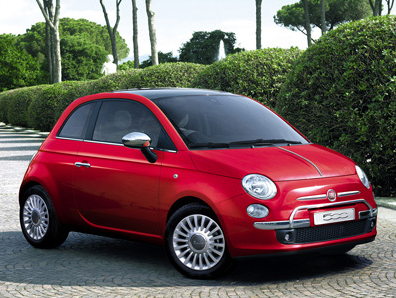
For a tiny car, the Fiat 500 is telling a big story.  And it says a lot about how to create multiple brand narratives around a new product.

Fiat 500

Since its creative splash during Super Bowl XLVI, Fiat has given us two sequels that speak to different audiences highlighting unique product attributes to each one.  The brilliance of the Super Bowl Abarth ad is that it took the age-old “love affair with a car” metaphor and made it real.  The woman seductively bending over at the curb wasn’t just any kind of sex symbol; she was an Italian sex symbol.  It was the embodiment of lust and bust.  “Che cosa guardi?” she screams in Italian.  The translation is simple, “What are you looking at?”  The answer is just as simple–a brand new sexy-hot Italian sports car.


Fiat has since followed with two more ads that stretch the storytelling for different audiences.  The latest incorporates another babe–this one in a car seat.  The ad follows two family guys with tickets to the big game and extra baggage strapped into the back seat.  But they get caught behind a grey-haired senior citizen in his vintage Chrysler Imperial.  (Think Clint Eastwood)  But the speed of the Fiat shows this is clearly not Halftime in America–it’s full throttle.  The message: drive the kids in the fast lane.


Then there’s the House Arrest ad once again featuring the Abarth, but this time in bad boy black.  The car races through the hallways of a mansion stocked with booze and babes.  When the car finally screeches to a halt in the ballroom, the driver climbing out is none other than Charlie Sheen.  The tag line is “Not all bad boys are alike.”  The message: have fun on your terms.


They are three ads with three distinct stories about a new product.  It’s sexy.  It’s practical.  And, it’s fun.  Can’t wait to see what else Fiat has up its sleeve.

Picture This — A Cure Community for Diabetes

5 Mar

Hopes and dreams don’t just hang in our minds, sometimes they hang in picture frames.

Blotz Family - OutFOX Diabetes 2012 Walk Team

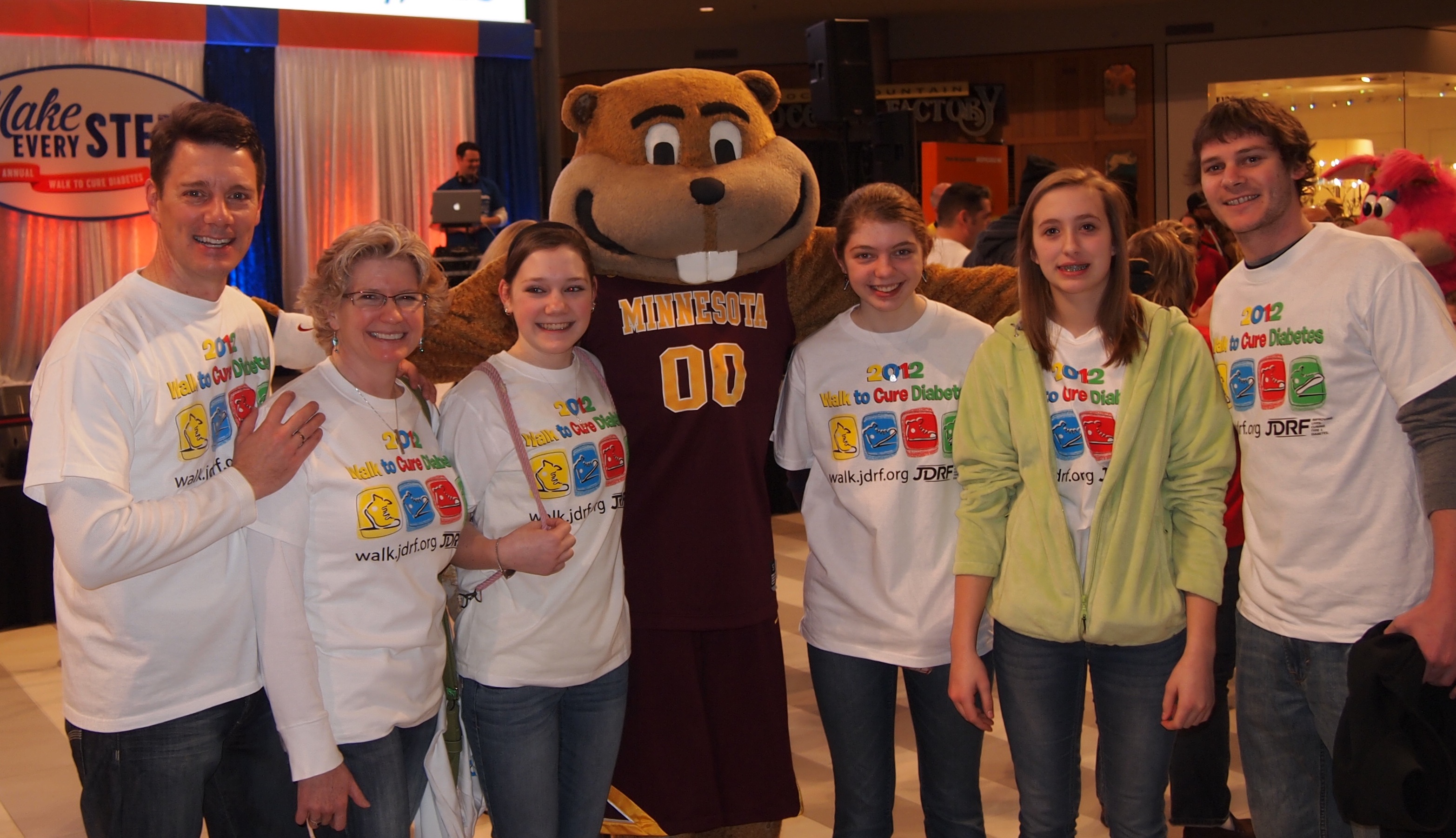
At the recent Minnesota JDRF Walk to Cure Diabetes, the hopes and dreams spilled from the pictures taken and pictures displayed on shirts and posters all across the Mall of America.  Almost all of them were of children.   Each one shouts a story, each one begs for someone to listen.  But the one picture that doesn’t exist is the image reserved for the empty frame that sits in each of our homes.  That’s the frame waiting for a picture of a cure.

Kim Bailey, an adult living with diabetes since her childhood once told me she envisions the frame as a picture of nothing.  “Let’s get rid of it.  It exists no longer.  Let’s get it done and put ourselves out of a job.”

Amen.

Until then, I still fill my frames with hopes and dreams for my daughters Maddy and Emme.  Maddy was diagnosed with Type-1 diabetes at the age of three, Emme at the age of eleven.  It’s not an easy disease for children, or their parents.  Manageable, yes.  Easy, no.  Besides the constant blood sugar tests, carb counting and needles sticks, there is the worry and many times the feeling of isolation and exasperation.

Alyssa Kapaun was diagnosed in 2011 with Type-1

At this year’s Walk there were two girls who know both the isolation and exasperation.  Alyssa Kapaun is a fifth grader who every day eats lunch by herself because she returns late to the cafeteria after getting her insulin shot in the nurse’s office.  To a parent, it’s a crushing sight; Alyssa on one end of the cafeteria all alone, her class on the other end.  I recently had the chance to meet Alyssa at her school—she didn’t eat lunch alone that day. 

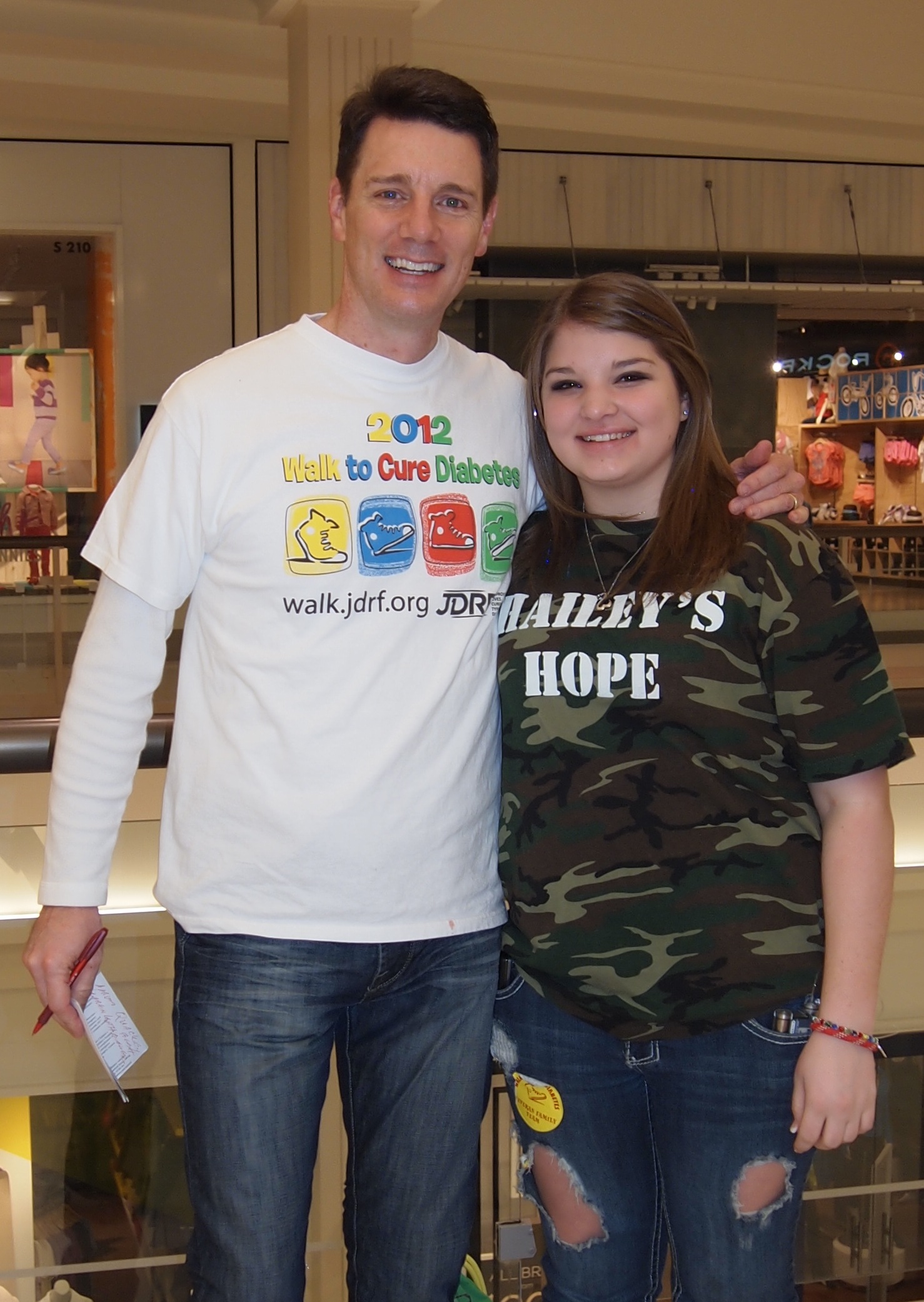
Hailey Stark of "Hailey's Army" Walk Team

                            And then there’s Hailey Stark, a high school freshman I first met at last year’s Walk hobbling along on crutches.  She was having a hard time of it.  The struggles of being a teenager, in addition to one with diabetes AND a broken leg were written on her face as plain as a low blood sugar reading.  She didn’t give up then, and she hasn’t given up now.  What a thrill it was to see her again at this year’s Walk without the crutches and with a team of friends.  The message that I hope Alyssa and Hailey took home from the 21,000 people at this year’s walk is that you’re never alone. 

The stories of those two children drive what is both an essential function and brand for JDRF.  At its core JDRF is a charitable organization that drives and funds essential research to cure, treat, and prevent Type-1 diabetes.  Since a group of mothers founded JDRF in 1970, it has contributed $1.6 billion toward research to find a cure–$116 million in 2011 alone.  In many ways, it is invisible work conducted in laboratories and clinics around the world.   But as Alyssa and Hailey show us, it is JDRF’s visible work of programming the Walks and fundraisers that provide a core social purpose and create a powerful brand.

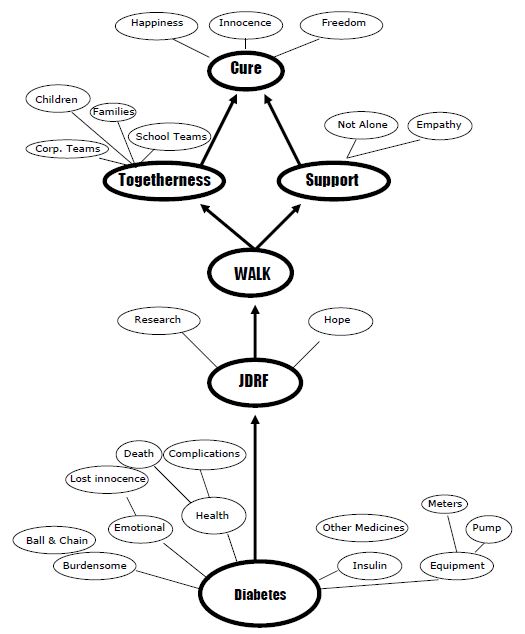
Figure 1 - JDRF Mental Model Map

Two years ago I conducted a communications research study to identify leverageable consumer insights into the Walk to Cure Diabetes.   Part of the study’s methodology utilized a Zaltman-style elicitation analysis that had a number of people affected by Type-1 diabetes assemble a series of pictures that best describe their feelings and thoughts about the disease.  The elicitation study produced a mental model map that started with diabetes and its burdens and laddered up to JDRF, the Walk, and finally, a cure. (Figure 1)  The subjects in the study produced two important and equal mind models of the Walk, one of support, and one of togetherness.  In the togetherness model, the concepts of “empathy” and the thought of “not being alone” stood out among the participants.  To all of the study’s subjects, the Walk represented the possibilities of a cure and the higher level values of happiness, innocence, and freedom. 

Together, this mental map produced a number of important take-aways.

Consumer Insights into Diabetes:

  • Diabetes is hard on families
  • Exceptionally hard on parents
  • Physical and emotional struggle for the patients of Type-1 diabetes
  • Lives are ruled by medicines and machines

Consumer Insights into JDRF:

  • Represents a means to a cure
  • Finding a cure means a return to innocence for our children

Consumer Insights into Walk to Cure Diabetes:

  • Family
  • Coming together
  • Support
  • Reinforces the sense of not being alone

What became very clear from the research is that people with ties to JDRF viewed it as a community.  Not just any community—A Cure Community.

JDRF has done extensive work in the past year to rebrand itself as the Type-1 diabetes organization.  It’s certainly one way to differentiate itself from the American Diabetes Association (ADA) which also supports research but has a core mission of helping people with diabetes live better lives.  The people who continue to support JDRF with their dollars want something more.  They want a cure and a return to the freedom and happiness it represents.  That’s why the consumer insight into JDRF as a cure community is so powerful.  It is the foundation to a brand for JDRF that has real meaning.

2012 JDRF Walk to Cure Diabetes at MOA

The 21,000 people who raised $2.1 million at the recent JDRF Walk know it.   Now Alyssa Kapaun and Hailey Stark know it, too.  They exist in their parents’ picture frames just as Maddy and Emme exist in my own.

And then there’s that empty frame, too.  I’m holding out to fill it with one giant group-shot of all the people we cure.

Halftime in America. How Chrysler Found a Voice, and Missed an Opportunity

14 Feb

                The silhouette emerging from the darkness on Super Bowl Sunday was more than a man stepping into the light.  It was a car company emerging from the blast furnace of scrap metal.  And, it was a nation emerging with it. 

"Halftime in America"

                The advertisement for Chrysler wasn’t directly selling a product, it was selling an idea—economic patriotism.   It picked up where Chrysler left off in Super Bowl XLV when Eminem introduced the new Chrysler 200 luxury car proclaiming “Detroit was back.”   This year’s message is  that Chrysler has survived a brutal first half of the recession, and if Chrysler can do it so can the rest of America.   As I wrote in a previous post, the ad was no accident and was strategically positioned to elicit a desired response.

  • Idea:  Halftime/Patriotism
  • Target Market Audience:  Anyone who has struggled in the economy
  • Desired Response:  Feel confident about Chrysler—feel confident about yourself
  • Competitive Frame:  Apathy and pessimism
  • Message Argument:  We’ve only just begun—can’t wait for the second half
  • Rationale:  Emotional trigger to build loyalty and awareness to Chrysler 

             The positioning of Clint Eastwood as the metaphoric coach giving the country a sobering Super Bowl halftime pep talk was brilliant casting.  Who’s not going to stand tall with Dirty Harry giving a “Million Dollar Baby” lecture? 

                Apparently, plenty.

                From Fox’s Bill O’Reilly, to former Bush White House Aide Carl Rove, many people saw it as a rallying cry to justify the auto industry bailout.  Additionally, many of those same people saw the halftime in America theme as a metaphoric campaign commercial urging voters to give President Obama a second term.  Media analyst John Rash said the backlash should not be surprising.  

Media Analyst John Rash

                “The commercial is a real shock test in that people can read into it what they bring politically,” said Rash.

                “Many republicans might be able to read here they have a well known conservative who in effect is trying to rally the country for a fresh start in the second half.  To some that would suggest electing a new administration.  Other’s certainly some democrats read into it using the auto bailout in Detroit as a template for the country’s comeback and they hear second half and they think second term.  So, people will project onto a spot what they think politically and socially.”

                But critics of the ad need to hear at least one more perspective.  Anna Ciaramitaro lives in Detroit and has witnessed its slow death in the new economy. 

Detroit resident Anna Ciaramitaro

              “It was one of the best commercials ever made,” said Ciaramitaro. 

                She added, “It was a commercial that touched the heart of Detroit and the people that lived there, the citizens, the residents there that experienced everyday what it’s like rebuilding a city again.  And we just wanted to share that with the rest of America.”

                And this is exactly where Chrysler missed an opportunity.  What if it didn’t just create an ad, what if it had created a community?  What Chrysler missed was the chance to launch a multi-channel campaign where people can tell and create their own “second half” stories.  Here are a couple of ideas:

  1. Branded website:  A separate webpage called secondhalf.com where Chrysler can showcase comeback stories/videos of ordinary Americans and companies.  User generated content would be the key component of this website.   Ideally, the stories would include some thread of how Chrysler products helped in the comeback.  The website should be prominently embedded on Chrysler’s homepage that customers can easily find.  The website branding would be integrated within Chrysler’s media buys:  “Tell your story. Secondhalf.com”
  2. Daily Twitter updates:  A separate Twitter feed of daily success stories tied to the Chrysler brand.
  3. Elementary School Art Contest:  Involve local Chrysler dealerships and schools in an art display that encourages children to tell their own stories through art work of how perhaps their own families have found ways to succeed.   The local Chrysler dealerships would serve as the galleries to display the art and present a cash prize to the school with the best presentation.
  4. Video contest:  An invitation to young film makers to create their own second half ad showcasing a comeback story.  All ads would be screened and judged by Oscar winning director Clint Eastwood.  The winning commercial would then air during the halftime of the NLF kick-off game in September. 

             During the Super Bowl, Chrysler implored the world to “hear the roar of our engines.”   Building a community could provide the echo chamber to let those engines roar from every corner of the planet.

                Yes, Chrysler is a car company.   But as Americans in every walk of life emerge from this brutal recession, Chrysler is also a success story.  Americans love winners.  That’s a sustainable brand value Chrysler can build and drive.

Best Buy’s Black Friday Game Changer

27 Nov

            On a day when Best Buy reluctantly followed the retail pack, they may have come out a leader and changed the rules.  When Wal-Mart, Target, and other big box competitors announced earlier this fall that they would open on midnight of Black Friday, Best Buy brought up the rear.  In the end, it may have been Best Buy that had an extra piece of Thanksgiving pie.

Figure 1 - Back Friday shoppers outside a Best Buy in Eden Prairie, MN. (Courtesy KMSP-TV)

            Best Buy not only changed its Black Friday tactics at the last moment, it brilliantly redefined the customer experience that may force its competitors to change how they too look at Black Friday.   What Best Buy did was to take a cold, mundane parking lot camp-out and turn it into a festival.  At its store in Eden Prairie, Minnesota, store employees set up a giant projection screen in the parking lot and showed Harry Potter-7 to entertain the hundreds of shoppers waiting in line.  But there was also another gift: Best Buy stocking caps and matching scarves.  And, in a classy move, Best Buy CEO Brian Dunn even arrived to greet customers and personally thank them for their loyalty.

            The tactics were not missed by Fox 9 News reporter Jody Ambroz.  “These shoppers are becoming big fans of Best Buy because of the way they’re getting treated out here,” Ambroz reported.

            The moves by Best Buy were strategic in three ways.  First, they let the customers know they were valued.  Second, the caps and scarves branded the entire line of campers for the television news cameras. (Figure 1)  Third, it let every news viewer at home know they were missing out on the fun, not just the deals.  Best Buy created a whole new value proposition.  The implicit message to consumers everywhere was this:  why camp out somewhere else, when you can party at Best Buy?

Figure 2 - YTD Stock Performance for Best Buy, Wal-Mart, Amazon, Target, and DJIA

            In many respects Best Buy had no choice.  In a hyper-competitive market, Best Buy is fighting for every dollar—especially in a year when it closed its UK stores and is shifting its retail strategy to sell more mobile technology.  Its stock is down 25% for the year and performing well behind Wal-Mart, Amazon, and Target. (Figure 2)  Allowing even a small percentage of rabid shoppers to spend what little recession-shrunken dollars they have left at a competitor five hours before Best Buy traditionally opens on Black Friday was simply not an option.

            Dunn telegraphed as much in a recent blog post when he said, “It is the most important holiday selling season ever. And it will be the most hard-fought holiday season – maybe in our history.”

            There is one remarkable aspect to what Best Buy did for Black Friday.  Somewhere, someone deep inside headquarters said the customer experience was as important as profits.  Just as remarkable, someone else listened.  Both won.  Best Buy’s Black Friday competitors are now on notice.  Game on.

Changing Plays: The Vikings New Stadium Strategy

8 Nov

                The game is called football.  But what the Minnesota legislature is playing is closer to hardball.  With no stadium bill gaining traction for the Minnesota Vikings, no agreement on a public funding mechanism, and with the clock ticking on the Metrodome lease, the Vikings are about as suspended as a slow motion replay of Gary Anderson’s field goal kick in the ’99 NFC Championship game.   This time they need a better outcome. 

                After 11 months of failing to gain a first down in the legislature, the Vikings are calling an audible.  Instead of running straight at their opponents, they’re taking a page out of the Packer’s playbook and leaping into the stands.  For the first time in their quest for a new stadium, they’re making their appeal directly to Viking’s fans.   The new strategy has just been unveiled in a two-minute web video. 

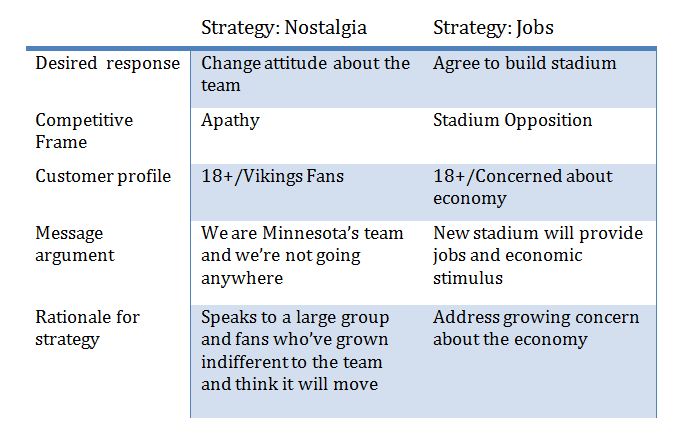
                The video is not only slick and likeable, but a very strategic communication move on the part of the Vikings.  The strategy jumps from the screen in a very logical and smart manner.  Their main strategic objective is to use both nostalgia and jobs as the touch points for talking directly to Minnesotans. 

Figure 1 - Vikings Video Strategy

               The chart at the right diagrams exactly how the video achieves this. (See Figure1) The Vikings competition at the moment is apathy among fans and people who oppose building a new stadium.  What the Vikings clearly need to accomplish is to change attitudes about the team’s commitment to Minnesota in addition to convincing the public that a new stadium will be good for the economy.  The video cleverly uses old highlight reels to make an emotional appeal and then collides it against the rational appeal of job creation.   The result is a communication message that is enjoyable and smart.

                So too is the channel.  A two-minute video is too long and too expensive for a TV advertising flight, but as a web video it targets the very audience the Vikings most need—their own fans. 

Figure 2 - Duncan Watts, Journal of Consumer Research, Dec. 2007

               In today’s world of social media, the genius of such a release invites Vikings fans and loyalists to become stadium evangelists and spread the message themselves.  Rather than a direct one-way message from a traditional ad campaign, marketing researcher Duncan Watts observes that it flows dynamically among many sources and doesn’t have to originate from thought leaders or authority figures. (Figure 2)  In this model the most important influencers are friends. 

                According to Vikings Vice President of Public Affairs Lester Bagley, that’s exactly the rationale behind the new strategy.   “This video signals the launch of a broader communications campaign where we want to take the case for a new stadium more directly to the public,” said Bagley.  “The goal is to deliver accurate information, dispel misinformation and arm and mobilize our supporters.”

                The Vikings are clearly running out of time.  It’s late in the fourth quarter, the team is now hoping their fans can not only catch the ball, but lateral it to others to run into the end zone.

Steve Jobs and the Power of Self-Actualization

15 Oct

            Search the Apple Apps Store on a brand new iPhone 4S and one will find 424 applications to “create.”  There are no apps for “conformity.” 

            Mark it up to the lasting legacy of Steve Jobs.

             The Apple co-founder who lost his battle with cancer last week developed technology devices that allowed people to easily create things.  He dared us to be different.  Nothing expressed it more than Apple’s ad copy when Jobs returned to Apple in 1997.

“Here’s to the crazy ones. The misfits. The rebels. The troublemakers. The round pegs in the square holes. The ones who see things differently. They’re not fond of rules. And they have no respect for the status quo. You can quote them, disagree with them, glorify, or vilify them. About the only thing you can’t do is ignore them. Because they change things. They push the human race forward. And while some may see them as the crazy ones, we see genius. Because the people who are crazy enough to think they can change the world, are the ones who do.” (Apple Inc.)

             What Jobs tapped into was the psychological notion of self-actualization.  Everyone has the power to change themselves and those around them, what Jobs and Apple did was design the technology to make it happen.  In the process he asked us not only to think differently, but to create differently.  Break out of the box. 

             On the day of Job’s passing, we did just that at Fox 9.  We left our $30,000 video camera in the trunk and instead pulled out our iPhone and iPad. 

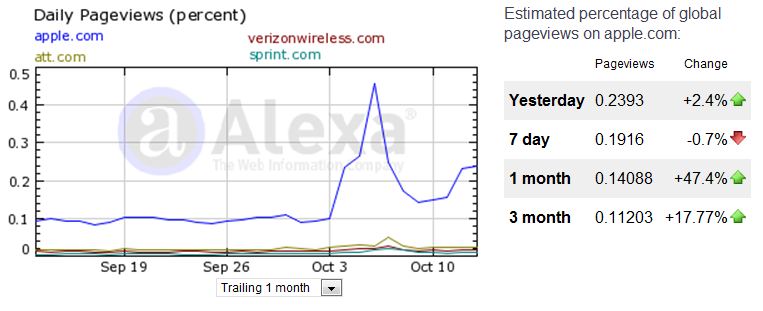
            The genius of the culture Apple has created is in the loyalty of its customers.  If Jobs created any legacy it’s in the notion that people want technology that easily helps them be who they are.  The proof is in the web traffic scores since the announcement of the iPhone 4S. 

Web page traffic for Apple, Verizon, and ATT

            Visits to Apple’s site are up nearly 50%, 24% at ATT, and 19% at Verizon Wireless, two of the dominant service providers for the iPhone.   All three expect record sales.

            Admittedly, it creates an interesting paradox that the company which has pushed people to become individuals has them lining up like Lemmings.  But what this is really all about is a dominant brand idea.  In a world that too often settles for “me too,” Steve Jobs taught us to say, “I am…”


Branding Famine Relief: How The American Refugee Committee is Feeding Starvation Through a Community of Stars

12 Oct

           It’s hard enough to get the world to care about famine.  It’s even harder when that famine is part of a 20-year cycle of endless white noise
called Somalia.

Therein lies the challenge of the American Refugee Committee.   Just how do you encourage people to contribute money to solve a seemingly endless crisis?  Its answer is in a new branding campaign that turns famine relief fundraising on its head.   Instead of asking people look outward at the results of famine, they’re now pushing them to look inward and become a “Star for Somalia.”


The new campaign is the brainchild of ARC and the creative team at IDEO in Palo Alto, California.  IDEO is fundamentally a design firm, known for creating breakthrough products such as the Apple mouse.  At its core, IDEO helps people channel creativity to solve problems.   Somalia is a big problem, but its team worked with ARC to un-harness the creative energy of everyday people to not just feed starving people, but to create a conversation about it.

Instead of forming a traditional campaign pumping out one-way messages about Somalia, ARC’s Daniel Wordsworth says the “I Am A Star” effort creates a multi-channel dialogue.

“Here is a chance for folks in Minnesota, in the US and all over the world to say this shouldn’t be like this and that we can make a difference. And what we’re trying to do is launch a campaign that says you can make a difference and we want you to do it your way,” said Wordsworth.

It’s already working.  Inspired to do something, Mohamed Samatar and Bonnie Bentson formed their own 5K Run called “Run to Unite.”  They are among the first “Stars” in the new ARC sky.

“Everybody can do something in some way,” said Benston. “And whether it’s as big as creating a 5K or as small as walking in it or running in it, or telling your friends that I’ve heard about this, we can all help in some way.”

That’s what happens when you ask people to look inward.  That’s personal empowerment and the beginning of a potentially powerful brand.

Look for my story on ARC and how it’s trying to change the conversation on Somalia on Fox 9 News Saturday night right after baseball.