Archive | Social Media Trends RSS feed for this section

Facebook Usage Down. Why This is Not The End–Yet

14 Jun


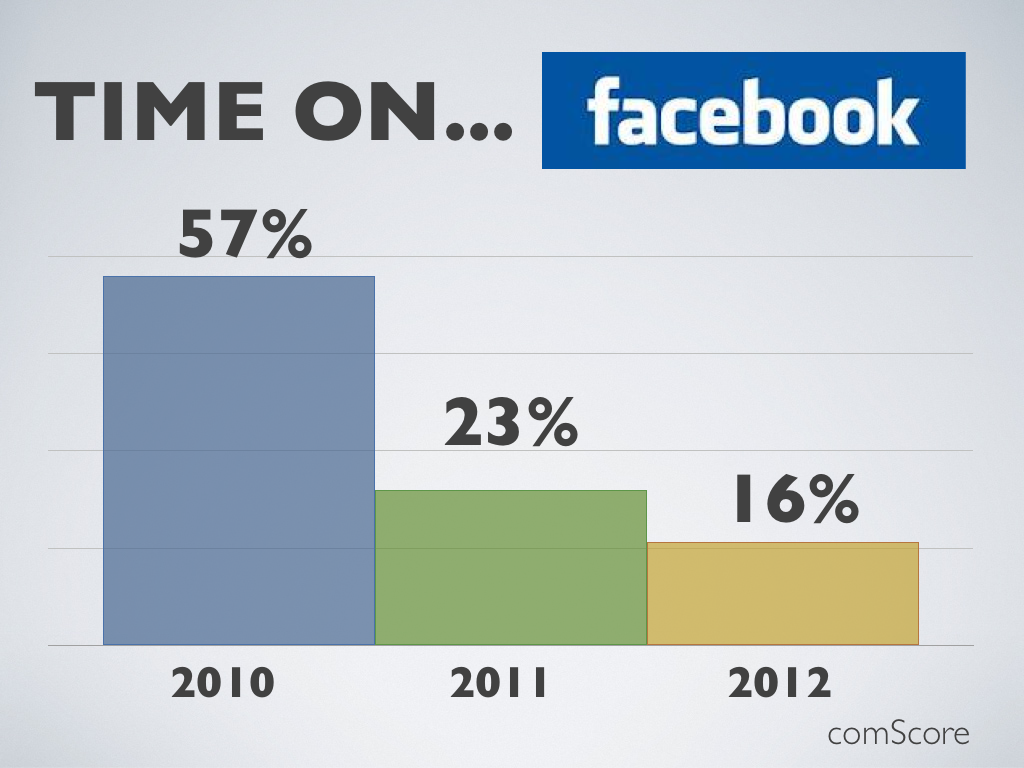
Figure 1 – April-to-April increase of user time per month on Facebook

The latest user research on Facebook indicates the dominant social media site is losing some of its luster.   A series of recent data sets indicates Facebook engagement is maturing and users may be losing a sense of the novelty that once came with the social networking site.

New research from the web analytics firm comScore Inc. shows that unique visitors to Facebook in April rose to 158 million, an increase of only 5% from the year before.  Its growth rate was down 24% from April of 2011 and 89% from April of 2010.

ComScore’s data obtained by the Wall Street Journal also shows a slowdown in growth rate of time spent on Facebook.   In April, users spent a little more than 6 hours a month on the site, an increase of 16% from the year before.  That compares to a 23% increase in April of 2011 and 57% in 2010.  (Figure 1)

Additional research from Reuters and Ipsos indicates 34% of Facebook users were spending less time on the site than they did just six months ago.   The phone survey of more than 1000 participants represented recall and was perhaps not as accurate of a measurement as the analytics study generate by comScore.

Nevertheless, they all tap into an insight that the fascination with Facebook may be peaking.

Among Facebook’s core users of young adults 18-35 there are mixed reviews.   Allysa Sajady is a 20-something grad student who still uses Facebook, but admits not as often. 


Jackie Randall is a dentistry student who no longer has the time to constantly update her friends.


The waning fascination with Facebook is easily explained with a nearly 100 year old psychological model known as the Wundt Curve. (Figure 2)

Figure 2 – Wundt Curve

Wilhelm Wundt created the model to help explain the newness of an idea or product.  In the model, the X axis (vertical) represents enjoyment, and the Y axis (horizontal) represents stimulus intensity or newness.  The curve portrays rising enjoyment as an idea or product is new and then falling enjoyment as the product becomes overly familiar.  The primary lesson from Wundt is that sustainable relationships are created when a familiar product is changed just enough to make the experience new again.  In other words, the optimum position on the curve is slightly outside the X & Y intercepts.

That’s exactly what Facebook has attempted to do by creating the new timeline feature and by acquiring the photo sharing application Instagram.  With those two moves Facebook is staking its claim on sustainable side of the Wundt Curve.   Yahoo and MySpace have floundered deep inside the curve.

For all of its sudden criticism, Facebook is still a behemoth brand.  ComScore notes that Facebook has already collected 71% of all 221 million U.S. internet users.  They spend more than six hours a month on Facebook far exceeding the four hours a month they spend on all of Google’s sites and the 3.5 hours they spend on Yahoo sites according to comScore.

For those who make a living following social media trends, Facebook is far from dead.

“Absolutely not,” said Dan Antonson of S-M-C Pros of Minneapolis.  “I think technology is always going to trend, it’s always going to change. And I think what we’re seeing is a shift, absolutely a shift in behavior.  But that shift doesn’t necessarily mean that Facebook isn’t working,” said Antonson.


In fact, for Antonson Facebook is working.  “I mean, when you look at some of these recent reports of one-in-five page views on the internet being Facebook, it’s hard to say it’s going away anytime soon.”

It may not go away, but the challenge for Facebook is to keep changing the experience enough to keep it new to the user.
GM and Ford — A Case of Two Facebook Strategies

7 Jun

General Motors recent announcement to stop buying advertising on Facebook may have been the backfire heard in agencies around the world.  GM didn’t just turn off the engine, it slammed the breaks with such force that it had the advertising industry and social media world bouncing off the air bags.  That tends to happen when any brand cancels a $10M buy.  GM argued the Facebook ads and were simply ineffective.

To be sure, social media is a constantly shifting platform that challenges brands in finding a cost effective way of using multiple social channels to target customers.  But as a customer engagement platform, is GM really using Facebook effectively to drive conversations with its customers?

Figure 1 – Ford’s Facebook Cover Photo

Figure 2 – GM’s Facebook Cover Photo

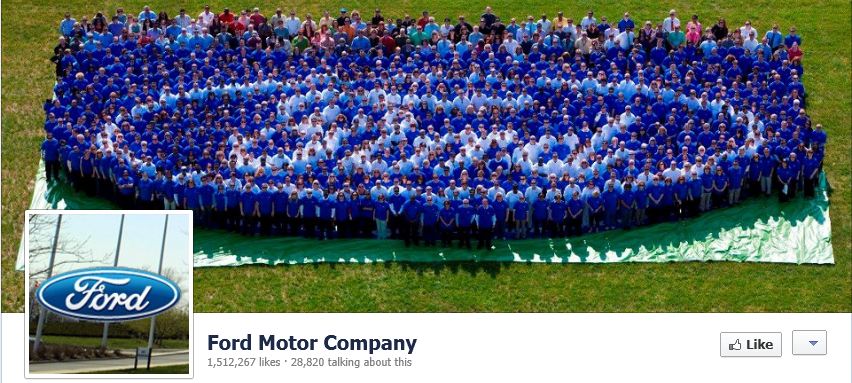
Let’s start with a simple look at the Facebook cover photos of both GM and Ford. (Figures 1 & 2)  One of these pages immediately tells the user its company is about people, the other is about objects.  At its core, social media is about having relationships with other people.

Extensive research on social media engagement indicates a strong correlation between seeking gratification and fulfilling psychological needs.  Louis Leung found a significant draw to social media by people who needed recognition and empowerment.  Brand new research from the University of Boston shows that Facebook use is motivated by the need to belong and a secondary need for self-presentation.  Additionally, John Eighmey and Lola McCord established how the need for entertainment is vitally important to maintaining an online relationship.  But among the most important insights for brands comes from Mihaela Vorvorneanu at Purdue University whose research found a desire for consumer interaction with corporations on Facebook only if it gives them a badge of personal identity, or a tangible reward such as a discount on products or services.

Figure 3 – Ford’s Car Giveaway

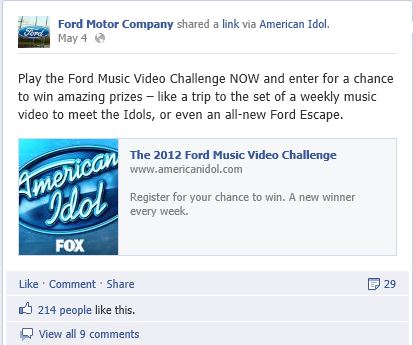
On the later point, Ford seems to deeply understand these motivations.  During the final week of its American Idol sponsorship on Fox, Ford ran a Facebook post inviting viewers to enter the Ford Video Music Challenge and have a chance at winning a new car.  (Figure 3)  Another engagement strategy by Ford is asking its followers to contribute their own ideas on topics such as designing their own Ford Fusion or what they’d do with the gas money they’d save if they owned an electric car.

Figure 4 – GM’s May Sales

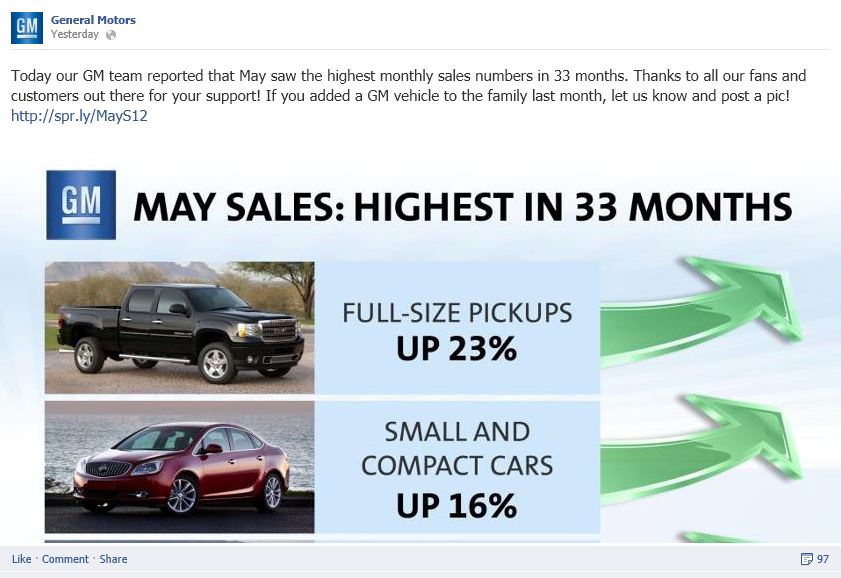
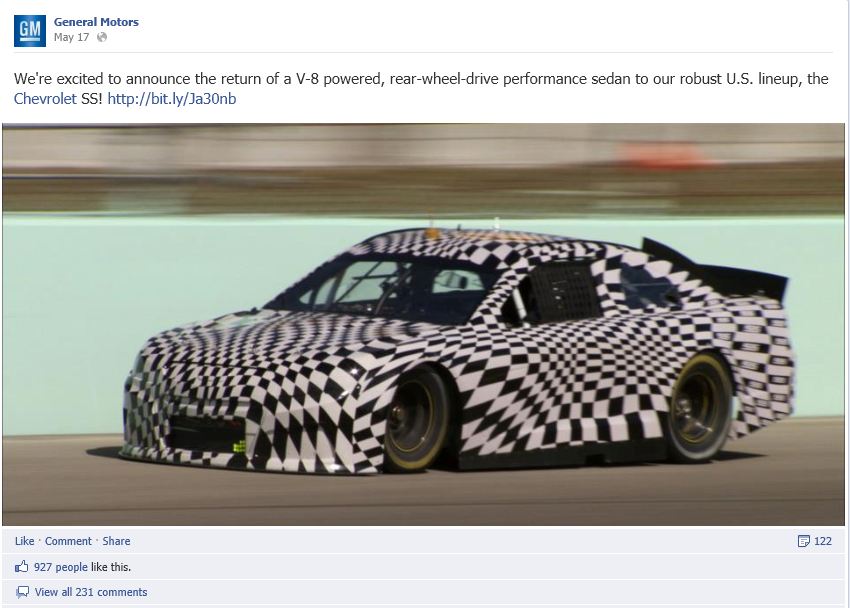
GM’s Facebook page tends to look more like a corporate newsroom site.  One recent posting trumpeted May’s sales growth. (Figure 4)  Another linked to a CNN.com interview GM CEO Dan Akerson.   While it all defends and defines the corporation, it’s not exactly the kind of content that invites a personal dialog with the brand.  In fairness, there are some moments of truly cool engagement, such as the picture it recently posted of the new top-secret Chevy SS prototype. (Figure 5)  The posting builds intrigue and anticipation at the same time serving as a sneak-peek reward for any GM Facebook follower.

Figure 5 – Chevy SS Facebook Post

The one thing GM has going for it is its social media maven, Mary Henige.  She is a walking, talking, one-woman evangelist for General Motors.  Henige has more energy than a fully charged Chevy Volt and is not afraid to use Twitter and various other channels to engage customers in the GM brand. (Follow Henige on Twitter @maryhenige)  One good example is the Facebook page for Chevrolet.  It uses more of the follower-involving content utilized by Ford to draw people into a relationship with the brand.

It could be reasonably argued that GM’s core customers have stronger emotional bonds to their individual car brands than to the corporation behind them.   In that regard it could make sense to let the GM Facebook page be more of a corporate PR blog.  But that’s not what social media is about, and GM may be missing an opportunity to make true relationship drivers of all of its social media channels.

Vikings Stadium Victory: The Power of Social Democracy

12 May

When the founding fathers guaranteed the right to petition government, they never conceived of Facebook or Twitter.  But the mass democratization that just occurred in Minnesota just may be what James Madison had in mind when he conceived of the Bill of Rights.

Artist rendering of a new Vikings stadium

In a stadium debate that was inexorably mired in partisan politics and collapsing like the Metrodome roof, Vikings fans took to the internet, social media and their phones to drive the votes in favor of building a new “People’s Stadium.”

To be sure, the Vikings and labor unions helped amass their fans and members to call and write their legislators.  But web analytics also show that there was a substantial organic movement among citizens.

Figure 1- Google Trends

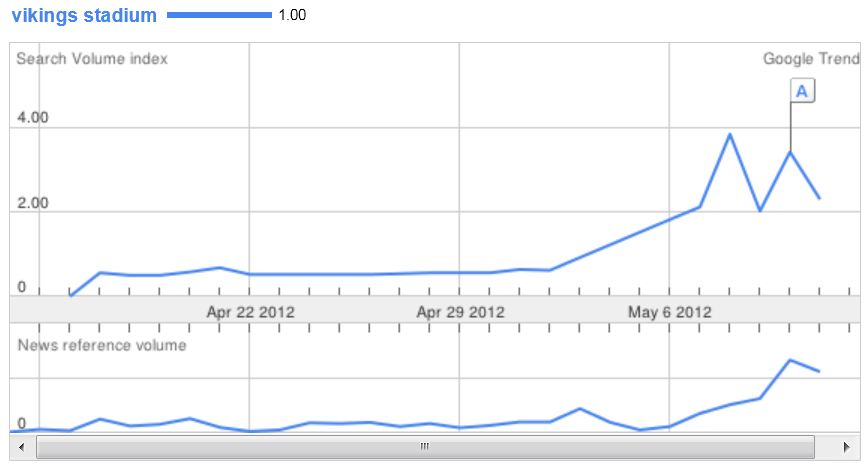
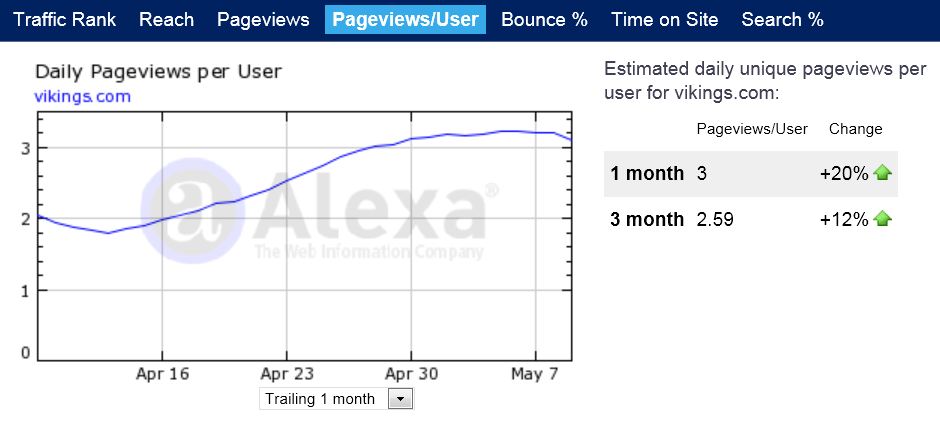
In the days leading up to the final stadium vote in the Minnesota legislature, there was a substantial groundswell in what digital analysts call “search” and “share.”  Google Trends data (Figure 1) shows the exponential rise in Minnesotans searching for information on the Vikings stadium leading up to the floor vote in the House of Representatives on May 7th.   Additionally, the number of unique page views to vikings.com also rose ahead of and during the vote. (Figure 2)

Figure 2 – Daily unique page views

But perhaps one of the Vikings’ more effective strategies was enlisting their more than 1.3 million Facebook fans.  It’s a strategy they’ve tried before.  With a post on May 4th, the Vikings asked their followers to contact their representatives. (Figure 3)

Figure 3 – Facebook Post, May 4th, 2012

That alone cannot explain why thousands of constituents followed through.  But there’s a theoretical framework that does.  It’s called Prospect Theory.   The theory was developed in 1979 by Princeton psychology professor Daniel Kahneman who later won the Nobel Prize in Economics.  In its simplest form, it holds that people are risk averse.  In the case of the stadium debate, Minnesotans in the end were more afraid of possibly losing the Vikings than they were about gaining stability in taxes and state finances.  There were plenty of worthy and important arguments about jobs, public debt, and voter referenda, but in the end it was fear of losing the Vikings—perceived or real—that perhaps carried the day.

At least one key lawmaker the acknowledged the importance of the social movement at the governor’s May 10th news conference following the final passage of the stadium bill.

“You made an incredible mark on your legislators, I can tell you,” said Sen. Tom Bakk.


Bakk told how lawmakers often times share with each other how many emails they get.  “You know, if you get six or eight on something, people talk about it.  I got 987 between 10 o’clock one night and 6 o’clock the next morning,” said Bakk.

That’s petition.  That’s power.  And it’s another example of the new rise in social democracy.

Screen Splitting—How Brands and TV News can Overcome Simultaneous iPad and TV Viewing Habits

28 Apr

It wasn’t long ago that the biggest enemy to television advertisers and programmers alike was the TV remote.  Ah, for the good old days.

New mobile technologies and platforms have given consumers virtually effortless and instant access to hundreds of competing communication channels.  And now we learn that they’re increasingly accessing these channels while actually watching TV—or not watching.  Welcome to television’s latest nightmare.  The monster keeping brands and programmers up all night isn’t necessarily getting bigger, it’s just multiplying.

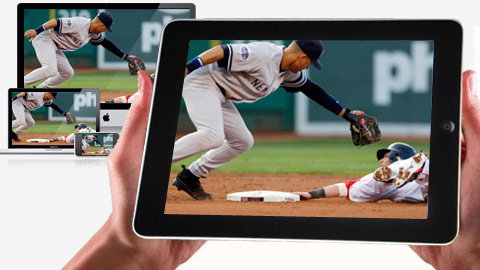
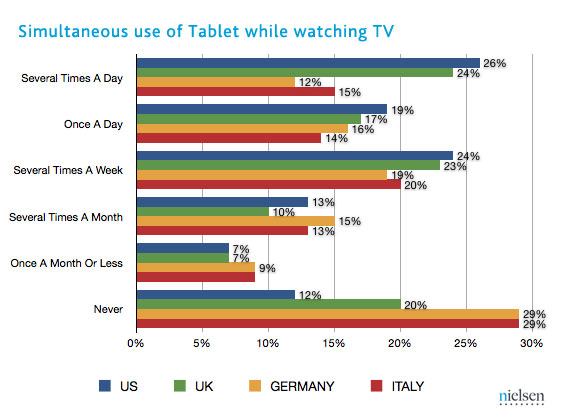
Two new data sets of consumer research provide valuable insights into how audiences are using media, often at the same time.  The behavior is called screen splitting.  It’s arisen from the explosive growth in mobile technology and even new platforms such as the iPad and tablet computing.  The Nielsen Company’s latest survey of connected device owners indicates depth of this new behavior.  Fully 88 percent of tablet owners and 86 percent of smartphone owners said they used their device while watching TV at least once during a 30 day period.  For 45 percent of the American tablet owners, screen splitting was a daily event, 26 percent said they simultaneously used their tablet while watching TV several times a day. (Figure 1)  The data was similar for smartphone owners.

Figure 1 - Courtesy Nielsen Co. (4th qtr 2011)

The second data set suggests the media switching happens at an almost frenetic pace among many viewers.  Innerscope Research specializes in conducting biometric studies of consumer viewing habits.  In a recent study commissioned by Time Warner, Innerscope outfitted 30 participants with biometric belts that recorded their physical responses as they used media throughout more than 300 hours of time away from work.  The participants also wore special glasses embedded with cameras that tracked what platform they used and for how long.  The results showed that consumers in their 20’s, or digital natives, switch media venues about 27 times per non-working hour.  To put that in perspective—about 13 times per standard half-hour television show or newscast.  Older consumers who didn’t grow up with the new technologies, those who Innerscope calls digital immigrants, shifted media at a 35 percent lower rate—just 17 times per non-working hour.

Together, the research sets tell us how our viewers are no longer sitting at the table to consume our products.  Instead, they’re running through the ala carte line.  They’re not eating whole meals, they’re snacking.  As soon as the instant gratification wears off, they’re onto the next snack.

Given this new reality, the question becomes how do brands and programmers adapt?  From a conceptual point of view, their product has to be positioned to hit the viewer’s emotional and intellectual sweet spot.  Advertising researcher and scholar John Eighmey gives us a conceptual model he calls Reward Theory.  It conveniently categorizes the elements that must interplay with each other for consumers to latch onto a piece of visual communication to consume, enjoy, and share.  It is the same model that explains why YouTube videos go viral. (Figure 2)

Figure 2- John Eighmey's Reward Model for explaining viewers engage in and share content.

First and foremost, the content must be stimulating.  It must be enjoyable to watch, clever, or surprising.  Second, it must have an element of empathy or personal identification. Third, it must lack confusion.  Fourth, is narrative or theme familiar to the viewer? That is, does he or she recognize the theme or scenario in which the information is presented?  Fifth, it must have news value such as a new claim or idea.  Finally, the message has brand reinforcement in that it creates positive attitudes about the message or messenger.

From a practical and operational mode, strong brands have learned that they must create stimulating content and integrate it 360 degrees across multiple platforms and channels.  For Coca-Cola and Proctor and Gamble it’s no longer acceptable to run just a TV ad and a print ad and call it a day.  They now know their brand and content has to live in traditional media, social media, digital media—all the channels that their customers use.

TV Newsrooms must adapt the same strategy.  Some already are.  KTTV, Fox 11 in Los Angeles is now routinely using Google+ to involve viewers in “hangouts” with their anchors during the newscasts.  The hangout participants can even chat with the anchors during the commercial breaks and watch the behind-the-scenes action in the studio.

It’s a smart approach.  Nielsen’s fourth quarter 2011 research on simultaneous TV and tablet usage shows 47% of the general population visited a social networking site during the program they were watching on TV.  Additionally, 37% claim to look up information related to the program they’re watching. (Figure 3)

Figure 3 - Nielsen Co.

If viewers are going to be screen splitting, the goal is to get them to interact with your brand on the second screen or channel.  Here are some tactics for TV newsrooms:

  •  Reporters should steer viewers to Facebook or Twitter for additional content or pictures (you may lose their attention briefly, but you keep them engaged in your brand).
  • During major stories, or continuing coverage, create a branded hash tag for viewers to follow and  interact with.  Display the “lower third” super of the hash tag during the related content.
  • Read what other viewers have to say on Facebook.
  • Let followers know their specific content or posts will be used on-air (everyone likes to be on TV, even if it’s a quote).
  • Replace all talent name supers with their social media addresses.
  • Work with station web page designer to display the real time Tweets of reporters and anchors on the home page.

What’s hard for many brands, especially newsrooms to understand is that consumers seek, use, and bend media content to meet their integrative needs.  Sometimes those needs are for information and knowledge, often times it’s for entertainment.  The latest research from Nielsen and Innerscope show that if brands and programmers can’t meet those needs, the consumer moves on—fast.  It all comes back to what broadcaster Linda Ellerbee’s daughter once said about television, “Live TV is me sitting in front of the set.  If it’s boring, I’m out of here.”

Social Media Engagement — Timing is Everything

12 Apr

Social media channels can be part of a great business strategy to engage customers.  Followers who like and share your posts create the ultimate popularity contest—especially if they help spread the word of great customer service, a product or sale that hits their value driven sweet spot.

But as a matter of tactics, is there a day or time to best reach your customers?

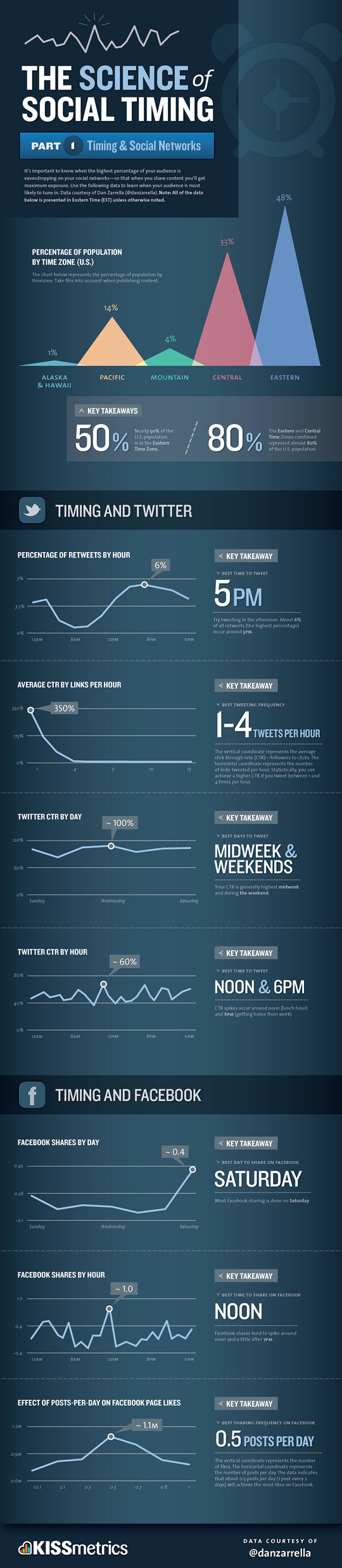
Conducting some good consumer research of your target audience could help reveal those moments of opportunity.  But without that research, the folks at Kissmetrics give us a couple of guideposts, especially with Facebook.

  • Saturday is the best for sharing
  • The best time of the day is the hours leading up to noon, and then again around the dinner hour
  • At least one post every other day generates the most “likes.”

But it’s also vitally important for businesses to remember that there is a reason why this platform is called “social” media.   Those businesses that use social networking sites (SNS) as a traditional one-way communications channel will not get encouraging results.  However, those who use SNS as means to listen and interact with their customers are likely to have more success.   It’s one thing to post content, it’s another to immediately respond to customer comments and feedback.

More Adults Using Social Media. What it Means for Businesses.

30 Mar

Figure 1 - Adults Using Social Networking Sites

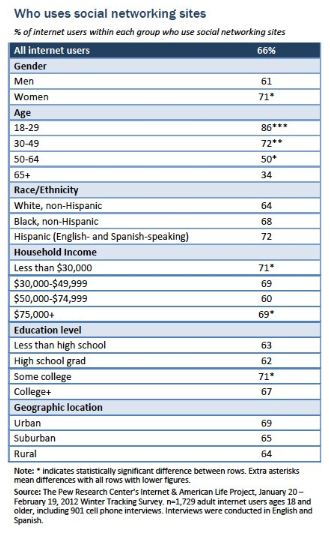
The research folks at Pew Internet have just given us more proof that the phenomena known as social media is not just a passing fad.  As Facebook has reached 483 million daily users, Pew latest data shows us that 66% of online adults now use social networking sites.   Not surprisingly women are leading the way. (Figure 1)

The latest Pew research mirrors trends I gathered in my own research of social media users in the Twin Cities.   Women tend to be power users.   Not only are they more heavily engaged in social media,  women were more likely to “friend” or “like” a business than men would.   Facebook is the channel of choice with 90% of Twin Cities respondents indicating use the site.  Pew’s new national data set from February of 2012 shows us that women are still in driver’s seat with 71% using social networking sites.

Figure 2

Pew also confirms that social media use is still in a growth phase.   Typical daily usage among adults has rocketed from 27% in April of 2009 to 48% in February of 2012. (Figure 2)

So what does this mean if you’re a business owner looking to reach out to your customers?

  • Conduct some customer research.  Are your customers using social media, and what channels?  What do they want from you—product news?  Help?
  • If women are your primary customers, you must be on Facebook.
  • Encourage customers to follow you on SNS to get exclusive content or discounts.
  • Respond to customer comments on a DAILY if not IMMEDIATE basis.

The last tip is vital.  Internet users who are accessing social media for customer service want immediate feedback.  I recently spoke with Brittney Madsen the online manager at The Wedding Shoppe in St. Paul who said that her customers are increasing turning to the store’s Facebook page to ask questions about designers, price, and inventory.   Madsen said that if she doesn’t respond within minutes, the customers will go to a competitor looking for answers.  In this store’s experience, social media has become just as important of a business tool as a phone.

The Wedding Shoppe’s experience along with Pew’s latest research shows adults are embracing social media.  While it is still a place for personal connections, by making your engagements personal to your customer, you can be a part of their lives.

How Businesses and Consumers are using Social Media for Customer Support

25 Mar

As the internet becomes more ingrained as a 21st century communications channel, it should come as no surprise that consumers are using it to reach out to businesses to either connect or solve problems.

Current research from Pew shows how 59% of all adults use the internet.   Of those people, 43% use social networking sites.   But how are they using social media to connect with brands and business, and just as important, how are those brands responding?

Here is an extremely useful infograph from the folks at Zendesk that shows how those relationships are forming.

Pink Slime — Anatomy of a Contagion

23 Mar

The gooey mess known as Pink Slime has suddenly become a public relations mess too.  But, how did it go from a food additive to a food disaster in record time?  A large part of the answer lies in the power of social memes and the ability of key audiences to spread it like a contagion.

Figure 1 - Pink Slime

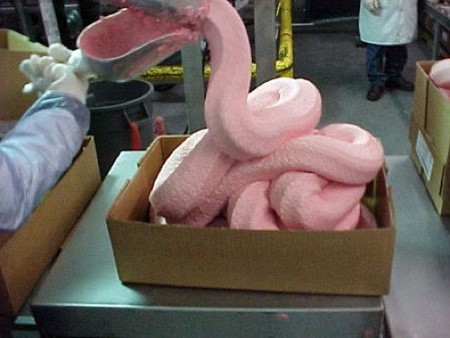
Let’s break it down.  In this case, the food additive included in some forms of processed beef came with a descriptive slang name and an iconic image: pink slime. (Figure 1)

In its basic form, pink slime a substance made from the rendered connective tissues and intestines of cows.  Because those tissues are susceptible to e-coli contamination, they are processed with ammonium nitrate to kill the bacteria and act as a preservative.   For years the FDA has approved the additive as a safe filler for meat products.  But when an image and video of the substance appeared in the news reports in early March about its presence in school lunch hamburgers, pink slime became a household word as fast as parents could hit the “send” button on their computers.   As a Google Trends analysis shows, pink slime went viral in a matter of 24-hours and has not let up since. (Figure 2)

Figure 2 - Google Trends

Three key factors are involved here.  First, the image itself of the pink slime became what social psychologist Jaap Van Genneken would call a strong replicator.  In other words, it’s an iconic image that developed and sealed an emotion in the minds of the viewer.  In this case, the image leads to the very human response of questioning what this substance is doing in our food—especially our children’s food at school.

Second, the image sealed itself in the minds of an important audience.   That audience is mainly women, in particular, the mothers of school children.

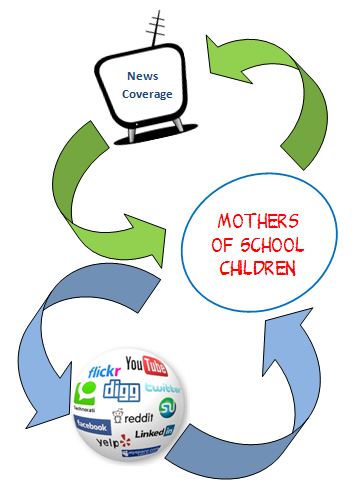
Third, these women not only saw the image of the pink slime included in stories in various news media, they spread the story to their friends and peer groups in social media.  My own audience research among social media users indicates that women are heavily invested in, and are heavy users of social channels.   They not only use social media as a way of discovering news from their friends, but to share news and issues that are important to them.   When this story broke, the image, the issue, and the salience to their children and families created its own perfect recipe for a modern-day social issue contagion. (Figure 3)

Figure 3 - Contagion Model

The result has been a sudden abandonment of meat products containing the so-called pink slime.  Several major grocery store chains have now said they have stopped ordering beef products containing the additive.   One of them is Twin Cities based SuperValue which owns and operates Cub Food stores throughout the Midwest.   Here’s its statement:

“We’ve heard concerns from many of our shoppers about the inclusion of finely textured beef in some of the ground beef products available at our stores. Effective today, we have made the decision to no longer purchase fresh ground beef products that contain finely textured beef.”  -SuperValue

            The power of the contagion lies in the statement’s first sentence.   Consumers spoke up.  SuperValue listened.  It’s a 21st century lesson in the speed of which issues closely tied to strong memes can spread, and the power of key audiences armed with a “send” button.

How Rick Santorum Pulled off the Iowa Caucus Upset

7 Jan

                The fall harvest in Iowa is long over, but GOP presidential candidate Rick Santorum managed to winnow a few extra bushels—of votes.   The caucus night celebrations and day-after headlines that trumpted Mitt Romney as the victor have been nullified by a certification count that  awards Santorum the winner by a mere 34 votes.   The history books will record Mitt Romney as the loser of the Iowa Caucuses and cast Ron Paul as the candidate who finally gained legitimacy.  But, Santorum’s last minute surge will likely be studied by campaigns and political scientists for years to come.

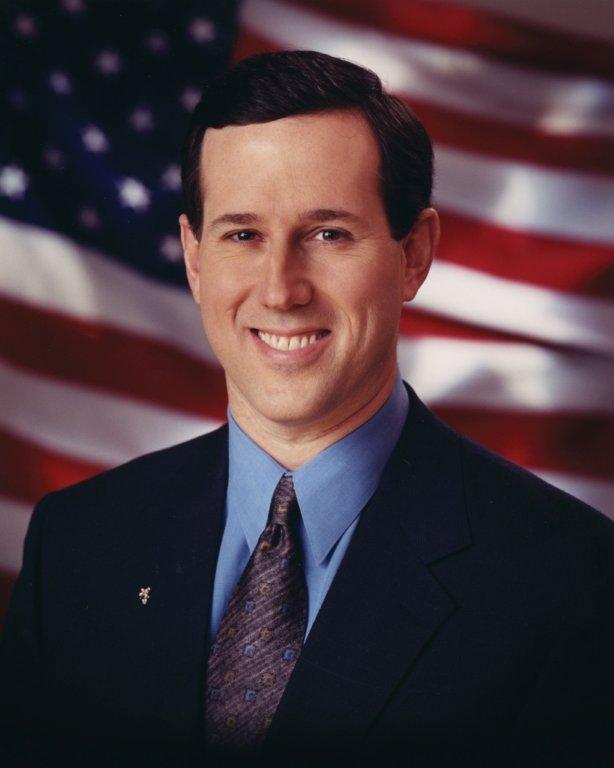
GOP Presidential Candidate Rick Santorum

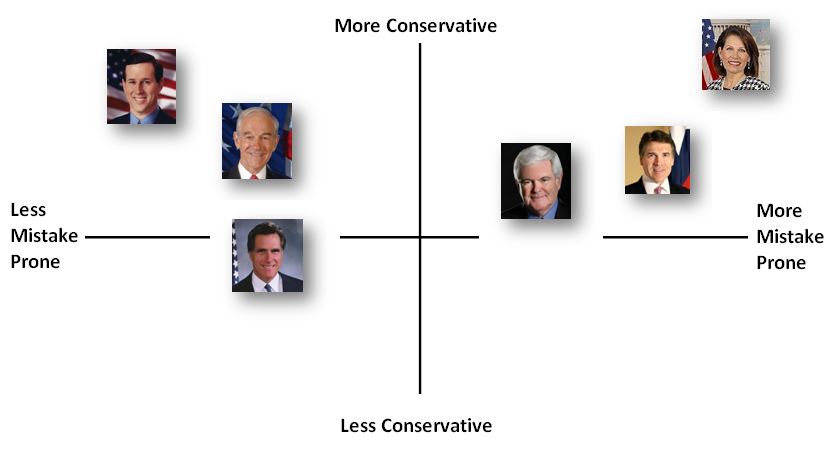
                From a marketing communications point of view, Santorum’s first place finish is a lesson in the importance positioning strategy, tactics and luck.  Santorum and his campaign successfully positioned himself as the social conservative who was consistently on message and disciplined enough to avoid mistakes.   In the words of my grandfather, a lifelong dairy farmer, Santorum avoided stepping in too many “sugar daddies.”  If you look at a perceptual strategy map of the major GOP candidates, Santorum carved out and maintained a unique position. (Figure 1)  He occupied the space on the map necessary for a candidate to succeed among Iowa’s GOP activists: consistently conservative and gaffe free.

Figure 1 - GOP Perceptual Map of Iowa Caucus Candidates

              It’s no accident that Romney, Santorum and Paul all finished in a near dead heat and everyone else as “also ran’s.”   That’s where a little bit of luck played a significant factor.  Michele Bachmann may have staked her claim as the most conservative candidate and an effective debater, but her perceived missteps on vaccines and other issues gravely affected her position on the perceptual map in the minds of voters.  Texas Governor Rick Perry, and former House Speaker Newt Gingrich didn’t fare any better.

             Santorum’s finish is also remarkable given the fact that he had little to no brand awareness in Iowa.   His surge in the weeks leading up to the caucuses came as a result of what marketers call an effective execution of product news and product experience.  In other words, his campaign staff and volunteers were able to effectively reach party activists with a message of how he was different and relevant.   Furthermore, his personal appearances gave potential voters a chance to experience the candidate and size up his message against their own values. 

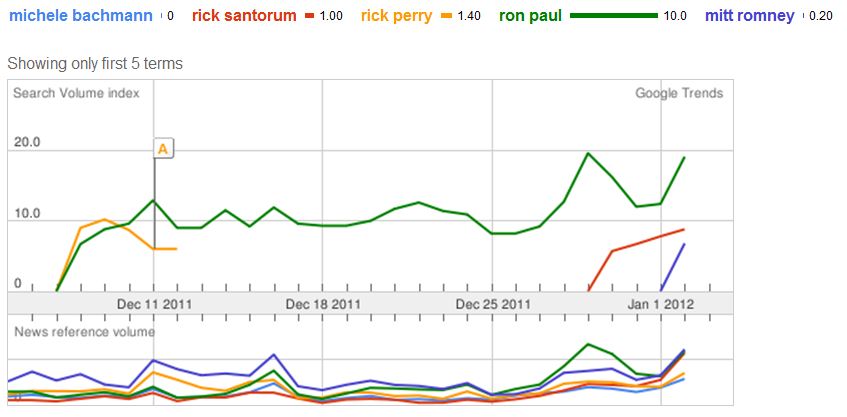
Figure 2 - Google Trends Data Leading up to Iowa Caucases

             In my most recent post, I noted how Ron Paul was far and away leading the pack in buzz.   This too is another essential marketing driver.  The metrics in Iowa as measured by Google Trends showed Santorum gaining more web searches in the days leading up to the caucuses. (Figure 2)  It’s an important metric because it shows that people are yearning to discover more about the candidate.  In the end, Santorum was perhaps able to convert or activate more of that buzz into votes than was Paul. 

             The challenge now for Santorum and his campaign is trying to compete in two new markets.  New Hampshire, South Carolina and Florida are a long ways from the corn fields of Iowa.  Their voters have a different conservative value proposition will have their own perceptual map of where the candidates align.   In New Hampshire, every indication is that Mitt Romney has strong brand awareness and emotional bonds with GOP activists.  Those are powerful drivers for any challenger to overcome.  But Santorum clearly now has a degree of buzz.  What his campaign does with it and how it responds to the new scrutiny that will come could very well determine how long it takes for republicans to settle on a presidential nominee.

Ron Paul’s to Lose? How Google May Predict The Iowa Caucuses

31 Dec

            As we approach the Iowa Caucuses the GOP presidential candidates are making their closing arguments, but in many respects the party faithful are already voting—with their computers. The results present a fascinating web search tracking poll that could very well become a significant predictor of Tuesday’s winners and losers.

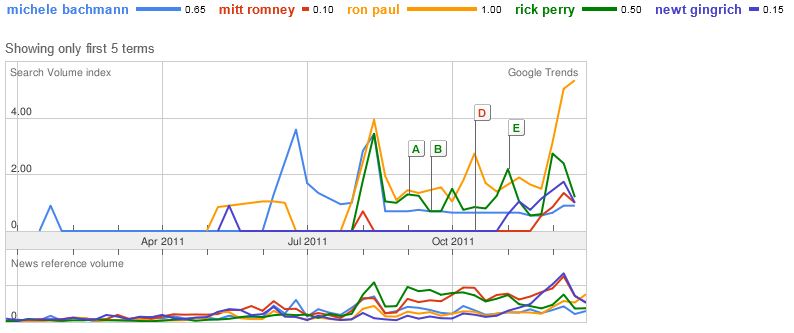
            Back in August, the folks at Google digested the internet search trends of Iowans leading up to the GOP Straw Poll. Native daughter Michele Bachmann dominated the search results and became the somewhat surprise winner of the straw poll. (Figure 1)

Google GOP Candidate Search in Iowa

Figure 1 - August Google GOP Candidate Searches in Iowa

            But the latest Google data from Iowa paints a different story. Texas Congressman Ron Paul far and away leads the trend results with Bachmann significantly trailing. (Figure 2)

Figure 2 - Current Google GOP Candidate Searches in Iowa

            Paul is the only candidate who is trending up, everyone else is in a steep decline. In fact during the last 30 days in Iowa, Bachmann barely registers on Google Trends. Similar search data in August showed former Minnesota Governor Tim Pawlenty barely trending and in the end he failed miserably in the straw poll and promptly withdrew from the presidential race.

            In my August 15th post, I noted how Bachmann was like a product brand and successfully used two key marketing drivers to her advantage, buzz and activation. She was able to garner much needed attention by positioning herself as the outspoken native Iowan who saluted to the Tea Party flag. Most critically, she was able to activate that buzz into votes at the straw poll. Bachmann was the Tobasco Sauce in a field of corn heading for the canning factory.

           Five months later the trend results indicate Iowans feel burned and are searching for someone with less spice. Enter Ron Paul. He’s positioned himself as the Heinz 57 of the field—bold and authentic. He also has a consistent narrative.

GOP Presidential Candidate Ron Paul

            Hamline University analyst David Schultz has repeatedly made a compelling case that narratives win elections. Paul’s Libertarian narrative of less government and more individual freedom may represent views that are outside of the mainstream, but nevertheless have been authentically consistent. Meanwhile, Bachmann’s narrative and brand have both been eroded by unfocused campaign appearances and staff defections. Iowans through their search results seem to indicate they no longer have an appetite for hot sauce, but they certainly aren’t big on ketchup either. (Gingrich, Romney, Perry, and Santorum)

            Clearly, Paul has the buzz. What remains to be proven is if his brand is strong enough to activate that buzz into votes at Tuesday’s caucuses.