I’ve shared with people over the years my passion for finding a cure for Type-1 diabetes.
I have two very good reasons.
My oldest daughter Madison was diagnosed at the age of three, our other daughter Emerson was diagnosed at twelve. Two children. Two lives filled with constant blood sugar monitoring and insulin injections.
OutFOX Diabetes Walk Team - Mall of America February 25h, 2012
For more than a decade my family and I have been active within JDRF to help raise money to find a cure for Type-1 diabetes. This year my family is joining the Fox 9 family to form a walk team called OutFOX Diabetes. The Walk takes place February 25th at the Mall of America in Bloomington, Minnesota. We don’t necessarily need walkers, but we need supporters. If you’d like to be a virtual walker with us, click on the hyper link and make a donation to our team.
We are making incredible progress toward finding a cure. Last year JDRF spent $116 million on research and much of it is producing encouraging results.
We are grateful to all who have helped in the past and continue to support the search for a cure.
It’s far from a scientific sample of the electorate, but Google has so far been a fairly reliable predictor of election results so far in the 2012 presidential cycle.
Google tracks what people search for online. In a way, it’s a measure of groundswell and interest. Marketers call it buzz. When one mines the Google Trends data just for Minnesota in the past 30 days the search results show Ron Paul far and away has the most buzz. (Figure 1)
Figure 1 - Minnesota Google Search Trends
In the past six months I’ve observed how Google Trends served as a barometer for Michele Bachmann’s surprise win in the Iowa Straw Poll and Rick Santorum’s tight finish in the Iowa Caucuses.
The latest scientific poll out by Public Policy Polling shows Rick Santorum with a substantial lead over Mitt Romney, 30-24%. Newt Gingrich is next with 22% and 20% for Ron Paul. In other words, PPP shows nearly the opposite results as Google.
To be sure, Ron Paul has attracted a loyal following of younger supporters who have swamped every Minnesota campaign appearance in the past several days. Paul has also trended very well in Google in previous presidential contests. In fact, Google Trends showed him with the most buzz prior to the Iowa Caucuses. However, he has not been able to convert that buzz into votes. We’ll see if he’s able to accomplish that Tuesday night in Minnesota.
Super Bowl XLVI has recorded its winners and losers among teams and certainly among brands.
This year’s annual Super Bowl of advertising has produced another list of memorable commercials, and certainly a list of forgettable and regrettable ones too.
VW - Dog Strikes Back
Tracking agencies have already ranked the ads based upon their popularity among viewers and it should come as no surprise that Doritos once again finished strong with its mainstay use of humor.
Part of the purpose of Super Bowl ads is to entertain. But, it’s important to remember that if those ads don’t creatively communicate a strategic message about the brand or product, then it’s a colossal waste of $3.5 million.
With that in mind, I picked the minds of two advertising heavy weights. John Eighmey is the Campbell Mithun Chair of Advertising at the University of Minnesota. Eighmey spent a good portion of his career at Young & Rubicam in New York and steered the production of many of the great advertising campaigns of the 1970’s and 80’s including the Hallmark card ads that made everyone cry. From Eighmey’s point of view one commercial this year stood out from the rest: Fiat’s 500 Abarth.
“It’s the one commercial any creative person would want on his reel.” Eighmey said.
Many car companies during the past 50 years have tried to sell the idea of having a love affair with a car. Eighmey says this is the first one to make the metaphor real. The hot model bending over at the street curb was the personification of love at first sight. But when woman stood up and started shouting in Italian and charging toward her admirer it became clear that this was the embodiment of every man’s dream—a siren that loved him back. The sexy tattoo of the Abarth logo on the back of her neck was the only foreshadowing of the surprise to come.
It wasn’t just a cleaver ad, it targeted a specific audience with a specific message and a specific desired response:
Idea: Love affair with a car
Target Market Audience: American men who love sports cars
Desired Response: Test dive this car!
Competitive Frame: All other compact cars
Message Argument: Fall in love with the sexy Italian car that will love you back
Rationale: Introduces legendary European car to an American audience
Campbell Mithun CEO Steve Wehrenberg noted a number of good Super Bowl ads including the VW Beetle dog training commercial, but the one that stood out for him was the Chevy Silverado Apocalypse.
This ad too, was no accident. It used the predictions of the 2012 apocalypse and a bit of end-of-the-world lore about the survivability of Twinkies to differentiate the Silverado from all other pick-up trucks.
The strategy of the Silverado ad jumps off the screen:
Idea: Surviving the apocalypse
Target Market Audience: Men who buy pick-ups
Desired Response: Buy a Silverado
Competitive Frame: Ford F-150 and all over pick-ups
Message Argument: A Chevy can survive the end of the world
Rationale: Uses humor to tell a story about the reliability of the Silverado
The ad presents what advertising Godfather Rosser Reeves would call a unique selling proposition—Chevy trucks last. In an economy where consumers are hanging onto their cars for 10-plus years, the Silverado has value.
I have to admit, my personal favorite made me stand up and cheer. It was Chrysler’s “Halftime in America.” The conceptual positioning of Clint Eastwood as America’s coach giving a halftime economic pep-talk was simply brilliant casting. Who wouldn’t want to stand tall with Dirty Harry?
Here again, the means of communication is intentional and very specific.
Idea: Patriotism
Target Market Audience: Anyone who has struggled in the economy
Desired Response: Feel confident about yourself—feel confident about Chrysler
Competitive Frame: Apathy & Pessimism
Message Argument: We’ve only just begun—Can’t wait for the second half (Oh, and thanks for the bailout!)
Rationale: Emotional trigger to build loyalty and awareness to Chrysler cars.
“Halftime in America” builds upon several salient ideas to help us make a positive association with the Chrysler brand. First, it blatantly bends the old Ronald Reagan metaphor of “morning in America” which was Reagan’s positive, optimistic view of the country. Second, the ad was perfectly positioned to run at half time of a hard fought game building upon the sports come-back metaphor. And third, it awakens the reality that this economy is really not a game; real people have lost—we are turning a corner and refuse to lose again.
Three ads, three takes. Can’t wait for Super Bowl XLVII.
The pink ribbon that ties together a breast cancer community managed to tie a pink noose instead.
Susan G. Komen somehow hung itself. Somewhere, someone inside the organization cut the rope just in time. But, it’s gasping for air.
The tragedy in its decision to cut off funds to Planned Parenthood not only damaged the image of an exceptionally worthy organization and powerful super brand, it potentially threatened the lives of the some of very women it has promised to serve. The question is, how did this happen?
The legal and moral arguments over the Komen’s initial decision to pull its grants from Planned Parenthood have been well documented. Komen was getting increasing pressure from the right to life movement to no longer fund breast cancer screenings at an organization that also provides abortions. How Komen responded to the pressure will be analyzed in case studies that compare it against such classic PR disasters as New Coke, and more the more recent debacles of ACRON, Go Daddy, and SOPA . Each has its unique set of circumstances, yet each has its similarities. They all lost track of their audience, their value proposition, and their soul. But what compounded Komen’s disaster was the speed and means by which its stakeholders struck back. Social media channels provided the platform and the echo chamber for the outrage to spread like a contagion.
The outrage begins with what a significant number of Komen’s loyalists and evangelists viewed as a violation of trust. Komen’s core mission is saving the lives of women. It’s website boldly states, “Susan G. Komen for the Cure is fighting every minute of every day to finish what we started and achieve our vision of a world without breast cancer.” It’s not just a credo, it’s a commandment.
Komen’s founder and CEO, Nancy Brinker proclaims, “We’re proud of the fact that we don’t simply dump funds and run. We create activists—one person, one community, one state, one nation at a time—to try and solve the number one health concern of women.”
But Komen’s announcement that it would suspend eligibility for further grants to Planned Parenthood for breast cancer examinations seemingly violated its core proposition and values. Brinker attempted to argue in a YouTube video that the decision was not politically motivated. But in a world where perception is reality, no one bought it. Tragically, Komen, never saw it coming.
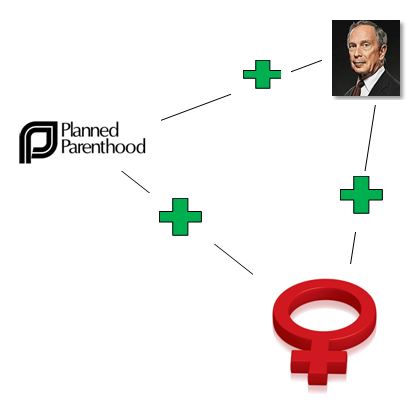
From a pure communications analysis, Komen’s actions were incongruent with both with its mission and its constituents. What it failed to take into account is that Planned Parenthood is also a regarded women’s health organization with considerable overlap among Komen’s own activists and volunteers. I’ve created a simple heuristic model that shows the positive and negative congruencies between Komen, Planned Parenthood and women. (Figure 1)
Figure 1 - Komen's Communications Incongruency Model
Planned Parenthood has a loyal constituency of its own. Among its supporters is New York Mayor Michael Bloomberg. When Bloomberg took to Twitter and announced a $250,000 donation to Planned Parenthood, it leveraged more money and buzz. (Figure 2)
Figure 2 - New York Mayor Michael Bloomberg's Tweet
What Bloomberg effectively achieved was a new congruency. (Figure 3) Women and donors who support both Planned Parenthood and Komen didn’t take to the streets, they followed Bloomberg and took to their smart phones and computers.
Figure 3 - Mayor Bloomberg's Communcation Congruency Model
The outrage in social media channels such as Facebook and Twitter spread faster than the opening steps of a Komen 3-Day event. A little more than 24-hours after Brinker took to Youtube defending Komen’s actions, the organization issued an abrupt apology and restored funding to Planned Parenthood. The carefully crafted message reads as follows: “We want to apologize for recent decisions that cast doubt upon our commitment to our mission of saving women’s lives.” In other words, they rediscovered their soul and their credo.
Which brings us back to Komen’s initial decision. How would the course of events been different had the executive leadership made its decision based upon the organization’s core values and mission? These are the same questions Komens PR agency, Ogilvy, will have to ask as well. In the coming days Ogilvy will have to craft a set of strategic messages to satisfy not just Komen’s supporters of Planned Parenthood, but those supporters who strongly oppose that fact that Planned Parenthood also provides abortion counseling. The tragedy is that unless Ogilvy is working pro-bono, Komen will spend a huge sum of money on damage control that otherwise would have gone to breast cancer research.
Komen will likely recover and catch its breath. But it’s near death experience is a valuable lesson for organizations to constantly pay attention to their core values. If not, in this new world order of social democracy, their followers will hold them accountable.
Old school Washington just got a lesson new school democracy.
The outcry over the proposed Stop Online Piracy Act and the January 18th internet blackouts lead by Wikipedia was the information age equivalent of the shoot-out at the OK Corral. This time Wyatt Earp was armed with a computer and millions of social media followers all firing cyber bullets at will. The McLaury Brothers in congress never stood a chance. SOPA and its companion Senate bill PIPA have been sent to a Boot Hill grave site. Don’t expect daisies to pop up anytime soon.
Social democracy won. But perhaps just as important is what lost—intellectual property.
The arguments on both sides were focused and compelling. Among the most articulate voices against SOPA is a brilliant Twin Cities internet and social media entrepreneur, Tyler Olson of SMCpros.
“SOPA fundamentally changes the internet,” Olson argues.
What frightens Olson and thousands of savvy internet consultants and entrepreneurs like him is that SOPA would have allowed the U.S. Justice Department to shut down internet sites that unbeknown to them contained or linked to copyrighted and protected material, be it movies, music, books, software, or other creative content.
“When the government, companies, individuals can request that anything be taken down it becomes an issue of freedom of speech, it becomes an issue of the Great Firewall of China which will now be potentially in the U.S.,” said Olson. “And those are the things that go against the democracy of America.”
Olson’s views have sympathetic support from at least one prominent media law expert. University of Minnesota Law Professor Jane Kirtley says SOPA goes after a critically important issue in an unfocused way.
“It’s using a sledge-hammer where a stiletto would be more appropriate,” said Kirtley.
But lost in the outcry over censorship and First Amendment rights, were the rights of people to also protect the things they create. Steve Cole is a jazz musician and recording artist who’s most recent album Moonlight has topped the Billboard jazz charts. Cole is also chair of the music business department at the McNally Smith College of Music in St. Paul, Minnesota.
“Of the music that is distributed through various channels only five percent we’re able to monetize. So, if that doesn’t give you an idea of what a herculean problem internet piracy is I don’t know what would,” said Cole.
I’ve included extended video Fox 9 interviews of both Kirtley and Cole making their arguments.
The main target of the SOPA legislation was overseas websites that steal and distribute copyrighted material that have been untouchable to U.S. regulators.
“We’re trying to fix a system that is broken. We’re trying to protect ourselves against violators of our intellectual property and their distribution too, and we don’t have a mechanism for enforcing that for overseas violators and this legislation does give us that ability,” said Cole.
The SOPA legislation was largely backed by institutional content providers including the man who ultimately helps me may my mortgage. (Disclosure statement: no one in my organization has been told to support a particular point of view on SOPA) NewsCorp Chairman Rupert Murdoch has been an outspoken supporter of SOPA for the same reasons as Cole. As the owner of 20th Century Fox, Fox News Channel and the Wall Street Journal, Murdoch believes SOPA is needed to combat a growing culture where people believe everything on the internet is free—or should be.
But there’s also another take on the debate and it come from James Allworth and Maxwell Wessel in the Harvard Business Review. Their analysis is that the media giants are pushing SOPA to protect business models that are no longer nimble and innovative.
“SOPA is a legislative attempt by big companies with vested interests to protect their downside,” Allworth and Maxwell write.
Had SOPA passed congress, they argue it would likely cripple emerging digital businesses. “Start-ups will be less competitive in the United States and we’ll have effectively disabled one of the few remaining growth engines of the economy,” said Allworth and Maxwell.
Every voice raises a significant issue. In the end, creative content should and must be protected. Our younger generation of internet users has to understand that not everything is free for their taking, copying, and sharing unless the creators of that content say they can.
Which brings us back to the OK Corral. Wyatt Earp won the day, but there will someday likely be another shootout. Let’s hope congress, as Professor Kirtley suggests, comes to the corral with a scalpel instead of a sledge-hammer.
Volkswagen has done it again. The same folks that gave us the Beetle and Farfegnugen have collided Das Auto with Star Wars and once again have succeeded in creating a memorable brand experience.
The venerable VW has just released a pre-quel to its 2012 Super Bowl ad and it successfully uses a pack of dogs to bend the Star Wars meme from its wildly popular and successful 2011 Super Bowl ad.
The deliciously wonderful ad by VW’s agency Deutsch is no accident. It’s a smart and highly purposeful means of communication. It targets a specific audience and asks them to take a specific action. Here’s the strategy:
Target Market Audience: Speaks to everyone who LOVED the 2011 Darth Vader ad.
Desired Response:SHARE IT and watch the new Super Bowl ad.
Competitive Frame: All other Super Bowl ads.
Message Argument: It’s entertaining.
Rationale: It builds anticipation for the new product ad and reinforces the intangible value of the VW brand.
It’s clear the creative forces at VW/Deutsch wanted to borrow from the momentum of the most shared advertisement of 2011. The Passat ad cleverly used two strong replicators in a child and Darth Vader. They created an emotional force that caused viewers to watch, enjoy, and pass on.
This time, VW has kept the Star Wars theme but replaced a child with an arguably stronger replicator: dogs. Will it take off? Three million YouTube views in the first 24-hours suggest it’s already in another galaxy. And all of it with no media buy. If the most valuable commodity on earth is attention, VW is getting it.
The fall harvest in Iowa is long over, but GOP presidential candidate Rick Santorum managed to winnow a few extra bushels—of votes. The caucus night celebrations and day-after headlines that trumpted Mitt Romney as the victor have been nullified by a certification count that awards Santorum the winner by a mere 34 votes. The history books will record Mitt Romney as the loser of the Iowa Caucuses and cast Ron Paul as the candidate who finally gained legitimacy. But, Santorum’s last minute surge will likely be studied by campaigns and political scientists for years to come.
GOP Presidential Candidate Rick Santorum
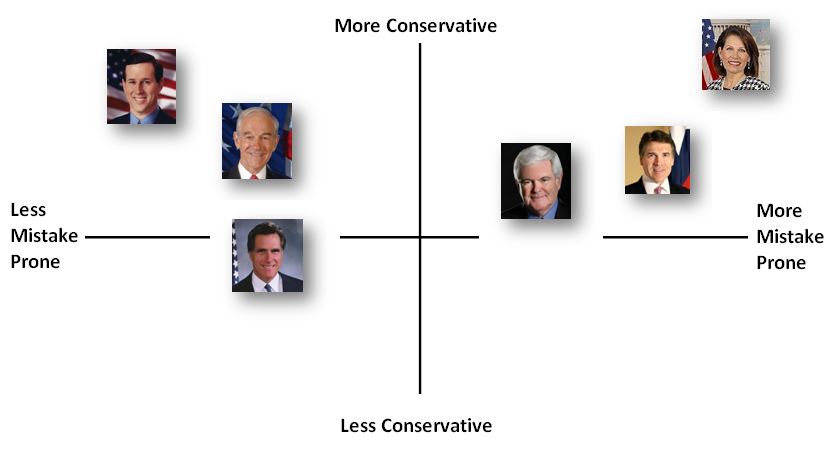
From a marketing communications point of view, Santorum’s first place finish is a lesson in the importance positioning strategy, tactics and luck. Santorum and his campaign successfully positioned himself as the social conservative who was consistently on message and disciplined enough to avoid mistakes. In the words of my grandfather, a lifelong dairy farmer, Santorum avoided stepping in too many “sugar daddies.” If you look at a perceptual strategy map of the major GOP candidates, Santorum carved out and maintained a unique position. (Figure 1) He occupied the space on the map necessary for a candidate to succeed among Iowa’s GOP activists: consistently conservative and gaffe free.
Figure 1 - GOP Perceptual Map of Iowa Caucus Candidates
It’s no accident that Romney, Santorum and Paul all finished in a near dead heat and everyone else as “also ran’s.” That’s where a little bit of luck played a significant factor. Michele Bachmann may have staked her claim as the most conservative candidate and an effective debater, but her perceived missteps on vaccines and other issues gravely affected her position on the perceptual map in the minds of voters. Texas Governor Rick Perry, and former House Speaker Newt Gingrich didn’t fare any better.
Santorum’s finish is also remarkable given the fact that he had little to no brand awareness in Iowa. His surge in the weeks leading up to the caucuses came as a result of what marketers call an effective execution of product news and product experience. In other words, his campaign staff and volunteers were able to effectively reach party activists with a message of how he was different and relevant. Furthermore, his personal appearances gave potential voters a chance to experience the candidate and size up his message against their own values.
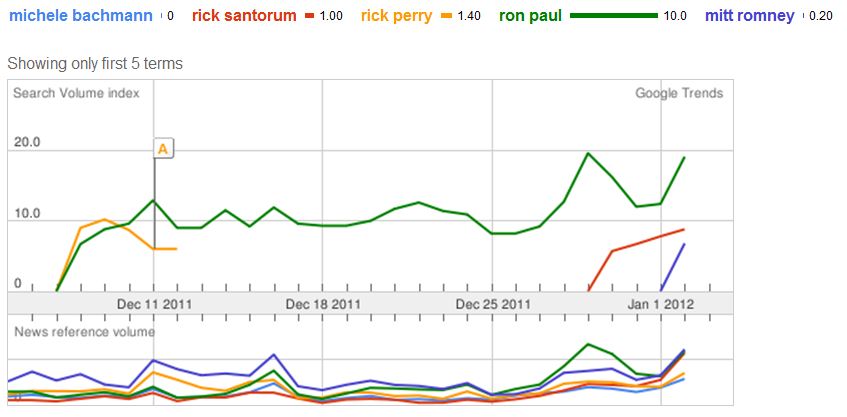
Figure 2 - Google Trends Data Leading up to Iowa Caucases
In my most recent post, I noted how Ron Paul was far and away leading the pack in buzz. This too is another essential marketing driver. The metrics in Iowa as measured by Google Trends showed Santorum gaining more web searches in the days leading up to the caucuses. (Figure 2) It’s an important metric because it shows that people are yearning to discover more about the candidate. In the end, Santorum was perhaps able to convert or activate more of that buzz into votes than was Paul.
The challenge now for Santorum and his campaign is trying to compete in two new markets. New Hampshire, South Carolina and Florida are a long ways from the corn fields of Iowa. Their voters have a different conservative value proposition will have their own perceptual map of where the candidates align. In New Hampshire, every indication is that Mitt Romney has strong brand awareness and emotional bonds with GOP activists. Those are powerful drivers for any challenger to overcome. But Santorum clearly now has a degree of buzz. What his campaign does with it and how it responds to the new scrutiny that will come could very well determine how long it takes for republicans to settle on a presidential nominee.
As we approach the Iowa Caucuses the GOP presidential candidates are making their closing arguments, but in many respects the party faithful are already voting—with their computers. The results present a fascinating web search tracking poll that could very well become a significant predictor of Tuesday’s winners and losers.
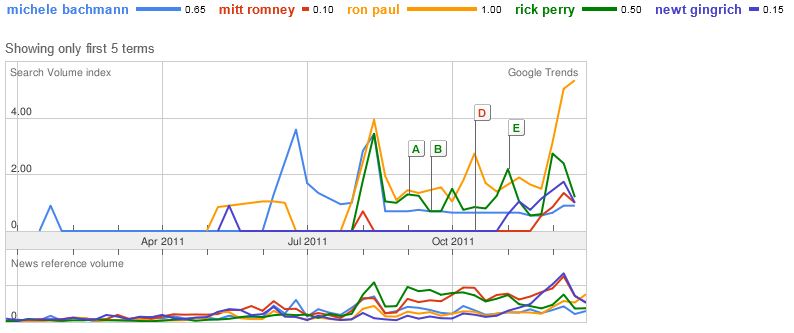
Back in August, the folks at Google digested the internet search trends of Iowans leading up to the GOP Straw Poll. Native daughter Michele Bachmann dominated the search results and became the somewhat surprise winner of the straw poll. (Figure 1)
Figure 1 - August Google GOP Candidate Searches in Iowa
But the latest Google data from Iowa paints a different story. Texas Congressman Ron Paul far and away leads the trend results with Bachmann significantly trailing. (Figure 2)
Figure 2 - Current Google GOP Candidate Searches in Iowa
Paul is the only candidate who is trending up, everyone else is in a steep decline. In fact during the last 30 days in Iowa, Bachmann barely registers on Google Trends. Similar search data in August showed former Minnesota Governor Tim Pawlenty barely trending and in the end he failed miserably in the straw poll and promptly withdrew from the presidential race.
In my August 15th post, I noted how Bachmann was like a product brand and successfully used two key marketing drivers to her advantage, buzz and activation. She was able to garner much needed attention by positioning herself as the outspoken native Iowan who saluted to the Tea Party flag. Most critically, she was able to activate that buzz into votes at the straw poll. Bachmann was the Tobasco Sauce in a field of corn heading for the canning factory.
Five months later the trend results indicate Iowans feel burned and are searching for someone with less spice. Enter Ron Paul. He’s positioned himself as the Heinz 57 of the field—bold and authentic. He also has a consistent narrative.
GOP Presidential Candidate Ron Paul
Hamline University analyst David Schultz has repeatedly made a compelling case that narratives win elections. Paul’s Libertarian narrative of less government and more individual freedom may represent views that are outside of the mainstream, but nevertheless have been authentically consistent. Meanwhile, Bachmann’s narrative and brand have both been eroded by unfocused campaign appearances and staff defections. Iowans through their search results seem to indicate they no longer have an appetite for hot sauce, but they certainly aren’t big on ketchup either. (Gingrich, Romney, Perry, and Santorum)
Clearly, Paul has the buzz. What remains to be proven is if his brand is strong enough to activate that buzz into votes at Tuesday’s caucuses.
It’s that time of the year when the “Best of…” lists come out. My favorite so far is Ad Week’stop 10 commercials of 2011. Some of them you’ve seen and some you have not.
My two favorites on the list actually promote European brands and are outstanding examples of the strategic use of a concept that advertising psychology expert John Eighmey calls “Attitude Toward the Ad.” Simply put, if one “likes” the ad, it will affect one’s attitude AND their beliefs and expectations about the brand and the product. The Super Bowl each year is ground zero for brands which rely on this expectancy-value mode approach to advertising.
One of the ads that effectively uses this concept mashes up milk with cats and Leonard Bernstein. The ad for Cravendale milk asks us to think: What would happen if cats actually had opposable thumbs?
The other ad is a wonderful demonstration of taking a well-known metaphor and bending it into another. In this case the schema is that of a mad-cap movie director, but viewers soon discover all is not as it seems.
The implicit message here is that the Canal+ movie channel can bring out the “inner-director” in you.
Both ads are wonderful examples about using the power of creativity to establish positive attitudes toward a brand. Now, where is the glass of milk and the TV remote?
On a day when Best Buy reluctantly followed the retail pack, they may have come out a leader and changed the rules. When Wal-Mart, Target, and other big box competitors announced earlier this fall that they would open on midnight of Black Friday, Best Buy brought up the rear. In the end, it may have been Best Buy that had an extra piece of Thanksgiving pie.
Figure 1 - Back Friday shoppers outside a Best Buy in Eden Prairie, MN. (Courtesy KMSP-TV)
Best Buy not only changed its Black Friday tactics at the last moment, it brilliantly redefined the customer experience that may force its competitors to change how they too look at Black Friday. What Best Buy did was to take a cold, mundane parking lot camp-out and turn it into a festival. At its store in Eden Prairie, Minnesota, store employees set up a giant projection screen in the parking lot and showed Harry Potter-7 to entertain the hundreds of shoppers waiting in line. But there was also another gift: Best Buy stocking caps and matching scarves. And, in a classy move, Best Buy CEO Brian Dunn even arrived to greet customers and personally thank them for their loyalty.
The tactics were not missed by Fox 9 News reporter Jody Ambroz. “These shoppers are becoming big fans of Best Buy because of the way they’re getting treated out here,” Ambroz reported.
The moves by Best Buy were strategic in three ways. First, they let the customers know they were valued. Second, the caps and scarves branded the entire line of campers for the television news cameras. (Figure 1) Third, it let every news viewer at home know they were missing out on the fun, not just the deals. Best Buy created a whole new value proposition. The implicit message to consumers everywhere was this: why camp out somewhere else, when you can party at Best Buy?
Figure 2 - YTD Stock Performance for Best Buy, Wal-Mart, Amazon, Target, and DJIA
In many respects Best Buy had no choice. In a hyper-competitive market, Best Buy is fighting for every dollar—especially in a year when it closed its UK stores and is shifting its retail strategy to sell more mobile technology. Its stock is down 25% for the year and performing well behind Wal-Mart, Amazon, and Target. (Figure 2) Allowing even a small percentage of rabid shoppers to spend what little recession-shrunken dollars they have left at a competitor five hours before Best Buy traditionally opens on Black Friday was simply not an option.
Dunn telegraphed as much in a recent blog post when he said, “It is the most important holiday selling season ever. And it will be the most hard-fought holiday season – maybe in our history.”
There is one remarkable aspect to what Best Buy did for Black Friday. Somewhere, someone deep inside headquarters said the customer experience was as important as profits. Just as remarkable, someone else listened. Both won. Best Buy’s Black Friday competitors are now on notice. Game on.
Communication insights and analysis from a multiple Emmy and Edward R. Murrow Award winning journalist and former communications advisor. Master's degree in strategic communication from the University of Minnesota.





 Stand by...