Natalie Strand and the Power of “I Can”

21 Nov

                Amazing things happen when you put your mind to it.  Natalie Strand has proven it for most of her life.  Diagnosed with Type-1 diabetes when she was just 12 years old, she didn’t let it hold her back.  At an age when most adolescents would view such a diagnosis as a barrier, Strand viewed it as an opportunity.   

             The changes to her body brought on by diabetes led to an intense curiosity about medicine.  That curiosity led to medical school.  Medical school led to Oxford.  Oxford eventually led to the Mayo Clinic in Rochester, Minnesota and then to the faculty of UCLA.  These days most American television viewers don’t know Dr. Strand by her title, they know her by her victory—winner of The Amazing Race.   

             Dr. Strand shared her story and her secrets to success this weekend with the families connected to the MinnDakotas chapter of the Juvenile Diabetes Research Foundation.  Each step along her journey Dr. Strand says she’s succeeded by eliminating the words “I can’t” from her vocabulary.

            “I think it’s a very simple thing.  You just have to decide to do it,” Strand said.  “Whatever it is that you are doing, if you decide at the onset that no matter what comes up, you’re going to do whatever it takes.  You’re never going to say I can’t.”

              For most of us, the keys to success are not that simple.  To be sure, they weren’t for Dr. Strand either.   Social psychologists have come up with a unique model to explain how we approach personal obstacles.  In their Theory of Trying, Richard Bagozzi and Paul Warshaw explained that people evaluate goals based upon their attitudes of success and their attitudes toward failure.  (Journal of Consumer Research, 1990)  Failure combined with fear can be powerful motivators—we are often more afraid of loss than we are motivated by success.  (Kahneman, 1979)  It’s all about framing.  Dr. Strand has succeeded by continuously framing her life in terms of success.  Failure is not an option. 

             How refreshing in an era of unemployment, stagnation, and polarization.   At a time when our economy and our political system prove “it can’t,” along comes an amazing winner who shows that as individuals “we can.”

Nixon and Vietnam, A Veterans Day Legacy

15 Nov

(UPDATE – 9-29-12: our documentary segment on Geoff Steiner has just won the 2012 Emmy Award for best single military story)

*          *          *


The past collided with the present this week and the crash reminds us of the tragedy that was Vietnam.

On the eve of Veterans Day, the Nixon Presidential Library released a recording of the former president dictating his account of talking to Vietnam War protestors at the Lincoln Memorial in the pre-dawn hours of May 9, 1970.  The president had a sleepless night after giving a nationally televised news conference a few hours earlier on the progress of the war.   By Nixon’s own account he went to the Lincoln sitting room in the White House to listen to some Rachmaninoff when he was approached by his personal attendant Manuel Sanchez.  Sanchez was a recently naturalized Cuban refugee and new to Washington and the White House.  Feeling melancholy, Nixon asked him if he had ever seen the Lincoln Memorial at night.  Sanchez admitted he hadn’t, so Nixon gathered a small group of secret service agents and off they went—into history.

What Nixon didn’t anticipate was running into a group of wide-eyed college students who had driven all night from upstate New York to protest against the war.  Just five days earlier National Guard troops opened fire on a similar group of protestors at Kent State University and killed four students.   In his Dictabelt recording Nixon admits he awkwardly tried to make small talk, but it quickly turned to the war:

“As I tried to explain in my press conference that my goal in Vietnam was the same as theirs, to stop the killing and the war, to bring peace… I know most of you, that probably most of you think I’m an S.O.B., but I want you to know that I understand just how you feel.”  – Richard Nixon, 1970


On the very morning Nixon was trying to justify the war, a 19 year old Marine from Minnesota was performing his duty to carry it out.  Geoff Steiner landed in Vietnam prior to the Tet Offensive in 1968.  Sixteen thousand U.S. soldiers lost their lives that year.   By 1970, he was a battle scarred survivor of a war with seemingly no end.   Coming home was hardly any easier.   Like many Vietnam veterans Steiner suffered from post traumatic stress disorder.   The scars ran too long and the pain too deep.   Finally, one day he put a gun to his head, but instead of finding a bullet, he found God.

Vietnam Veteran Geoff Steiner with producers Rod Rassman and Mark Anderson

Today, Steiner is a Chaplain who quietly passes the time on 40 acres of land near Cushing, Minnesota.   He is a loner who is hardly alone.  Several times a week Steiner walks through the early morning mist with a shovel, a seedling, and a prayer.   He plants trees in honor of the men who never came home and those who did come home but never found their inner peace.

“When I bought this land, there wasn’t a tree in sight,” said Steiner.   “Now, I have thousands of them.”

This is exactly where Nixon and Steiner collide.  Nixon wanted to end the Vietnam War through “peace with honor.”  Steiner simply wants honor with peace.   He lives it every day.

And that’s exactly why we met on Veterans Day among the living memorial now growing on his rolling Minnesota land.  I teamed up with producers Mark Anderson and Rod Rassman to profile Steiner for part of an upcoming film on veterans called “11-11-11.”  The film will portray a day-in-the-life of veterans on the very day that we honor their service.   We think Steiner not only has a great story to tell, but is an American worth knowing.

That’s why it’s so ironic that on Veterans Day this year we heard two voices on Vietnam, one from the present and one from the past.  The oxides on Nixon’s tape recording have faded with time, the scratchy audio a reminder of a reel that only plays in the echo chamber of history.   Geoff Steiner needs no recording; the legacy of Vietnam is on permanent replay in his mind.  He has his trees, but they will never completely hide the horrors of war.

*               *               *


Changing Plays: The Vikings New Stadium Strategy

8 Nov

                The game is called football.  But what the Minnesota legislature is playing is closer to hardball.  With no stadium bill gaining traction for the Minnesota Vikings, no agreement on a public funding mechanism, and with the clock ticking on the Metrodome lease, the Vikings are about as suspended as a slow motion replay of Gary Anderson’s field goal kick in the ’99 NFC Championship game.   This time they need a better outcome. 

                After 11 months of failing to gain a first down in the legislature, the Vikings are calling an audible.  Instead of running straight at their opponents, they’re taking a page out of the Packer’s playbook and leaping into the stands.  For the first time in their quest for a new stadium, they’re making their appeal directly to Viking’s fans.   The new strategy has just been unveiled in a two-minute web video. 

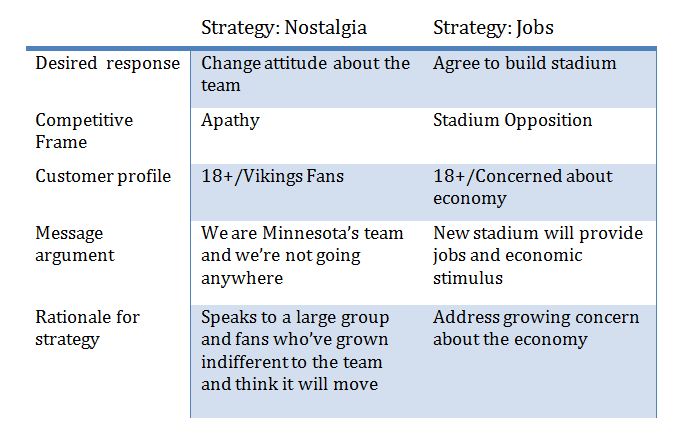
                The video is not only slick and likeable, but a very strategic communication move on the part of the Vikings.  The strategy jumps from the screen in a very logical and smart manner.  Their main strategic objective is to use both nostalgia and jobs as the touch points for talking directly to Minnesotans. 

Figure 1 - Vikings Video Strategy

               The chart at the right diagrams exactly how the video achieves this. (See Figure1) The Vikings competition at the moment is apathy among fans and people who oppose building a new stadium.  What the Vikings clearly need to accomplish is to change attitudes about the team’s commitment to Minnesota in addition to convincing the public that a new stadium will be good for the economy.  The video cleverly uses old highlight reels to make an emotional appeal and then collides it against the rational appeal of job creation.   The result is a communication message that is enjoyable and smart.

                So too is the channel.  A two-minute video is too long and too expensive for a TV advertising flight, but as a web video it targets the very audience the Vikings most need—their own fans. 

Figure 2 - Duncan Watts, Journal of Consumer Research, Dec. 2007

               In today’s world of social media, the genius of such a release invites Vikings fans and loyalists to become stadium evangelists and spread the message themselves.  Rather than a direct one-way message from a traditional ad campaign, marketing researcher Duncan Watts observes that it flows dynamically among many sources and doesn’t have to originate from thought leaders or authority figures. (Figure 2)  In this model the most important influencers are friends. 

                According to Vikings Vice President of Public Affairs Lester Bagley, that’s exactly the rationale behind the new strategy.   “This video signals the launch of a broader communications campaign where we want to take the case for a new stadium more directly to the public,” said Bagley.  “The goal is to deliver accurate information, dispel misinformation and arm and mobilize our supporters.”

                The Vikings are clearly running out of time.  It’s late in the fourth quarter, the team is now hoping their fans can not only catch the ball, but lateral it to others to run into the end zone.

The Power of the Narrative

27 Oct

Every good story has a beginning, middle, and end.  This story begins with a note from a long lost friend needing a small favor.

My old colleague Cortney Napurski always had sharp skills and big ambitions.  She’s more than proven it in the past four years, no longer the young journalist just out of college.  During that time she’s chased dreams while the rest of us chased paychecks.   And all the while she became the kind of young woman who no longer fits on a one page resume: a Londoner, master’s graduate, and a mother.

Now, she’s chasing another dream called a PhD.  It’s also where her note fits in asking for a letter of recommendation for a research grant.  What Cortney hopes to prove is that literature is a better tool at teaching history than by forcing kids to memorize dates, facts and names from a text book.   In other words, she’s attempting to prove what her journalism background has instinctively taught her—the instructional power of the narrative.  The best journalism has always been a collection of verifiable facts woven into narrative form.   Narratives are the glue by which humans cognitively communicate and connect with one another.  There’s a reason why the Anasazi carved petroglyphs, why Homer wrote poems, why Jesus told parables—because they work.

We use narratives to sell and define products, presidential candidates, even ourselves.  They tell the story of our lives, even our careers.  As a reporter, I’ve written hundreds of narratives.  But ask my colleagues about the one that perhaps best defines me as a storyteller, and they’ll most often say it’s a little ditty called Motown.   It’s a memorable gem I had the honor to co-write with NPPA National Photographer of the Year Andy Shilts.


What Motown Adams teaches us is that we all have a story to tell.   Motown’s story is one of redemption.  Watch it once and you’ll remember him forever.

And that’s exactly why my friend Cortney is onto something.  If literary narratives from the early 20th century can elicit the same connection and emotion, then Cortney is hypothesizing they can also become an effective teaching tool that connects students to the people, culture, events, and higher level values of that time.

In the process, Cortney is writing her own narrative.  She has a great beginning.  I can’t wait to see where she goes next…

Steve Jobs and the Power of Self-Actualization

15 Oct

            Search the Apple Apps Store on a brand new iPhone 4S and one will find 424 applications to “create.”  There are no apps for “conformity.” 

            Mark it up to the lasting legacy of Steve Jobs.

             The Apple co-founder who lost his battle with cancer last week developed technology devices that allowed people to easily create things.  He dared us to be different.  Nothing expressed it more than Apple’s ad copy when Jobs returned to Apple in 1997.

“Here’s to the crazy ones. The misfits. The rebels. The troublemakers. The round pegs in the square holes. The ones who see things differently. They’re not fond of rules. And they have no respect for the status quo. You can quote them, disagree with them, glorify, or vilify them. About the only thing you can’t do is ignore them. Because they change things. They push the human race forward. And while some may see them as the crazy ones, we see genius. Because the people who are crazy enough to think they can change the world, are the ones who do.” (Apple Inc.)

             What Jobs tapped into was the psychological notion of self-actualization.  Everyone has the power to change themselves and those around them, what Jobs and Apple did was design the technology to make it happen.  In the process he asked us not only to think differently, but to create differently.  Break out of the box. 

             On the day of Job’s passing, we did just that at Fox 9.  We left our $30,000 video camera in the trunk and instead pulled out our iPhone and iPad. 

            The genius of the culture Apple has created is in the loyalty of its customers.  If Jobs created any legacy it’s in the notion that people want technology that easily helps them be who they are.  The proof is in the web traffic scores since the announcement of the iPhone 4S. 

Web page traffic for Apple, Verizon, and ATT

            Visits to Apple’s site are up nearly 50%, 24% at ATT, and 19% at Verizon Wireless, two of the dominant service providers for the iPhone.   All three expect record sales.

            Admittedly, it creates an interesting paradox that the company which has pushed people to become individuals has them lining up like Lemmings.  But what this is really all about is a dominant brand idea.  In a world that too often settles for “me too,” Steve Jobs taught us to say, “I am…”


Branding Famine Relief: How The American Refugee Committee is Feeding Starvation Through a Community of Stars

12 Oct

           It’s hard enough to get the world to care about famine.  It’s even harder when that famine is part of a 20-year cycle of endless white noise
called Somalia.

Therein lies the challenge of the American Refugee Committee.   Just how do you encourage people to contribute money to solve a seemingly endless crisis?  Its answer is in a new branding campaign that turns famine relief fundraising on its head.   Instead of asking people look outward at the results of famine, they’re now pushing them to look inward and become a “Star for Somalia.”


The new campaign is the brainchild of ARC and the creative team at IDEO in Palo Alto, California.  IDEO is fundamentally a design firm, known for creating breakthrough products such as the Apple mouse.  At its core, IDEO helps people channel creativity to solve problems.   Somalia is a big problem, but its team worked with ARC to un-harness the creative energy of everyday people to not just feed starving people, but to create a conversation about it.

Instead of forming a traditional campaign pumping out one-way messages about Somalia, ARC’s Daniel Wordsworth says the “I Am A Star” effort creates a multi-channel dialogue.

“Here is a chance for folks in Minnesota, in the US and all over the world to say this shouldn’t be like this and that we can make a difference. And what we’re trying to do is launch a campaign that says you can make a difference and we want you to do it your way,” said Wordsworth.

It’s already working.  Inspired to do something, Mohamed Samatar and Bonnie Bentson formed their own 5K Run called “Run to Unite.”  They are among the first “Stars” in the new ARC sky.

“Everybody can do something in some way,” said Benston. “And whether it’s as big as creating a 5K or as small as walking in it or running in it, or telling your friends that I’ve heard about this, we can all help in some way.”

That’s what happens when you ask people to look inward.  That’s personal empowerment and the beginning of a potentially powerful brand.

Look for my story on ARC and how it’s trying to change the conversation on Somalia on Fox 9 News Saturday night right after baseball.

The Price and Weight of Freedom

5 Oct

            If it’s true that freedom bears a heavy price, then it comes in a heavy box, too.

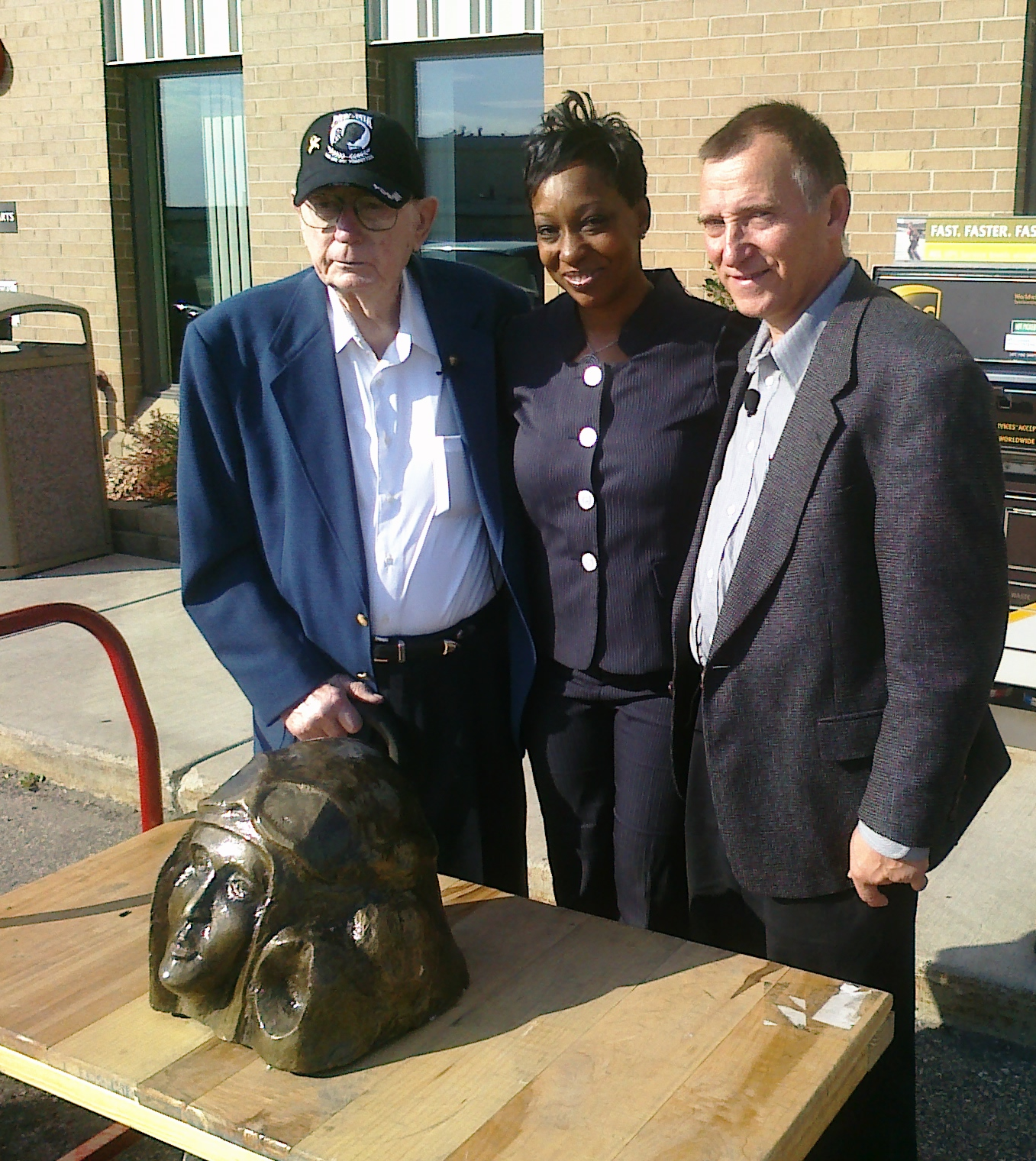
            In this  case freedom’s box weighs 135 pounds and is delivered by UPS.  Sixty years ago, it was delivered by the U.S. 8th Air Force.   A B-24 crew member by the name of Wally Grotz was among the brave airmen who delivered freedom to the people of Poland in the form of heavy bombs raining down on the Nazi’s.   For his bravery, he paid an equally heavy price: shot down, captured, and imprisoned.

U.S Airman Statue by Polish Artist Zygmunt Wujek

               “Freedom is a wonderful thing and you don’t know what it really is until you don’t have it anymore,” said Grotz.

            The German Luftwaffe sent Grotz to the infamous Stalag Luft IV near Koszalin, Poland.    By the end of the war it would house 7,000 American POW’s.   He spent two months there before the Germans forced him and hundreds of other prisoners on a 500 mile march to Berlin.  Grotz was among the few to survive the march.  The Russians and British finally liberated him as they closed in and the Third Reich collapsed.

            Grotz never forgot the experience.  Neither did Poland.  When the Pomerania region of Poland dedicated the old Stalag Luft IV site as a memorial in 2006, Grotz was the only living American POW to return.  They raised a statue to the airmen of the U.S. 8th Air Force but the sculptor, Zygmunt Wujek, wanted to give Grotz something more.  This week if finally arrived—the box of freedom.

            It took two hammers and a crowbar for Wally and his son Jim to pry open the box’s green wooden slats.  They pulled at the packing Styrofoam like curious kids on Christmas morning to finally reveal the surprise.  There, gleaming in the October Minnesota sun was a bronze bust of an American airman.  An exact replica of the statue dedicated at Stalag Luft IV in Poland.  To the Pole’s it might as well be their version of the Statue of Liberty.

            When the artist told Grotz of his gift, he was stunned.  “I asked them, how so much appreciation after 60 years?  He said, ‘it took us a hundred and 25 years to get our freedom and we appreciate it.’”

            As a former POW, Grotz is one of the few of us in America who uniquely understands.  “There’s just a few of us left who actually remember what these poor Polish people went through,” said Grotz.  “Five years under the Nazi’s and then from 1945 until the end of the cold war under the communist rule.”

Former POW Wally Grotz, UPS Sales Representative Lisa Anderson, and Wally's son, Jim Grotz
Former POW Wally Grotz, UPS Sales Rep Lisa Anderson, and Wally’s son, Jim Grotz

                 Grotz has accepted the sculpture on behalf of all his fellow 8th Air Force veterans.  He intends to display it in the lobby of the Veterans Hospital Minneapolis.  Then, on Veterans’ Day he and his family will drive it to the 8th Air Force Museum in Pooler, Georgia where curators will display the sculpture among its permanent collection.

            Grotz’s family, especially his son Jim could not be more humbled.  “I think it’s a very fitting tribute to all veterans of this country that people of a small region of the world would come back after the fact and say, ‘Thank you veterans for having made us a free nation,’” said Jim.

            Yes, freedom has a price.  In this case it comes with deep gratitude, and a box that can no longer carry it.

PR Failure: When Good Brands Like Applebee’s Refuse To Join The Conversation About Bad News

1 Oct

            Mistakes come in all packages.  This one comes on a 5 x 11” piece of paper.

            The slick color direct mailer went out to 10,000 customers with a nice $5 coupon.  The mailer trumpets a newly remodeled Applebee’s in Maple Grove, MN.  Any marketing executive would tell you it’s a great and efficient “activation” driver to bring lapsed users into the restaurant.  Tragically, the headline on the back of the mailer launches another driver: Buzz.  And this buzz is not good.

            Here’s the headline:  “REDISCOVER YOUR WHITE MAPLE GROVE APPLEBEE’S!”

Applebee's Mailer

            It speaks for itself.  Applebee’s did not.

            Several irritated viewers contacted us about the mailer wondering how could the neighborhood restaurant be so insensitive?  It turns out it was a printing
mistake.   Similar mailers were created earlier in the year for the reopening of the Applebee’s in White Bear Lake, MN.  Applebee’s believes the printer didn’t quite
interchange all of the words.

            When Fox 9 contacted the corporate spokeswoman, there was no apology and little explanation.  My colleague Erik Runge, a good and seasoned reporter, was stunned.  He inquired about getting an interview from someone at Applebee’s explaining the error and was denied.  He then asked about getting a written statement and again—denied.

            There are some basic rules about crisis management.  One of them is get ahead of the discussion.  But the most important rule is to become a part of the discussion.  Applebee’s corporate silence is equivalent to sticking its head in the sand.   By not becoming a part of the narrative, they let everyone else—including their customers and the media—create the narrative for them.  Once that happens, they have lost control of their brand.

             Those of us who are Applebee’s customers know it as a good neighborhood restaurant chain with great service.  The tragedy is it’s painfully obvious that the spokeswoman in the corporate office is not committed to the brand or its soul.

            She needs to be force-fed some PR soul food.  And then she needs to be fired.

When Great Brands Tell Us “Don’t Worry, Be Happy.” Coke Does It Again.

18 Sep

            Good brands know what they are and who they’re talking to.  Great brands inspire others to do the talking and share the experience.

            In the latter category, Coca-Cola has done it again.  Coke’s brand has always been about happiness in a bottle.  Its message has always been about sharing the happiness.

            But only great brands can use their core reputation to get people to think about how the brand extends to other walks of life.  Coke’s new internet video called “Experience the Great Happification” is a musical teaching machine on the six secrets of happiness.

            In these times of high unemployment, falling stocks, and perhaps an impending world recession, Coke gives us a lesson in how to be happy.  That’s a brand that knows its power and knows how to extend it.

            And all of it from a bottle of sugar water.    Thanks, Coke.   I’ll take a cold one.

A Case of the Disappearing Middle Class Job Market

17 Sep

            If every economic report comes with a list of footnotes, I just found one that deserves to move to the front of the narrative.  This footnote comes with high hopes and a stack of resumes.

            Her name is Jeannette Doss.  She’s unemployed and looking for a job.  She’s fluent in sign language and Spanish and has worked in the past as an interpreter.  This time she’s struggling to just find a job as a receptionist.

Jeannette Doss Looking for Work at the Hennepin Co. Jobs Fair

            “It’s very, very hard.  It’s very difficult.  There are lots of people out here.  And everybody is actually going for the same thing,” said Jeannette.

            She joined dozens of other unemployed workers at the Hennepin County Jobs Fair held at the Mall of America.  Representatives from 35 companies were on hand ready to accept applications.  Stir Crazy, a new restaurant opening at MOA needs to hire 160 employees.  Macy’s at Ridgedale Shopping Center is now hiring 250 seasonal workers for the holidays.   All are welcome job openings in a dismal economy that the experts actually call a recovery.  However, accept any of these jobs and one will struggle to pay the grocery bill.  Or the winter heating bill.  Or the mortgage.  Stir Crazy’s pay range is just $8-$13 an hour.

Figure 1: Recession Unemployment Recovery- BLS

            The reality of the New Economy is underscored by brand new data from the Bureau of Labor Statistics that shows the American worker is losing the war on wages.  For the month of August alone, pay dropped 2.3 percent from a year ago as consumer prices rose 3.8 percent.  It coincides with additional BLS research that shows the economic recovery is the slowest and most painful in modern times. (Figure 1)  The recessions of ’90-’91, ’81-’82, and the oil crisis recession of ’74-’75 all had recoveries that produced jobs at an exponentially faster rate than now.  The BLS notes that for the first time the employment ratio for women has fallen as fast as men.

            Which brings us back to Jeannette Doss, unemployed and having trouble finding a decent job at a decent wage.  Fortunately, she’s optimistic.

            “There are some prospects and I’m looking for call backs,” said Doss.

            And while you ponder Doss’ fate ponder this, too.  CEO pay in 2011 has risen 23 percent.