Intel – igent: When Social Action Campaigns are Smart and Strategic (And good for Business)

8 Jul

            The very company that has implored us for years to “look inside” for authenticity has now asked us to widen our vision for a different kind of empowerment.  The result is a wonderfully effective example of aligning creative communication with strategic brand goals.

             Computer chip maker Intel has launched a new ad campaign highlighting its sponsorship of the 10×10 Fund to educate girls around the world.  The cornerstone of that sponsorship is a new documentary called Girl Rising. (Figure 1) It’s a strategically smart corporate social responsibility commitment (CSR) that uniquely takes Intel’s brand of empowering technology and extends it to empowering girls in underdeveloped countries. 

Figure 1 - Intel's ad campaign promoting the 10x10 Fund's Girl Rising documentary

Figure 1 – Intel’s ad campaign promoting the 10×10 Fund’s Girl Rising documentary

             But the genius of the new ad campaign developed by Venables Bell & Partners is the lesson it offers in smartly using several psychological communication theories and applying it to advertising to meet brand objectives.

             The campaign cleverly leverages Martin Fishbein’s Expectancy-Value Theory to change attitudes about young girls by affecting beliefs and expectations about their role in modern society. 

Girl Rising Appraisal Theory

Figure 2 – Appraisal Theory

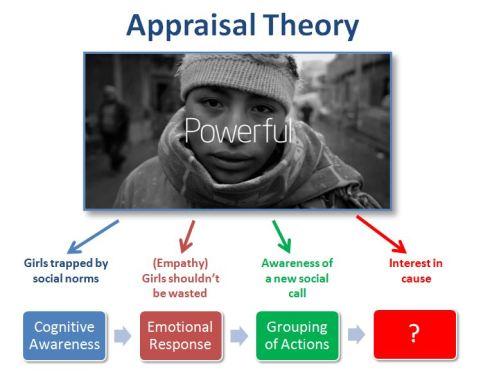
             But the ad also superbly models Appraisal Theory by using the power of emotion and mood to establish a cognitive connection to the message of girl empowerment. (Figure 2) The ad brilliantly begins by making the viewer aware of the social norms that entrap girls in many emerging counties.  The awareness leads to an emotional response that forms new thinking about a social call and possible interest in the cause. 

             But most important that positive feeling about the ad also creates a positive feeling toward the brand.  And in this case it lends awareness to Intel’s CSR commitment.

             It’s not just communication theory coming alive, it’s strategic, and dare I say… Intel-igent.

“I Lost My Best Friend Too.” A Speech Lesson From an Unlikely Source—Gov. Mark Dayton

25 May


    Minnesota Governor Mark Dayton put down the script this week.  The words that escaped the bondage of talking points prove the power of discourse that comes not from a page, but from one’s soul.

      On the political stage, even the corporate stage where every word spoken is weighed and measured, parsed and dissected, the governor displayed a moment of rhetorical brilliance—a teaching moment for leaders of all stripes. 

Peter Hobart Elementary School 4th graders Mohammed Fofana and Haysem Sani.  Both boys were killed in a land slide at Lilydale Regional Park in St. Paul, MN on May 23rd, 2013.

Peter Hobart Elementary School 4th graders Mohammed Fofana and Haysem Sani. Both boys were killed in a land slide at Lilydale Regional Park in St. Paul, MN on May 22nd, 2013.

      This was no ordinary audience.  No ordinary setting.   The gilded comforts of the governor’s capitol conference room were gone.   The clicking keyboards of reporters and the silent streaming of Tweets for a headline snacking world living in the moment were all as devoid as the hundreds of eyes staring back at him.

      Those eyes belonged to the classmates of two young boys who just lost their lives.  Mohammed Fofana and Haysem Sani were fourth graders at Peter Hobart Elementary School in St. Louis Park.  Their simple field trip to Lilydale Regional Park in search of fossils ended with a rock slide.  The tragedy didn’t just suffocate two fourth grade boys, if left their entire school gasping for answers. 

       The governor didn’t have any. 

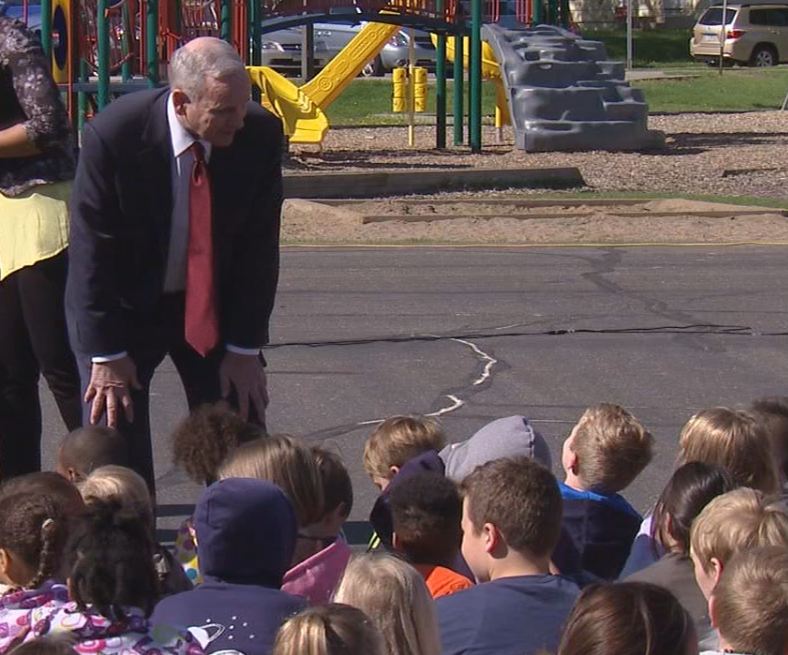
Gov. Mark Dayton talking to students at Peter Hobart Elementary School in St. Louis Park, MN on May 24th, 2013

Gov. Mark Dayton talking to students at Peter Hobart Elementary School in St. Louis Park, MN on May 24th, 2013

       Therein lies part of the simplistic strength of a message that was so powerful.  Before an entire school sitting cross-legged on the playground, the governor, like the school teacher he once was, bent down to talk to some of the kids at eye level.  Then getting up to the podium he did something nearly every executive of his stature never does—he stepped away.   Looking directly at the children he said these words:

       “At a terrible time like this, there’s nothing I can say.  There are no words that can make you feel better.  I know that because I lost my very best friend in an accident not unlike the one that took Mohammed and Haysem away from you.  He was hiking in a canyon in California and a rock slide came tumbling down.  It was raining a couple of days before and he was killed.

        I remember the horror I felt, I remember the shock, the disbelief.  And I remember greeting his wife and his daughter who is my God daughter, who was eleven years old.  And I said why, you know, why?  Why did this happen?  Why did not just a bad thing happen to a good person, but why did a terrible thing happen to a terrific person?  And in your school a terrible thing happened to a few young boys and two more who were injured.  And we pray for their recovery.”          – Mark Dayton

     For exactly three minutes and ten seconds Mark Dayton wasn’t a chief executive, he was a chief grandfather.   His own story of personal loss transcended the moment for those children and their parents.  Like a warm blanket, he covered their frailties by exposing his own.    He didn’t have an answer.  But he had a connection.  He had a narrative.

     What makes this moment especially remarkable is that Dayton, like many executives, is a leader who often struggles to find the right words.  Lofty oratory is not among his chief gifts.  But his brief moment with those Peter Hobart students this week was a masterful example of the power of speech when one searches for a connection and a story to tell. 

     The teaching moment for communicators and leaders alike is the essential need to always consider one’s audience.   In this case they didn’t need words on a page; they needed words from the heart.   Dayton put down the script and let his soul fly free.   

      Speech class is dismissed.

Ship my Pants — The Strategy Behind Kmart’s Edgy Commercial

15 Apr


      Kmart has reinvented the Blue Light Special and it’s… well, a bit blue.  Perhaps too blue for traditional television and that’s part of the unique strategy.

      The original discount department store has pulled a little sophomoric potty humor out of isle ten in hopes of gaining more attention in a retail marketplace dominated by Walmart, Target and Amazon. 

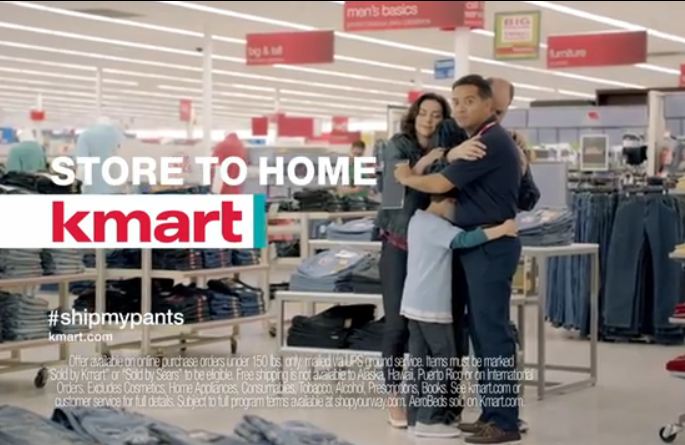
Kmart's "Ship My Pants" commercial created by DraftFCB Chicago.

Kmart’s “Ship My Pants” commercial created by DraftFCB Chicago.

      DraftFCB in Chicago has produced a brilliantly off-color and humorous message promoting Kmart’s ability to “ship my pants,” or anything else from kmart.com for free.   

      The message is very strategic.  Kmart is simply trying to regain lost customers by using humor to remind them that they don’t have to go to Amazon or Walmart to shop online. (Figure 1)

Figure 1

Figure 1

     The unique part of the strategy is to avoid television, and go directly to social media where edgy messaging can exceed the more sanitized boundaries of broadcast television.  It’s a messaging strategy more agencies and brands are exploiting in a multi-digital channel viral world.  In Kmart’s case, it was a brilliant success.  In the first 48-hours, “Ship my Pants” received more than two million YouTube views.

     Kmart is far from alone.  NJOY smokeless cigarettes also just scored a viral hit with Courtney Love dropping the f-bomb in an internet-only commercial that says bad girls can still be bad. 


    Several years ago, Ford didn’t have to say a word while promoting a sport version of its successful European compact car named Ka.  It targeted young urban men with an edgy internet video, the likes of which could never air in the United States.  


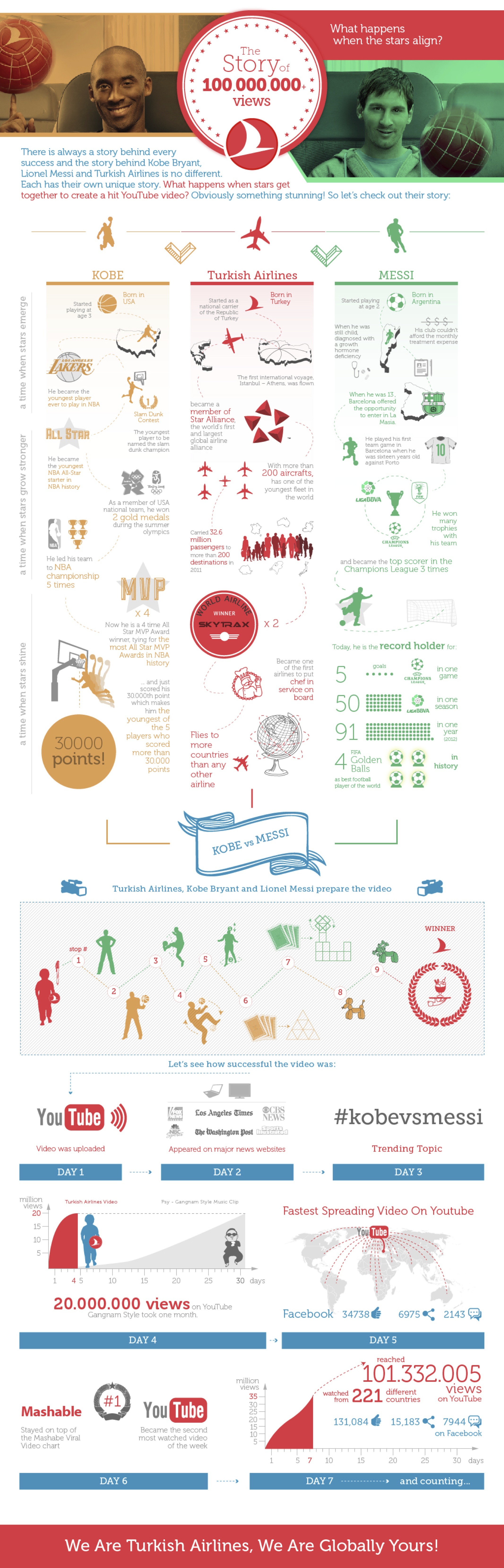
     Sometimes the strategy is not about being edgy, it’s about entertainment.  Turkish Airlines just achieved viral video gold with a commercial featuring two of the world’s best known athletes competing for the attention of a young fan.  The video was such a huge success that the airline created its own infographic explaining how it worked. (See below)

     Central to the strategy in all of these campaigns is the sharable functionality of social media.  Brand loyalists, followers, and viewers of these commercials who like and share the message among friends are in many respects more valuable than an expensive spot on prime time television.  In Kmart’s case, the strategy creates some opportunistic buzz for the brand at a time when JC Penney is hemorrhaging customers and every other discount retailer is still fighting for market share in the economic recovery.  

     Kmart and DraftFCB prove that creativity is still alive and well and fun… if not a little naughty. 

[Note: To keep up with more great video commercials, follow advertising savant John Eighmey]

Courtesy: Turkish Airlines

Courtesy: Turkish Airlines

Obama on Gun Control — A Message Management Case Study

30 Mar
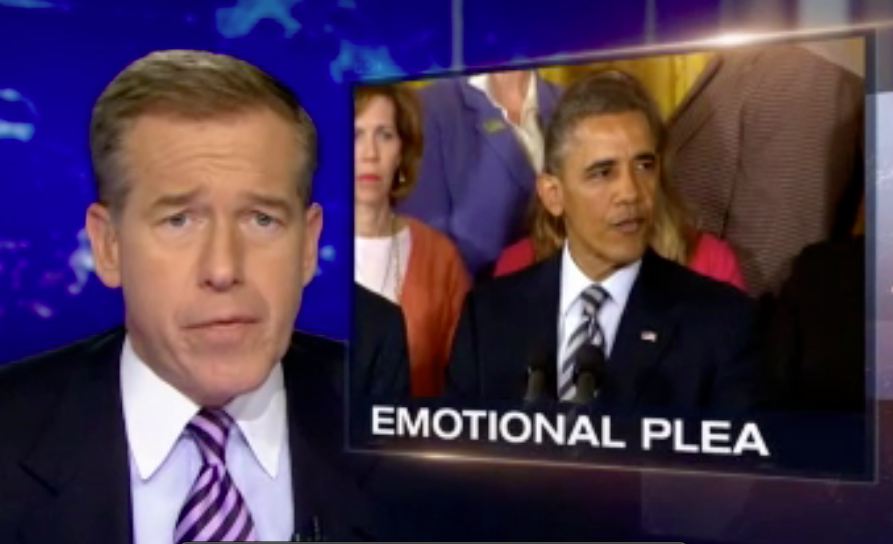
President Obama's gun safety push presented as the lede story on the NBC Nightly News on March 28, 2013

President Obama’s gun safety push presented as the lede story on the NBC Nightly News on March 28, 2013

              President Obama’s latest push on gun safety was hardly a shot in the dark.   His call for universal background checks on March 28th was a highly coordinated, multi-event, multi-channel message that offers a strategic communication model on a dynamic public policy issue.

                 With the raw emotions subsiding over the tragic Sandy Hook school shootings and the success of gun rights advocates at thwarting new legislative bans on military-style semiautomatic rifles, the Obama administration clearly needed to re-engage public opinion and build groundswell.    With little political support for banning military-style assault rifles, his new objective is keeping alive the proposal of universal background checks for all gun purchases.  The new strategy involves putting public pressure on congress.  The new tactics involved a national day of action with a highly coordinated series of events and social media engagements that would swamp news coverage and buzz in a 24-hour cycle. 

Figure 1 - Barak Obama Tweet on March 28, 2013

Figure 1 – Barak Obama Tweet on March 28, 2013

                 At the core of the new strategy was a White House press event featuring the victims and survivors of gun violence.  

               “Tears are not enough,” said the President. 

               He urged activists and citizens alike to “turn that heartbreak into something real” by urging their congressmen to pass meaningful gun control legislation.  By using the bully pulpit of the presidency, Obama was able to command the necessary national news coverage and earn the A-1 lede slot on the network evening news. 

Accent Signage shooting survivor John Souter speaking at a Minneapolis news conference.

Accent Signage shooting survivor John Souter speaking at a Minneapolis news conference.

                But just as important to the strategy was sending the same message to communities across the country, especially in blue states such as Minnesota and communities where gun violence is a salient issue.  In that effort the White House coordinated with gun safety organizations to hold more than 100 media events across the country that day featuring local gun violence victims pleading for action.                         

               In Minneapolis, the event featured John Souter, a survivor of the tragic workplace shooting at Accent Signage on September 27th.  Six of his co-workers died.  Souter was shot twice.   It was his first time speaking about the unspeakable.                 

                “How has it changed me?” contemplated Souter.   “I’m not the same person that’s for sure.  I don’t laugh like I used to.  These things are with you every day.”

                He commanded the attention of every news camera, every reporter’s notebook in town.  The local news conferences served as a force multiplier to the president by ensuring that local gun violence victims would be seen and positioned next to the president’s remarks in the evening news coverage.


Barak Obama Facebook post on March 28th, 2013

Figure 2 –  Barak Obama Facebook post on March 28, 2013

                It was also no accident that in the middle of Souter’s emotional testimony, the Barack Obama Twitter page posted a simple message:  “Fact:  Since 1968, 1.3 million Americans have died from gun violence.” (Figure 1)                                

               The more than a half a dozen tweets were joined by Obama’s Facebook posting of an infographic showing support for universal background checks seemingly as popular at apple pie. (Figure 2)  The posting received 64,000 likes and more than 10,000 shares. 

               Likewise, the video of the president’s White House speech immediately uploaded to YouTube recieved nearly 13,000 views. (See video below)              

                By the metrics of social media engagements, earned media, and buzz, the strategy was superbly executed.    It shows that strategic engagement is no accident and it offers a modern model in multi-channel communication.   But real success in this case is whether the strategy activates votes in congress.  For the moment that is a much harder task.  The whip counts are still out.

When Holy Smokes Meet Holy Tweets

17 Mar


White smoke rising from the Sistine Chapel on March 13, 2013 signifying cardinals have elected a new pope.

White smoke rising from the Sistine Chapel on March 13, 2013 signifying cardinals have elected a new pope.

        In a world that communicates at the speed of light, the most important message in the universe wafted at the speed of smoke. 

         So much for the age of sophistication.

        But in that most ancient of means of communication, the smoke signals drifting from the roof of the Sistine Chapel collided with the ones and zeros that were beamed, typed, and shared around the world.   The strategic message immediately posted on the pontiff’s Twitter account @pontifex simply read, “HABEMUS PAPAM FRANCISCUM.”   The translation:  “We have a Pope Francis.” 

Figure 1

Figure 1

       In an instant, two memes went viral—the smoke and the Tweet.  

      Score one for the Vatican and its integrated cross-platform communications campaign.

      We now know what followed wasn’t just religious history, but also a significant milestone in social media.  Twitter analytics tracked the number of tweets about the new pope running at a frenetic pace of 130,000 a minute.  It now ranks as one of the mot shared moments in the world, second only to this year’s Super Bowl at 150,000, and nearly doubles that of the Oscars at 70,000. (Figure 1)

Figure 2

Figure 2

       As people watched and waited for Pope Francis to appear on the balcony overlooking St. Peter’s Square, they also retweeted  the message from @pontifex to the tune of more than 54,000 times.  That’s an impressive rate of sharing, although it stands in the shadows of President Obama’s election night tweet that was shared  by more than a half a million people. (Figure 2)

       Together they show how an institution steeped in tradition, deftly and strategically used two very divergent platforms to communicate to the world one of its most important messages of the new millennium.   

The Mobile Apps Revolution—How Brands and TV News Can Extend Engagement

11 Mar
TV news video app for iPad

TV news video app for iPad

     The spark that Guglielmo Marconi flung across the Atlantic in 1901 heralded a new world order.  From that moment forward, information transmission was forever divided between landlines and airwaves.  The past verses the future.  More than a century later the disruptive forces of technological innovation are still real—if Marconi could only see us now.

     The palm-sized computers we now hold in our hands have sparked an applications revolution that is every bit the information game-changer that Marconi ushered in with his wireless telegraph.  Just as radio led to television, computers led to the internet.  Now, mobile devices are leading to them both through applications—or apps. 

Figure 1 - ComScore U.S. Digital Future in Focus

Figure 1 – ComScore U.S. Digital Future in Focus

     The growth and usage of smartphone apps is prolific and real.  ComScore’s latest analysis of internet usages shows 37% of online minutes now come from mobile devices. (Figure 1)  Furthermore, four out of every five mobile minutes are spent on an app.

     Recent mobile research by Nielsen shows the average smartphone user now has 41 apps on their device. (Figure 2)  The dominant app by usage is Facebook followed by Google Maps. 

Figure 2 - Nielsen Smartphone Usage

Figure 2 – Nielsen Smartphone Usage

     Brands that that don’t embrace this new information revolution, including information providers such as news organizations, severely risk becoming marginalized in changing marketplace. 

     Sunil Gupta of the Harvard Business School has just laid out an impressive operational model for brands to build their own apps to extend their brand value on mobile platforms.   He does it by focusing on five categories:

    1. Add Convenience
    2. Offer Unique Value
    3. Provide Social Value
    4. Offer Incentives
    5. Entertain

     In Gupta’s model, he’s put the consumer first.  Far too many mobile news apps I’ve seen put the information consumer somewhere else.   Tap the icon and what comes up are stories that are 24 hours old, limited video, and information cluttered with pop-up ads.  Here’s what Gupta’s model might look like if we apply it in a customer-centric fashion.

1.       Add Convenience.  Here’s where most news apps fail with outdated information.  News junkies come to you for quick and current information, therefore stories and headlines need to be constantly updated.  Post short clips of video from the stories that are appearing, even if they are from a smartphone of a reporter in the field.  ComScore’s research indicates 60% of online searches for weather forecasts are all done on mobile devices, therefore those forecasts should also be constantly current.

 2.       Add Value.  Speaking of weather, one way to add value to a weather or news app is to create an alert system for approaching severe weather.  Another value-added strategy could partner with a local transportation agency to allow the app user to track commute times along a predetermined travel route.  Also, headlines broken down by zip code.

 3.       Provide Social Value.  Here’s where the app developers could build a feature to display the latest Tweets and Facebook postings from the organization.

4.       Offer Incentives.  The app could feature built-in coupons that tie in with a promotion or sponsor.  On-screen coupons to use at live events such as food discounts at ball games would be used as a strategy to build both app users and extend on-air sales.

 5.       Entertain.  This is where the app could offer clips of behind the scenes moments from entertainment programming such as American Idol or upcoming episodes of primetime news lead-ins.

     It’s a lot to think about in an era of shrinking staff resources and budgets.  But just as Marconi once upon a time proved to be a disruptive force in information technologies, mobile devices are proving they are just as disruptive.  The signals TV stations transmit from their towers are no longer the video and information dominant structures they once were.  As digital platforms grow and evolve, information content organizations need to develop multi-platform strategies or risk becoming yesterday’s news.

Minnesota Crime Data Reveals High Handgun Homicides

21 Feb


Figure 1 - MN BCA Uniform Crime Data on Homicides between 2001 - 2011

Figure 1 – MN BCA Uniform Crime Data on Homicides between 2001 – 2011

              In recent weeks and months several high profile mass shootings have focused the spotlight on firearms, mental illness and have brought calls for more restrictive gun laws.  Tragic events such as the shooting in Sandy Hook, Aurora, and even Minneapolis have fostered a broad discussion on the merits and need for safety balanced against the constitutional right of gun ownership.

                 During the past few weeks those discussions have taken center stage in committee rooms of the Minnesota state capitol.   Between the House and Senate, there are no less than 36 bills dealing with firearms. 

Figrue 2 - MN BCA Uniform Crime Data

Figrue 2 – MN BCA Uniform Crime Data

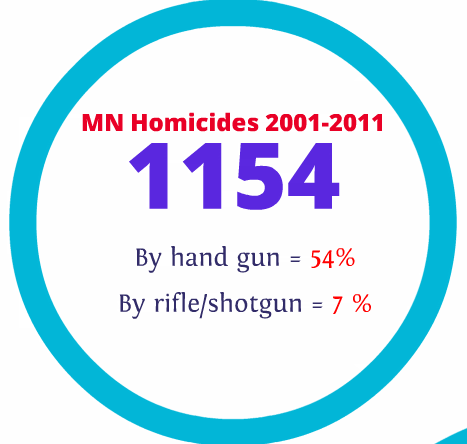
                 While there are strong emotions on all sides, sometimes there is value to stand back and look at data.  The Minnesota Bureau of Criminal Apprehension (BCA) gives us such a data set in its annual uniform crime reports. (Figure 1)

                 When one looks at the data sets from 2001 to 2011 we find that Minnesota suffered 1154 homicides.  Handguns caused more than half of those homicides, 54%.  Rifles and shotguns account for 7% of those homicides. (Figure 2)  The uniform crime data does not separate homicides by semi-automatic military style rifles. 

Figure 3 - MN BCA Homicides by Firearms 2001-2011

Figure 3 – MN BCA Homicides by Firearms 2001-2011

                 But when the data is focused on just the homicides caused by firearms during the this eleven year period there is an interesting pattern.  Fully 88% of the homicides by firearms are caused by handguns.  The remainder, 12% are caused by rifle and shotgun. (Figure 3)  The data set reveals what many prosecutors and those in law enforcement have advocated for years, that handguns and perhaps the unlawful access to handguns are the driving force of homicides in Minnesota.

The Best Super Bowl Ads That Did NOT Air During The Game

11 Feb
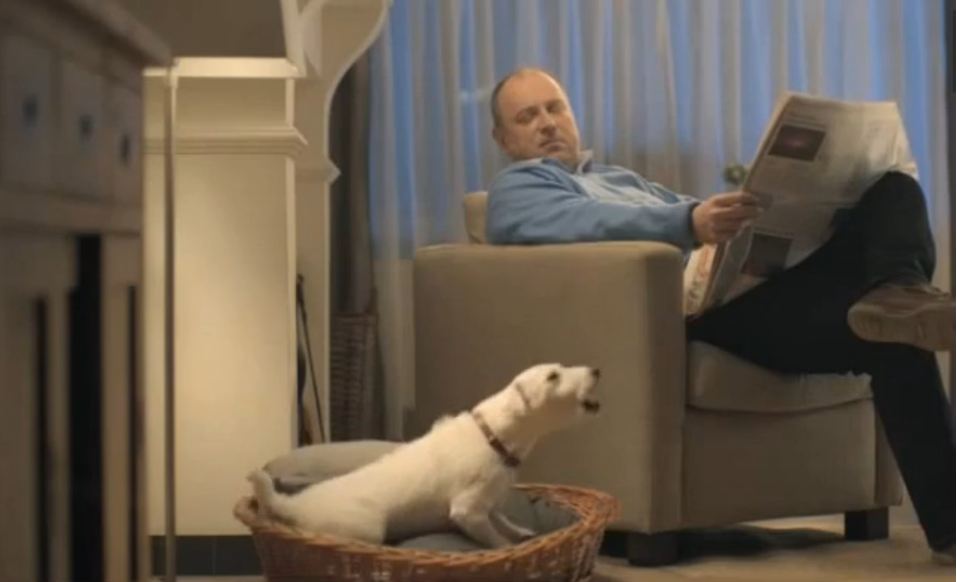
Volkswagen's Das Hund

Volkswagen’s Das Hund

         So you’ve seen all the Super Bowl Ads.  The gals cried over the Clydesdale reunion, the men wanted more of Kate Upton, everyone sang with Jimmy Cliff, and in living rooms across America Paul Harvey’s voice once again made time stand still. 

          There was one Super Bowl ad that didn’t cost a penny and didn’t air on CBS, yet scored a strategic touchdown on social media.  Two more ads that skipped the Super Bowl were equally as creative and targeted, but they too stood on the sidelines as their brands chose different offerings—one a pared down version.

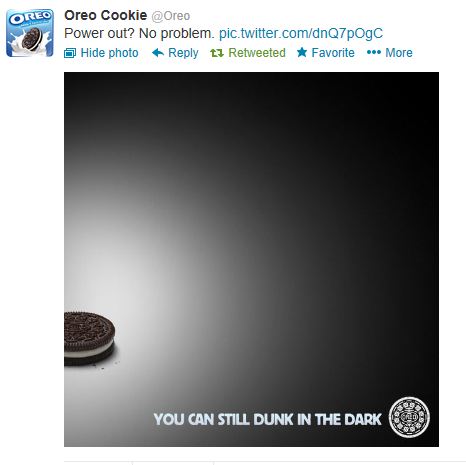
          The most brilliant message was posted on Twitter 20 minutes into the third quarter blackout inside the Super Dome.  The creative team at Oreo cookies, which had earlier aired an ad about people fighting over the virtues of light and dark, fired up their computer and went to the dark side.  They created a simple picture and copy: “You can still dunk in the dark.”  Targeted at social media savvy consumers trolling for entertainment during the black out, Oreo’s brand loyalists found the message and the picture turned viral in minutes.  

Oreos Super Bowl Tweet 2

          For advertising scholar John Eighmey, the stroke of brilliance by Oreo’s team demonstrates that brands don’t necessarily need a multi-million dollar ad budget to get attention.  In a post-mortem forum of the 2013 Super Bowl ads held at the University of Minnesota, Eighmey said, “It proves you don’t need infrastructure, just really smart people.”  He adds, “If you’re smart with strategy, you can react quickly.”

          Another exceptionally targeted ad that never aired during the Super Bowl has just hit the airwaves in Europe.  Volkswagen’s agency DDB played off of well established psychological research showing viewers of advertising most remember dogs and babies.  In Das Hund, DDB gives us the comical story of a dog who thinks he’s a car and falls in love with the new VW.    The target audience is not just dog lovers, but drivers who covet style and performance.   USA Today’s Ad Meter shows Super Bowl viewers liked VW’s Jamaican Get in-Get Happy, but with so much pregame exposure one can’t help but wonder if Das Hund wouldn’t have been a better choice.  


       And then there’s Coca-Cola.  I have to admit, I’m a big fan of Coke’s messaging strategy and its new brand extension of encouraging people to conduct random acts of happiness.  I’ve written in a previous post about Coca-Cola experimenting with this strategy in South America.  In the Super Bowl’s first quarter, Coke gave us a new U.S. 30-second version of the same concept complete with a soundtrack from Roger Hodgson formerly of Supertramp.  However, the 1:30 version is actually stronger and dare I say—more satisfying. 

          I’m only one voice, but I would have loved to have seen this version in the Super Bowl instead, perhaps even tied to a social media campaign about sharing one’s own acts of kindness. 

         Game on.   

AdAge/Blue Fin Labs - Top Social Super Bowl Commericals of 2013

AdAge/Blue Fin Labs – Top Social Super Bowl Commericals of 2013

Going Mobile–Is TV News Missing the m-TV Revolution? [Infograph]

2 Feb

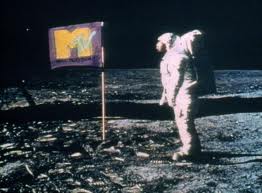
 MTV Flag               Like the flag in the old MTV promo, the way we use, watch, and access video and news is changing.  Welcome to the new m-TV—mobile television. 

                 Several new quantitative research studies suggest there is a revolution occurring before our eyes, one that consumers across two continents are literally holding in the palm of their hands.   Mobile technology and our ability to access information and share it from virtually any location may become either a disruptive force for broadcasters, or an incredible opportunity to extend content and brand value.      

Figure 1 - Pew Research Center

Figure 1 – Pew Research Center

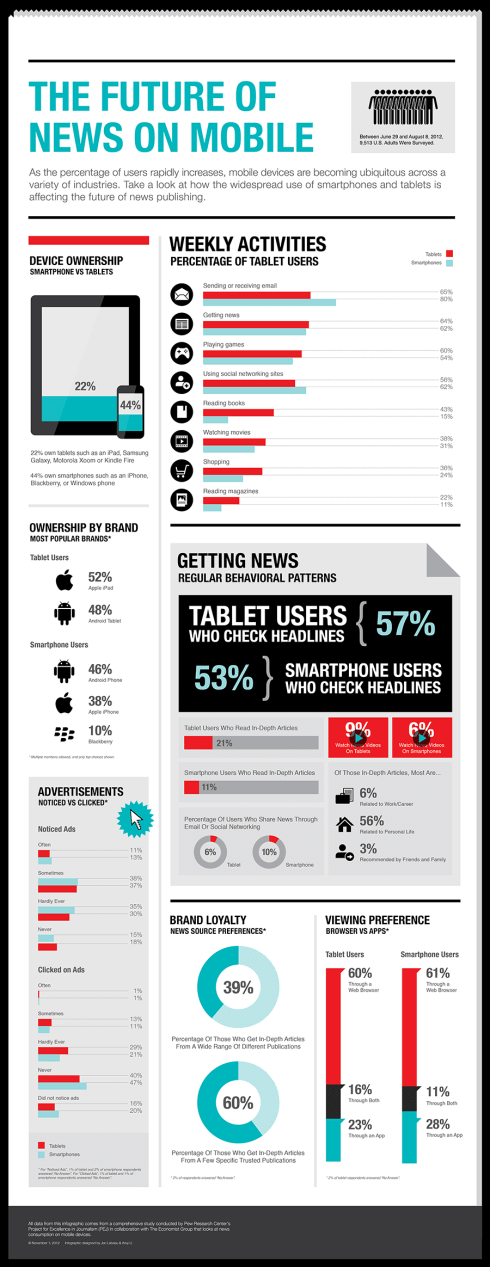
                Mobile devices are exploding in the U.S. marketplace.  Recent data from the Pew Research Center shows half of all U.S. adults now have a mobile connection to the internet through either a tablet or smartphone.  The results are based upon a scientific survey of 9,513 U.S. adults.  Accessing news is an important aspect what these users are consuming.  Fully 64-percent of tablet users and 62-perent of smartphone users say they use their devices to weekly to read and view news. (Figure 1)  In fact, Pew discovered that among tablet owners, news tied with email and games for the most popular activity.  On smartphones, news was second only to email.   

                For people who get news multiple times a day on their mobile devices, Pew also discovered they are more likely to turn to more sources, read more in-depth articles, and watch videos.

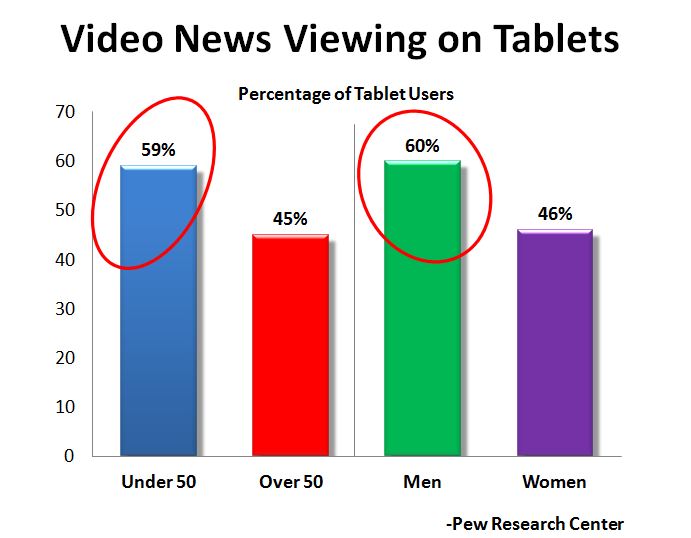
                This mobile video news consuming cohort represents virtually the same demographics most coveted by advertisers and television news organizations.  They tend to be young and slightly dominated by men—a many times illusive audience. (Figure 2) 
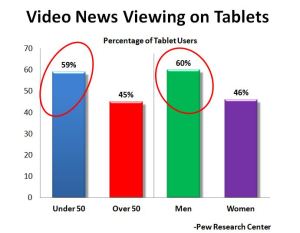
Figure 2

Figure 2

                This is by far not an American phenomenon.  In fact, the U.S. may be laggards compared to Europe.  Oscar Westlund’s research in the European communications journal Palabra Calve shows how mobile adoption and news consumption is far ahead of the U.S.  Sweden now has the greatest mobile penetration in the world with 101 mobile devices for every 100 people.  Westlund’s research of nearly 3,600 people reveals the early-adopters of these platforms tend to be men between the age of 15-49, and like their American cohort they are also power consumers of mobile news.  Fully 52-percent of these early-adopters use their devices for news.

                The trend is similar in Spain where the next generation of power consumers has already migrated to video news consumption.  Patricia Gonzalez Aldea’s research recently appearing in the International Journal of Iberian Studies revealed that young people haven’t stopped watching TV, they’ve only changed platforms in which they watch.

                Among the youngest group of 14-17 year olds Aldea discovered an important trend.  “They clearly prefer audio-visual media to keep them up to date with news and current affairs,” Aldea concluded.

                The findings in Spain show that the younger generation is demanding that TV content, even news, should be adapted to new platforms. 

TV news video app for iPad

TV news video app for iPad

                This all leads back to whether news organizations are leading the trend or following behind at their own peril.  Every credible newspaper and television news organization long ago established a presence on the web.  Many have also jumped into the world of mobile news apps.  Far fewer have stretched into the offerings of mobile video, and those which have tend to treat it as a necessary evil and not as a growth opportunity.                 

               The mobile trends and changing consumption habits demand that news organizations respond.  Television operations have an inherent advantage in m-TV given their video gathering and packaging expertise and infrastructure.  But they have to treat m-TV as a product launch, complete with a strategic business plan.

                Here’s a start:

  • Identify OPPORTUNITIES based on research:
    • Size of the organization’s digital consumption universe; Size of mobile market; Penetration and strength of 4G digital infrastructure among mobile providers; Number of current video downloads; Potential viewer reach; SWOT of m-TV expansion.
  • Goals:
    • Extend brand value through more mobile video content and views; Create a broader advertising base for increased revenue possibilities.
  • Objectives: Measurable benchmarks
    •  50% more mobile video content in 3 months; 55% more mobile app installations in 3 months; 65% more downloads in 6 months; 80% increase in six months of audience awareness of more mobile content.
  • Strategies:
    • Promote video content on web and apps; Create exclusive mobile content.
  • Tactics:
    • On-air promotion of mobile apps and web video; Drive video postings through Facebook & Twitter; Produce additional content and repurpose existing content for mobile platforms; Reporters post cell phone videos to social media to drive buzz for newscasts; More timely postings of video content.
  • Measurement:
    • Assess whether objectives were met.
  • Contingencies:
    • What if no buy-in from employees?  What if mobile engagement doesn’t increase?  What if brand awareness doesn’t grow?  What if ad click-through rates or ad views don’t increase?

                Traditional over-the-air television and news are not going away anytime soon, but their traditional market is clearly eroding.   Both Pew and the quantitative research conducted in Europe of mobile device usage makes it clear that audiences are rapidly changing the ways and platforms in which they access traditional content.  How content providers, especially news organizations respond may very well determine who survives and who profits.

                As Oscar Westlund concludes, “Mobiles are the future.  It’s not a question of whether it will be so, but when.”
Pew Research Center Infograph

Pew Research Center Infograph

The Strategy Behind Coca-Cola’s Offense on Obesity and Attitudes

15 Jan


               The branding factory that is Coca-Cola has popped the cap off a pair of highly strategic campaigns this week aimed at two different audiences but with one over-arching goal—changing attitudes.

                 First, there is the very bold and highly focused commercial taking on the weighty issue of obesity.  The 2-minute spot is an expensive piece of real estate on U.S. television, but in it Coke confronts head-on the growing conversation about the role sugary soft drinks may or may not play in the nation’s obesity epidemic.

                 Like any smart and engaging company, Coca-Cola has done its environmental scanning and clearly sees the risks evolving in the marketplace.  New York Mayor Michael Bloomberg’s assault on large serving size beverages is just the beginning of what could possibly be a disruptive series of regulations and consumer backlash.

                 Coke’s new ad called “Coming Together” has a simple message:  Obesity comes from too many calories and not enough exercise.  While Coke admits it is part of the problem, it also holds that it’s part of the solution.  The message put’s them clearly in the middle of the national conversation.  

Figure 1 - Google Trends data for Coca-Cola and Obesity

Figure 1 – Google Trends data for Coca-Cola and Obesity

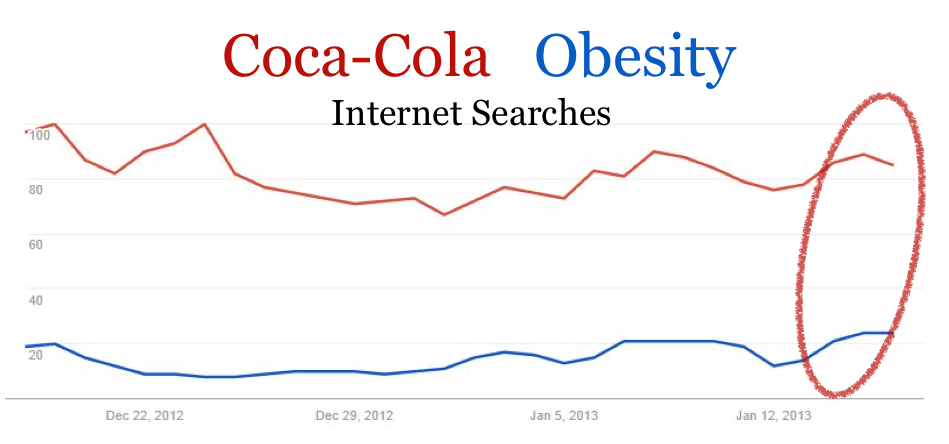
                The campaign is strategic not just in its message but its placement.  The ad aired on the evening cable news networks of MSNBC, Fox, and CNN.  Not only would the ad likely be seen by government decision makers and regulators, it knew the networks would also view it as a news story thereby exponentially extending the message’s reach.  The resulting attention created instant growth in internet searches for both Coke and obesity (Figure 1), and according to Alexa visits to Coke’s website grew 40-percent.


                 In its second campaign this week, Coke takes an equally strategic tract but with a different goal.   This time coke gets back to its by roots and core brand promise of sharing happiness.   But in this whimsical spot by Oglivy Brazil, the sharing is of random acts of kindness.  Strategically targeted toward ethnic urban dwellers, Coke extends its already powerful brand by encouraging people to share something other than a Coke. 

                 Two examples of how strong brands can use their equity and loyalty to not only create conversations, but to affect attitudes and behaviors that reinforce the brand’s core values.